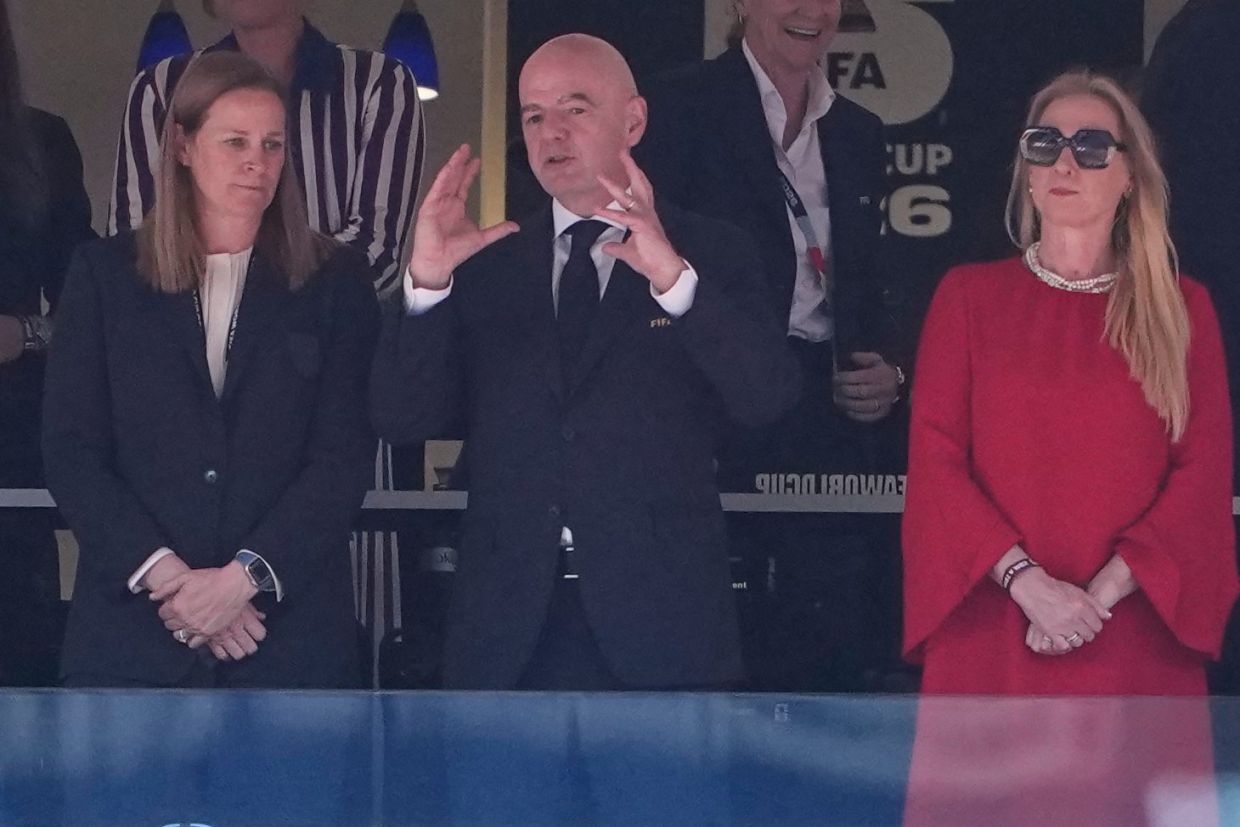
FIFA's institutional position has markedly solidified despite a World Cup tournament that drew criticism on multiple fronts, from ticket pricing and squad exclusions to allegations of political interference in match decisions. The organisation's president, Gianni Infantino, has navigated these disputes with apparent ease, maintaining his control while overseeing unprecedented revenue generation that is already reshaping how the sport's global governing body operates and influences member nations.
The 2026 competition faced sustained objections throughout its duration. Concerns ranged from the elevated cost of admission and the ostracization of Iran's national team to the controversial exclusion of a Somali referee from international competition. More inflammatory still was FIFA's bestowal of its inaugural peace award upon United States President Donald Trump, an honour that many considered politically incongruous. These accumulated grievances intensified dramatically when Infantino appeared to acquiesce to American pressure by allowing a suspended US player to resume participation after pressure from Trump, triggering condemnation across the global football community.
Yet the intensity of these disputes evaporates swiftly once matches conclude. Following Belgium's decisive 4-1 victory over the United States, the uproar surrounding American striker Folarin Balogun's reinstatement dissipated remarkably within hours. This pattern—controversy followed by rapid public forgetting—has become characteristic of modern World Cup cycles. Infantino, now in his late fifties, has demonstrated an almost calculated indifference to such criticism, maintaining his singular focus on the revenue-generating mechanisms that underpin FIFA's expanding global influence.
The financial performance of this World Cup has proven extraordinarily lucrative for FIFA itself. The organisation projects revenues of approximately $9 billion directly attributable to the 2026 tournament, representing roughly $2 billion in incremental income compared to the 2022 edition hosted in Qatar. This surge in money-generating capacity creates an inherent structural tension within FIFA's mandate: the organisation must simultaneously enforce competitive integrity and uphold regulatory standards while pursuing aggressive commercialisation strategies that sometimes conflict with sporting principles.
Infantino's ascension to FIFA's leadership followed a tumultuous period when American prosecutors pursued corruption allegations that threatened the organisation's legitimacy. His appointment represented an attempt at institutional rehabilitation, involving modest transparency improvements and expanded tournament formats. However, his tenure has progressively blurred the traditional boundaries between sports governance, financial interest, and political engagement—a trajectory that echoes patterns preceding FIFA's earlier scandals.
The commercialisation ripple effects extend throughout the tournament ecosystem. Catering contractors operating stadium concessions have captured substantial margins, with spectators in some venues spending up to $100 per person on food and beverages, nearly double the expenditure at comparable National Football League events. Advertisers have gained unexpected benefits from FIFA's introduction of mandated hydration breaks, effectively transforming the sport's traditional two-half structure into a four-quarter format more conducive to commercial messaging intervals. Host cities, which initially expressed apprehension about infrastructure costs, have witnessed measurable economic stimulus, with Bank of America transaction data for mid-June recording a 6.3 percent year-on-year increase in combined credit and debit spending across tournament venues, while non-resident spending surged 16.7 percent.
The expanded tournament format, which increased participating nations from 32 to 48 teams, has substantially redistributed FIFA's financial resources. The aggregate prize pool has doubled to a record $871 million, with every participating federation guaranteed a minimum payment of $12.5 million simply for qualification. For small island nations and developing football associations, these distributions represent transformative capital. Cape Verde, for instance, earned over $21 million through its unexpected tournament progression, equivalent to approximately 0.75 percent of the nation's entire GDP. For the majority of FIFA's 211 member associations, particularly those from Africa, South America, and Asia, these financial transfers constitute disproportionately significant revenue streams relative to domestic sporting budgets.
Infantino's forthcoming re-election campaign, scheduled for early 2027 during FIFA's 77th Congress in Rabat, Morocco, appears virtually predetermined. No opposing candidates have emerged, and major confederation presidents from Africa, Asia, and South America have already publicly pledged support. This third consecutive term would extend his authority well into the following decade, building upon his succession of Sepp Blatter, whose 2015 resignation occurred amid the corruption scandal that nearly derailed the organisation.
The controversy surrounding Infantino's alleged intervention in the American player's suspension has provoked vocal criticism from political and sporting figures. Jurgen Klopp, the celebrated former Liverpool manager, articulated widespread concerns by characterising the situation as corrupting, suggesting that direct negotiations between Trump and Infantino undermined the sport's competitive foundations. Politicians from Belgium and the United Kingdom have demanded his resignation. Nick De Marco, a British sports legal specialist, framed the core issue not as whether the original disciplinary decision was justified, but whether FIFA has fundamentally compromised its legitimacy as football's global regulatory authority.
Yet these objections appear increasingly inconsequential to Infantino's political stability. His coalition of supporting national federations, including confederation presidents from Asia, Africa, and the Middle East, has remained steadfast. Sheikh Salman, president of the Asian Football Confederation, publicly declared that "FIFA is in its best position ever." The Royal Moroccan Football Federation, speaking as a host nation for the subsequent World Cup cycle, characterised Infantino's leadership as advancing African and global football development. This institutional backing reflects the reality that for most member nations, FIFA's expanded financial distribution system and tournament opportunities have substantially enhanced their sporting budgets and international prominence.
The tournament itself has delivered authentic sporting merit alongside its controversial dimensions. Stadium capacities have remained full despite elevated ticket prices. The world's elite footballers have performed consistently at exceptional technical levels. The expanded format has generated unprecedented African representation, with nine nations from the continent advancing to knockout stages. Host nations have delivered hospitality standards exceeding those observed during recent tournaments in Russia and Qatar.
The enduring question concerns whether governance controversies translate into meaningful constraints upon Infantino's authority. The available evidence suggests not. As long as FIFA's financial distributions continue enriching member federations and the organisation maintains tournament growth trajectories, the sort of scandals that would typically threaten a leader's tenure appear insufficient to dislodge entrenched incumbency. For Infantino and FIFA, the calculus has become straightforward: controversy generates momentary international headlines and professional criticism, while institutional patronage networks, financial dependency, and distributed self-interest ensure that such objections fade as rapidly as final match statistics.

