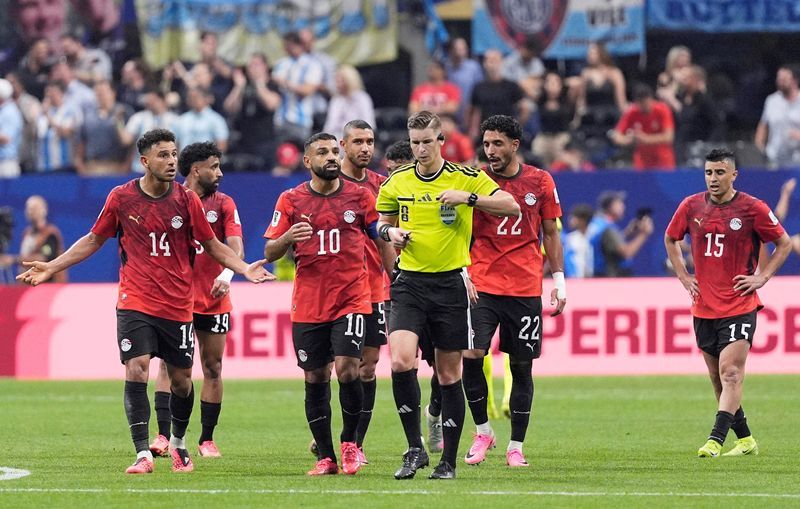
The head of FIFA's refereeing operations has moved to quash Egyptian complaints about the officiating in Argentina's contentious 3-2 triumph over Egypt in a World Cup knockout match, insisting that all decisions were made according to the rules and without any external interference. Pierluigi Collina used a statement released through FIFA's official channels to counter allegations that the match officials had treated Egypt unfairly, emphasising that criticism of referees—while a normal part of football discourse—must remain grounded in reality and not veer into baseless accusations.
The controversy stems from Argentina's remarkable comeback after trailing 2-0, with Enzo Fernandez scoring the dramatic winner in stoppage time. Egypt's football authorities subsequently challenged multiple decisions they viewed as pivotal to the match's outcome, particularly the disallowance of a second-half goal by Mostafa Zico and the failure to penalise a contact involving Mohamed Salah. The Egyptian Football Association described the sequence of events as raising "serious concerns" about consistency and fairness, while coach Hossam Hassan suggested external pressure may have influenced the referee's conduct.
Collina's defence centred on the application of Video Assistant Referee technology, which he characterised as having functioned exactly as designed. According to his account, VAR correctly identified a foul committed by Marwan Attia on Argentina's Lisandro Martinez during the build-up to Zico's goal, justifying the decision to overturn what would have been Egypt's equaliser. The FIFA official articulated a broader principle governing such interventions: once VAR detects a violation, the match referee is obligated to act upon that information, regardless of whether the infraction was immediately apparent on the field of play. This interpretation underscores FIFA's commitment to technical precision over traditional on-field observation.
Regarding the unpenalised contact between Salah and Julian Alvarez moments before Argentina's winning sequence, Collina framed the matter as a distinction between legitimate defensive play and a penal offence. He argued that a defender who makes contact with the ball first, before any subsequent contact with an opponent, has not committed a foul—thereby classifying Alvarez's challenge as permissible under the laws of the game. This distinction between intentional fouling and incidental contact highlights a persistent area of subjective interpretation in football, even with technological assistance. The explanation suggests that both the on-field referee and VAR operators evaluated the incident through the lens of what constitutes "normal football contact," a standard that inherently carries room for differing assessments.
Collina's remarks also carried an implicit warning about the consequences of unfounded allegations. He noted that accusations questioning the integrity of World Cup officials could escalate to threats against referees and their families, framing attacks on officiating credibility as potentially dangerous. This positioning of integrity questions as both factually incorrect and socially harmful reflects FIFA's broader effort to shield its refereeing corps from what it views as unjustified scrutiny. The statement emphasised that no external actor—not even FIFA President Gianni Infantino—could exert influence over match officials, presenting the refereeing system as hermetically sealed against manipulation.
The timing and tone of Collina's intervention suggest that Egypt's complaints had gained sufficient traction to warrant a coordinated response from football's governing body. Rather than allowing the controversy to fade naturally, FIFA chose to deploy its most senior refereeing authority to publicly defend the officials involved. This proactive stance indicates concern that unresolved doubts about the match's integrity could undermine confidence in the tournament more broadly, particularly among teams and associations that view themselves as disadvantaged by refereeing decisions.
For Malaysian and Southeast Asian readers, this episode carries implications beyond the immediate match. It demonstrates how disputes over officiating in high-stakes international competitions can rapidly escalate into questions about institutional fairness and impartiality. Regional football associations, which have their own grievances regarding refereeing standards in international contests, will likely observe how FIFA responds to organised challenges to its officials' credibility. The insistence that VAR operates with mechanical objectivity, while superficially reassuring, glosses over the human judgments embedded in reviewing footage and interpreting the laws of the game.
The distinction Collina drew between constructive critique and baseless allegations attempts to establish a boundary between legitimate football discourse and delegitimising attacks on officials. However, this boundary remains porous in practice. Teams and associations that believe they have been wronged by refereeing decisions will naturally interpret critical reviews of those decisions as justified, not as baseless allegations. The framing of such criticism as potentially inciting threats against officials serves to discourage public scrutiny of controversial decisions, even when those decisions may reflect genuine interpretive errors or inconsistent application of the rules.
Collina's defence of the disallowed Zico goal and the non-penalised Salah contact reveals the complexity of applying VAR to football's inherently fluid situations. The principle that VAR should intervene whenever it identifies a violation, regardless of whether the referee saw it initially, represents a significant shift toward technological oversight of match officials. Yet this system depends entirely on the accuracy and consistency of VAR operators' interpretations, an assumption that becomes tenuous when operators themselves may harbour unconscious biases or apply subjective standards inconsistently across matches and tournaments.
Egypt's exit from the tournament following this defeat underscores the high stakes of refereeing decisions in knockout competitions, where a single match determines a team's entire campaign. The Egyptian Football Association's formal complaint and Collina's equally formal response illustrate how refereeing controversies can become diplomatic incidents in their own right. When a nation's football authorities feel aggrieved by international competition, those grievances can influence broader perceptions of fairness in international sport and governance.
The broader context suggests that while FIFA has invested heavily in VAR technology, the system has not eliminated disputes over refereeing impartiality. Instead, it has perhaps shifted the terrain of controversy, with teams now challenging the judgment calls embedded in video review rather than the on-field observations of match officials. Whether Collina's defence will satisfy Egyptian football authorities or international observers remains unclear, but his statement represents FIFA's clearest articulation to date of how it interprets and applies its own refereeing standards in disputed situations.

