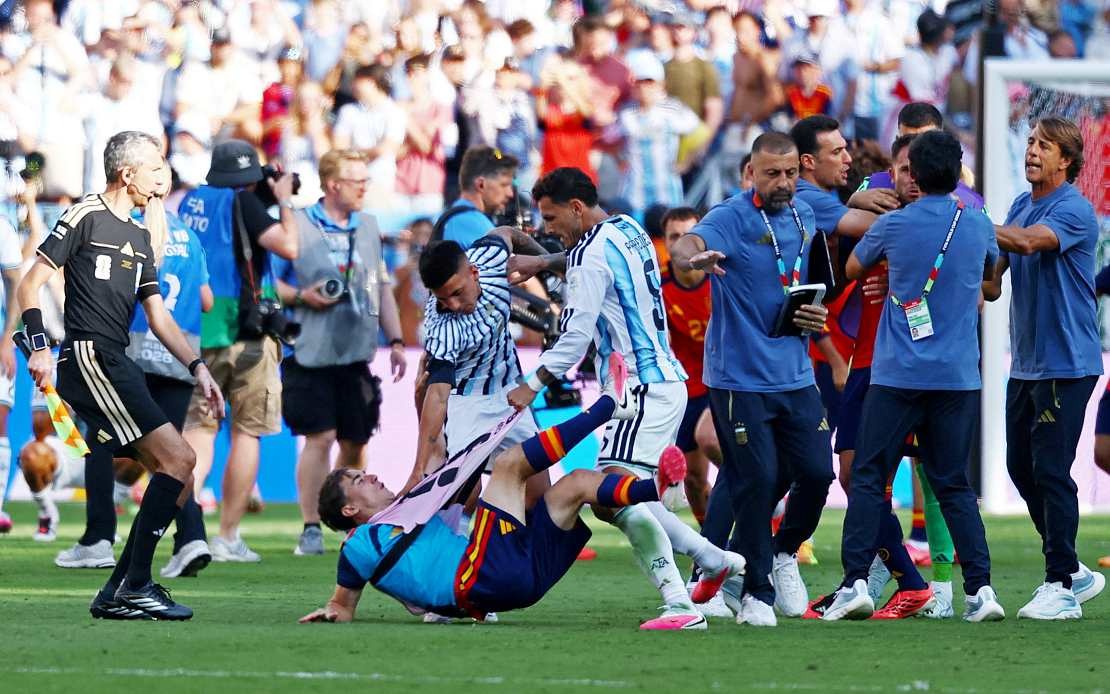
FIFA has formally launched a disciplinary investigation into Argentina's conduct during and immediately after their World Cup final defeat to Spain, with the global football governing body appointing a dedicated prosecutor to examine potential breaches of its disciplinary code. The decision comes after reviewing detailed match commissioner reports and footage from the high-profile encounter, signalling that the world's football authority intends to scrutinise the actions of the South American side both on and off the pitch during the tournament's culminating match.
The primary focus of the investigation centres on incidents that unfolded as the final whistle sounded in New Jersey. According to eyewitness accounts and match documentation, Argentina midfielder Leandro Paredes engaged in physical confrontation with Spanish players who were celebrating their victory on the pitch. The exact nature and severity of these alleged punches remain under formal review, with FIFA's newly appointed Disciplinary and Ethics Prosecutor tasked with determining whether the midfielder's actions constitute violations of the sport's established codes of conduct.
Argentina's overall deportment throughout the tournament has drawn considerable scrutiny, particularly regarding their approach to physical play. During their semi-final victory against England, the team faced criticism for their robust tackling and aggressive style, which reached a flashpoint when midfielder Enzo Fernandez received a straight red card after accumulating two yellow card offences. This pattern of conduct, combined with the alleged post-match altercation, suggests a broader pattern that FIFA's investigation may be attempting to address systematically.
The formal appointment of a Disciplinary and Ethics Prosecutor represents a significant escalation in FIFA's response and indicates that the governing body views the alleged breaches as sufficiently serious to warrant a thorough and independent examination. Under Article 36 of FIFA's disciplinary code, such appointments are reserved for cases involving substantial potential violations. The prosecutor will compile a comprehensive report before the FIFA Disciplinary Committee determines what, if any, sanctions should be imposed on the Argentine delegation.
A notable element of uncertainty surrounding this investigation concerns whether FIFA will also examine Argentina's display of a banner asserting Argentine sovereignty over the Falkland Islands, which occurred following their victory over England in an earlier knockout stage. Such political messaging potentially violates Article 34.3 of the tournament's regulatory framework, which restricts political demonstrations at World Cup events. The extent to which FIFA will incorporate this separate incident into the broader disciplinary review remains unclear, though the organisation has indicated that further details will emerge once the prosecutor completes their work.
Historically, FIFA has taken inconsistent approaches to similar infractions. When Argentina's Football Association engaged in analogous conduct following a 2014 friendly against Slovenia, the body imposed only a financial penalty. This relatively lenient response stands in sharp contrast to UEFA's approach to comparable violations. Following Euro 2024, the European confederation handed out one-match bans to Spanish players Rodri and Alvaro Morata after they engaged in chanting related to Spain's territorial claims regarding Gibraltar—a response notably more severe than FIFA's previous handling of Argentina's Falkland Islands banner.
The investigation also reflects FIFA's stated commitment to controlling political expression during international tournaments, though this enforcement has proven selective and contentious. During the 2022 World Cup in Qatar, FIFA informed the English Football Association that captain Harry Kane would face sporting consequences, beginning with a yellow card, if he wore a rainbow-coloured 'OneLove' armband as an expression of LGBTQ+ solidarity. This directive was particularly significant given Qatar's legal criminalisation of homosexuality, highlighting how FIFA's rules have prevented players from making statements on human rights while the governing body hosts tournaments in countries with severe restrictions on fundamental freedoms.
For Malaysian and Southeast Asian football observers, this investigation carries broader implications regarding FIFA's enforcement standards and the precedents being established for international competition. The investigation demonstrates that physical conduct during matches and immediate post-match celebrations remains subject to disciplinary action, particularly when such conduct is captured on camera and documented in official reports. As Southeast Asian football continues to develop and participate in international tournaments, understanding how FIFA applies its disciplinary code to different confederations and nations becomes increasingly important for coaches, administrators, and players operating within the region.
The outcome of this investigation will likely influence how FIFA addresses similar incidents in future tournaments and may establish benchmarks for what constitutes acceptable post-match behaviour. Should Argentina face substantial sanctions, it may signal a stricter enforcement approach moving forward. Conversely, if penalties prove minimal, it could suggest that FIFA continues to apply inconsistent standards depending on the parties involved and political sensitivities surrounding specific cases. The coming weeks will clarify FIFA's position as the Disciplinary and Ethics Prosecutor conducts their examination and prepares recommendations for the Disciplinary Committee's consideration.

