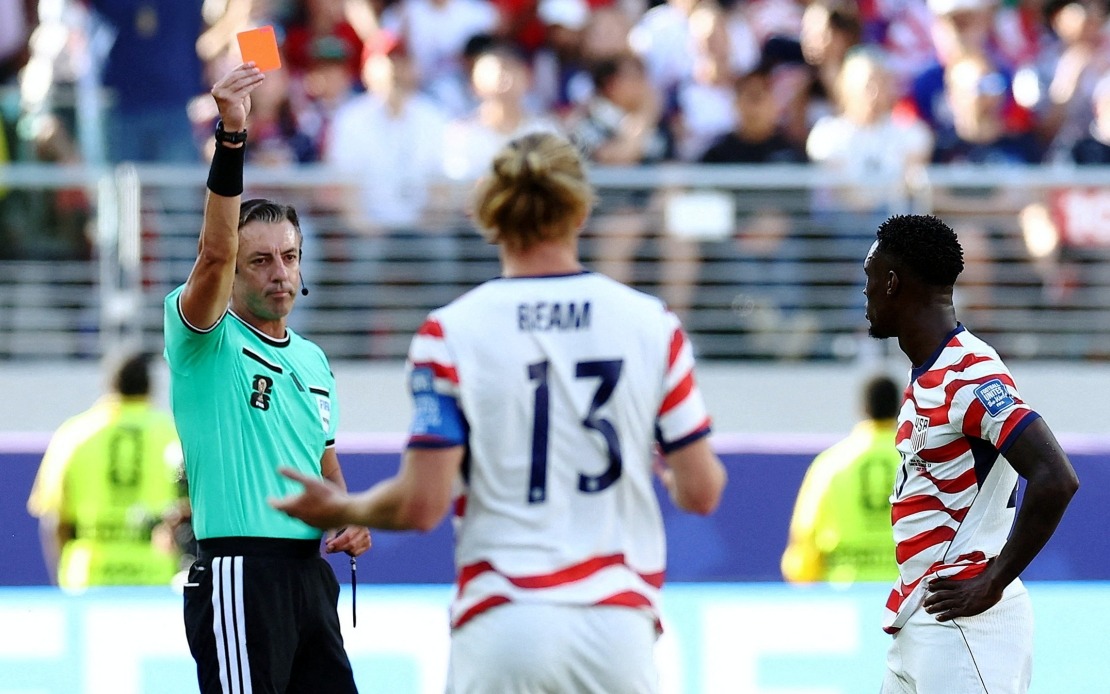
In a controversial decision that has drawn sharp criticism from the Belgian football authorities, FIFA announced on Sunday that it would suspend enforcement of a one-match ban imposed on American striker Folarin Balogun, permitting him to play against Belgium in Monday's World Cup last-16 encounter in Seattle. The ruling, made just hours before the fixture, has reignited debate about the consistency and fairness of tournament discipline and raised questions about whether elite teams receive preferential treatment in high-stakes competition.
Balogun received a red card during the United States' 2-0 victory over Bosnia and Herzegovina on July 1 after stamping on defender Tarik Muharemovic. The FIFA Disciplinary Committee subsequently ruled that his conduct violated Articles 14 and 66 of the FIFA Disciplinary Code and imposed an automatic one-match suspension. However, invoking Article 27 of the same code, FIFA determined that the suspension could be deferred, provided Balogun commit no further offences of comparable severity during a one-year probationary period. The decision effectively nullified the immediate suspension and allowed the player, who has already scored three goals for the US at the tournament, to remain available for the knockout stage.
For the Belgian Royal Football Association, the decision represents a troubling departure from established protocol. Belgium's official statement expressed "astonishment" at FIFA's ruling and emphasized that every other red card issued during the tournament had resulted in an immediate one-match suspension for the player involved. The federation argued that Article 66.4 of the FIFA Disciplinary Code explicitly mandates automatic suspension for the next match following a direct red card, a provision that has been uniformly applied throughout the competition until this moment. This apparent exception raised concerns about the principle of equal treatment that should govern international sport.
The Belgian federation further escalated its complaint by referencing the FIFA World Cup 2026 Competition Regulations, specifically Article 10.5, which unambiguously states that any player receiving a direct red card "will automatically be suspended from their team's subsequent match." According to Belgium's interpretation, the regulations leave no discretion for FIFA officials to suspend enforcement of such a sanction, particularly during the knockout phase when the stakes are elevated. The federation also cited FIFA World Cup 2026 Circular No. 16, distributed to all participating nations on May 12, which reinforced this automatic suspension principle. Prior to each match during the tournament, FIFA match coordinators and officials had reiterated this rule during formal briefing sessions and workshops.
The timing of FIFA's decision inevitably invites speculation about the pressures that may have influenced the ruling. The United States, as co-host of the tournament, had significant motivation to keep its leading scorer available for a critical knockout match. The American team has been seeking its first quarterfinal appearance since 2002, a milestone that adds considerable symbolic weight to the Belgium encounter. A loss would effectively end the host nation's aspirations, making Balogun's presence a material factor in the contest. FIFA's decision to suspend the ban just hours before kick-off meant that Belgium had minimal time to pursue alternative remedies or formal appeals, effectively presenting the Belgian federation with a fait accompli.
From a Southeast Asian perspective, this controversy underscores broader concerns about the governance of global sporting competitions. Nations in the region with emerging football programs and players who might reasonably aspire to World Cup participation will be observing how FIFA applies its disciplinary framework. The apparent flexibility in interpreting rules for prominent footballing nations, or those with geopolitical influence, sends a troubling message about the integrity of the process. Malaysia and other ASEAN countries that have invested substantially in youth football development and infrastructure improvements are watching to understand whether rule consistency extends to all participants equally or whether exceptions emerge based on commercial or political considerations.
The mechanics of FIFA's decision, while technically permissible under Article 27, sit uncomfortably with the stated intentions of the competition regulations. Article 27 does grant the FIFA Disciplinary Committee authority to suspend enforcement of a sanction on a probationary basis, but the purpose of this provision appears intended for circumstances where mitigating factors justify leniency or where the offence itself is marginal. A deliberate stamp on an opponent, resulting in a red card, appears to fall into a different category—conduct sufficiently serious to warrant mandatory suspension. The invocation of probationary suspension in this context suggests that FIFA prioritized the sporting spectacle of a high-profile match and the participation of a marquee player over strict adherence to published rules.
Belgium's response, while carefully worded, made clear that the federation views FIFA's decision as unjustifiable and potentially damaging to tournament integrity. The statement indicated that Belgium would explore all available options to protect its interests, a diplomatic formulation that leaves open the possibility of formal complaints to FIFA's governance bodies or even escalation to the Court of Arbitration for Sport. Should Belgium pursue such remedies, the case would likely become a watershed moment for how international sporting rules are interpreted and applied in high-pressure circumstances. The precedent set by FIFA's decision in the Balogun case could influence how similar disputes are resolved in future tournaments.
The underlying tension reflects a longstanding challenge in international football administration: the pressure to maintain entertaining matches and protect high-profile players against the imperative to enforce rules uniformly and impartially. Broadcasting companies, sponsors, and fans of elite teams have commercial and emotional investments in seeing star players perform on the tournament's biggest stages. Yet this commercial reality must be reconciled with the fundamental fairness that smaller nations and less prominent players can legitimately expect. When the US, one of the tournament's most commercially valuable participants, benefits from what appears to be an exception to published rules, the optics inevitably suggest that power and influence, rather than merit and rule of law, determine outcomes.
For Malaysian and Southeast Asian football observers, the episode illustrates why countries in the region must remain vigilant about international governance standards. As the region's football development accelerates and Malaysian clubs and players increasingly participate in continental and potentially global competitions, the consistency and fairness of disciplinary processes will matter immensely. A precedent establishing that suspension rules can be suspended for powerful nations creates an unequal playing field that disadvantages rising footballing nations. The message from FIFA's Balogun decision, whether intended or not, is that the tournament's regulatory framework has built-in flexibility that favors certain teams, a conclusion that undermines confidence in the sport's fundamental fairness.
The immediate impact of FIFA's ruling will play out on Monday's pitch in Seattle, where Belgium must contend with the full strength of the American attack, including a prolific goal scorer who might otherwise have been unavailable. Beyond that single match, however, the decision has lasting implications for how FIFA's disciplinary code will be interpreted and applied. Belgium's determination to explore all remedies suggests this matter will not quietly disappear but will likely remain contested in FIFA's formal processes. The resolution of Belgium's complaint, or the federation's pursuit of further action, will signal whether FIFA's World Cup regulations are genuinely binding or negotiable based on circumstances and pressure.

