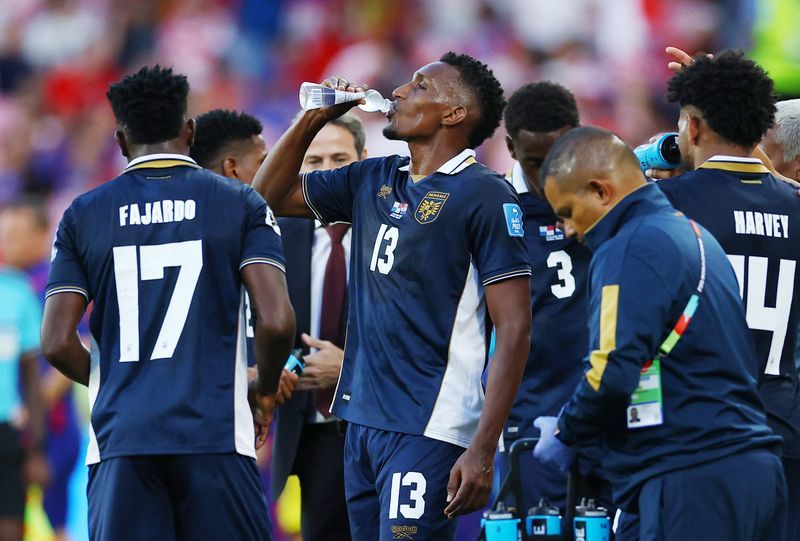
FIFA president Gianni Infantino has firmly rejected suggestions that mandatory hydration breaks introduced at the World Cup serve primarily commercial purposes, emphasising instead that the initiative stems from genuine sporting and health considerations. The three-minute stoppages, mandated at the 22nd and 67th minutes of each match, have generated significant controversy since the tournament's opening fixtures, with detractors questioning whether the measure fundamentally disrupts the flow and character of international football.
The introduction of these breaks coincides with the World Cup's staging across North America, where elevated temperatures present legitimate challenges for player welfare. However, the decision has inadvertently created additional advertising windows for broadcasters, a reality that has fuelled scepticism about FIFA's true motivations. Audiences watching matches have encountered an increased volume of commercial content during these stoppages, prompting vocal complaints from viewers who perceive the breaks as prioritising revenue generation over the integrity of the game.
Infantino moved swiftly to address these concerns in a statement, asserting that FIFA derives no incremental financial benefit from the hydration breaks themselves. He stressed that all broadcast and commercial agreements were finalised well before the tournament commenced, meaning the corporation had no financial incentive to introduce measures that would unlock new advertising slots. This distinction matters considerably in parsing whether the decision reflects operational opportunism or principle-driven policy-making.
Beyond hydration, the breaks have introduced a secondary dimension to the debate by enabling coaching staff to deliver tactical instructions during matches. This feature has attracted particular criticism from football purists and high-profile managers who argue that mid-match interventions fundamentally alter the essence of the sport. The traditional structure of a football match, with its uninterrupted rhythm and reliance on players' ability to manage tactical situations independently, represents a cornerstone of the game's identity.
England's Thomas Tuchel articulated this perspective bluntly, contending that the additional break "interrupts and changes the identity of the football match." His Uruguayan counterpart Marcelo Bielsa extended this critique further, arguing that dividing matches into shorter segments strips away the game's essential characteristic—its continuous, flowing nature that demands sustained concentration and adaptation from all eleven players on the pitch. These objections reflect a philosophical concern about whether modern administrative convenience should override traditions that have defined the sport for generations.
Notably, not all coaching voices have dismissed the initiative outright. Spain's Luis de la Fuente and Netherlands captain Virgil van Dijk have acknowledged the legitimate intent behind the rule when extreme heat poses genuine health risks. However, both have questioned its blanket application across all venues and climates, suggesting that more nuanced implementation—exempting matches played in cooler conditions or covered stadiums—would address health concerns without sacrificing the game's character unnecessarily.
Infantino's justification for the measure emphasises the World Cup's unusual temporal and physical demands. The tournament unfolds across 39 days with participating teams potentially playing up to eight matches within that compressed timeframe, creating extraordinary fatigue management challenges. In this context, a structured moment for physical and mental recovery carries genuine merit, particularly given the tournament's intensity and the expectation that all competing nations maintain competitive equality.
A secondary dimension of FIFA's reasoning concerns standardisation and fairness. Infantino articulated the concern that without uniform breaks, individual coaches might gain unfair advantages in warmer matches by virtue of temperature-dependent tactical opportunities unavailable in cooler fixtures. This standardisation argument reflects a legitimate competitive principle: that substantive advantages should derive from player quality and tactical preparation rather than environmental happenstance. By imposing identical conditions across all matches, FIFA sought to eliminate potential inequities arising from climatic variation.
Infantino further contended that the breaks have not measurably diminished match intensity, suggesting that players have sustained high performance levels throughout games despite the stoppages. This empirical claim, though difficult to verify definitively, attempts to counter arguments that the breaks disrupt momentum in ways that compromise the spectacle and competitive quality viewers expect. If performance levels genuinely remain undiminished, the measure might represent a welfare enhancement without corresponding competitive sacrifice.
The hydration break controversy illuminates broader tensions within contemporary professional football regarding player welfare, commercial imperatives, and competitive integrity. FIFA's position—rooted in health protection, standardised conditions, and the unique demands of World Cup scheduling—presents a coherent rationale. Yet the measure's confluence with expanded advertising opportunities has inevitably generated scepticism, a challenge no amount of procedural explanation can entirely overcome without demonstrated commitment to limiting commercial exploitation.
For Malaysian and Southeast Asian football observers, the controversy carries particular relevance as tropical climates throughout the region present year-round heat challenges similar to those the World Cup measures address. Whether the solution FIFA has championed proves durable and adaptable to regional competitions remains an open question, one that may influence how footballing governance evolves across Asia's increasingly competitive football landscape.