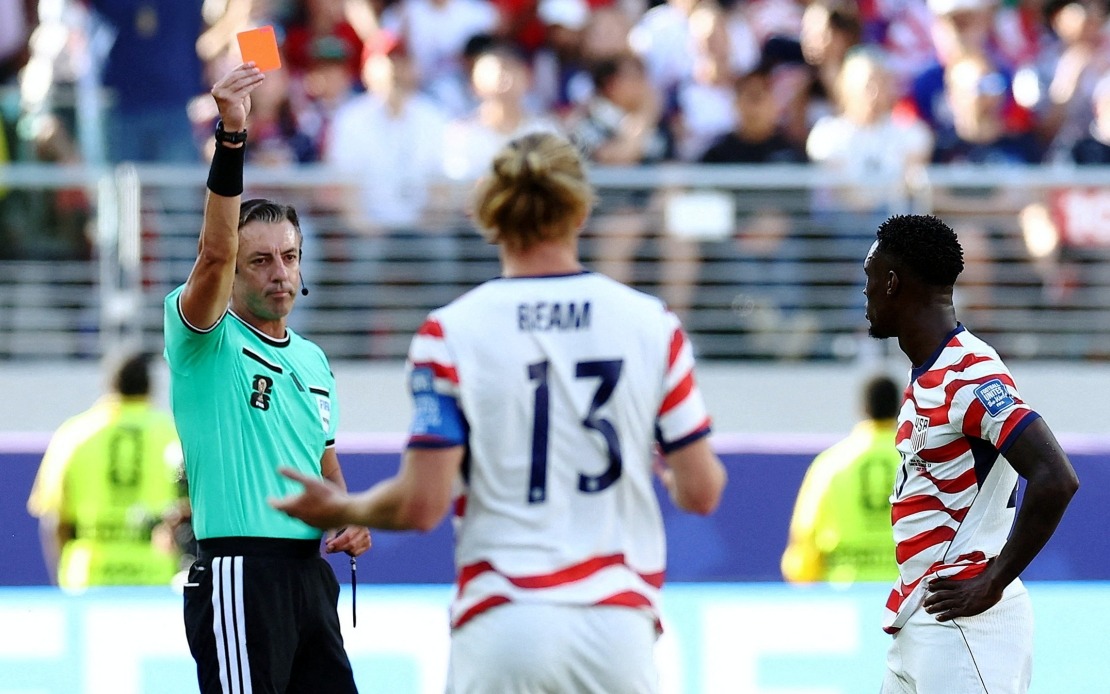
FIFA's referees chief Pierluigi Collina has publicly endorsed Brazilian match official Raphael Claus following criticism from United States President Donald Trump, who questioned the integrity of a controversial decision made during the tournament. The dispute centres on Claus's handling of a red card incident involving American striker Folarin Balogun in a last-32 encounter against Bosnia and Herzegovina, a ruling that has become unexpectedly entangled with high-level diplomatic intervention and raised broader questions about the independence of match officiating at the world's premier football competition.
The controversy erupted after Claus sent off Balogun following a VAR review in the Bosnia and Herzegovina match last week. Trump publicly labelled the referee as "suspect" and apparently pursued diplomatic channels to have the decision revisited. While Balogun's suspension was eventually overturned on Sunday—allowing him to feature in the subsequent last-16 fixture against Belgium—the episode has exposed tensions between national political interests and the autonomous authority that FIFA seeks to maintain over its referee selection and match management protocols.
In response to the presidential criticism, FIFA issued a comprehensive statement defending Claus's professional standing, describing him as "one of the world's leading professional referees and a valued member of Team One" at the tournament. The governing body emphasised that throughout his career, Claus "has consistently demonstrated the highest standards of professionalism and integrity," language that effectively positioned the criticism as an unfounded attack on an official's character rather than a legitimate technical debate about a specific match decision.
Collina's personal endorsement carried particular weight given his role as chief of FIFA's referee operations. He highlighted that Claus was making his second World Cup appearance, having previously officiated at the 2022 tournament in Qatar, thereby establishing his track record within the sport's highest echelon. Collina stated that the federation maintained "full confidence in him as a trusted match official," a reassurance that appeared designed to signal to the international football community that the decision would not be reversed or subjected to external political pressure.
The situation is notable because it reveals how high-stakes sports decisions can intersect with geopolitical considerations in ways that challenge governance structures. Trump's willingness to directly engage with FIFA President Gianni Infantino on a specific match ruling illustrates the leverage that major footballing nations and their leaders can attempt to exert over tournament outcomes. Infantino himself chose not to directly defend Claus by name, instead offering a generalised tribute to the match officials and invoking the principle that referees must be respected and the rules of the game protected from external interference.
Certainly, for Malaysian and Southeast Asian observers, this episode underscores a recurring tension within international sports governance: the balance between national interests and institutional independence. Malaysia and other regional nations often participate in tournaments where decisions by officials from different countries can affect outcomes crucial to local pride and sporting advancement. The Claus situation demonstrates that no nation, regardless of political influence, is insulated from disputes over officiating fairness, and that even sophisticated dispute-resolution mechanisms like VAR remain subject to interpretation and debate.
The possibility that Claus could be assigned to referee the tournament final—a proposition mentioned in official circles—adds another dimension to the controversy. Brazil's elimination at the last-16 stage theoretically removes any immediate conflict of interest regarding a Brazilian referee overseeing the championship match. However, the sequence of events has already complicated perceptions of impartiality. Future assignment decisions involving Claus or other officials caught in political disputes will inevitably be scrutinised for evidence of retaliatory or compensatory positioning.
Infantino's Instagram statement, while largely restating FIFA's orthodox position on referee respect and the significance of the rule of law in football, also conveyed a subtle political message. By emphasising that officials were "selected through a rigorous process which considered their skills, consistency, and quality over a sustained period," the FIFA president implicitly rejected the notion that political complaint should influence such selections. This framing asserts that merit and established procedure, not external pressure, determine who manages matches at this level.
The broader context reveals an evolving challenge for international sports organisations. The integration of advanced technology and video review, while intended to improve accuracy, has simultaneously created new avenues for contestation and dispute. Decisions that might previously have been accepted as final are now subject to extended analysis and second-guessing by partisan audiences, media commentators, and—as this case demonstrates—national political figures. For referees like Claus, this means that even conscientious, professional decision-making can become mired in controversy through circumstances largely beyond their control.
For Southeast Asian nations participating in or observing international football tournaments, the Claus-Trump episode serves as a reminder that the apparent neutrality and objectivity of institutional sports governance remains contingent and contested. Questions about referee selection, VAR implementation, and the adjudication of match-deciding incidents will likely continue to generate diplomatic attention and political commentary, particularly when high-stakes encounters between major footballing powers are concerned. The way FIFA has responded—with firm institutional backing for its official and principled statements about referee independence—suggests the organisation recognises the threat posed to its credibility by capitulating to political pressure.
Ultimately, whether Claus receives further tournament assignments, and how his career trajectory unfolds in the aftermath of this scrutiny, will signal whether FIFA's defence of its referee represents a durable commitment to institutional autonomy or merely a tactical response to immediate political pressure. The resolution of this tension will have implications not only for the tournament at hand but for the future relationship between national sporting interests and transnational sports governance structures that Southeast Asian nations and their athletes depend upon for fair competition.

