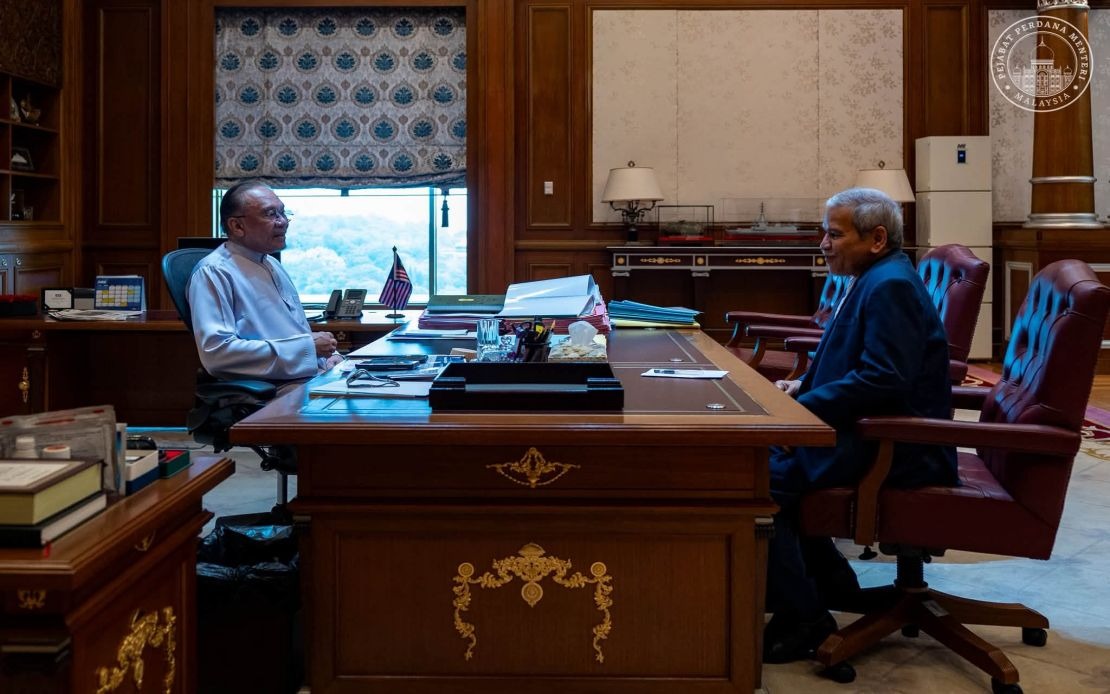
Prime Minister Datuk Seri Anwar Ibrahim has reaffirmed his government's commitment to reinforcing the Federal Land Development Authority (FELDA) as a critical institution serving the agricultural settler community. During a formal meeting with newly appointed FELDA chairman Tan Sri Ahmad Badri Mohd Zahir at his Putrajaya office, Anwar underscored the dual imperative of protecting settler livelihoods while modernising the organisation's competitive standing in contemporary markets.
The leadership transition, which saw Ahmad Badri assume the chairmanship effective July 15 following the completion of Datuk Seri Ahmad Shabery Cheek's tenure on June 30, signals fresh momentum in FELDA's management structure. Anwar's comments, released through a Facebook statement, reflect broader government prioritisation of the settler economy at a time when agricultural communities face mounting pressure from globalisation, changing land-use patterns, and demographic shifts.
As both Prime Minister and Finance Minister, Anwar positioned FELDA's revitalisation within the wider MADANI framework, the government's overarching development agenda. His remarks highlight recognition that sustaining FELDA requires balancing immediate welfare provisions for current settlers against longer-term institutional viability. This dual focus acknowledges legitimate concerns within the settler community about programme adequacy, while also addressing structural questions about FELDA's operational efficiency and market relevance.
The emphasis on intergenerational considerations carries particular significance. Malaysia's settler schemes, established decades ago as post-colonial development instruments, have increasingly grappled with questions of succession and youth engagement. Younger family members often pursue urban employment or different economic paths, creating sustainability challenges for traditional plantation-based models. Anwar's specific mention of younger-generation concerns suggests government awareness of this demographic reality and intention to develop targeted interventions.
Ahmad Badri's appointment represents continuity with reform-oriented management following earlier initiatives to modernise FELDA operations. The new chairman inherits an organisation navigating complex pressures: volatile commodity prices, labour availability constraints, environmental sustainability demands, and competition from alternative land uses. Government backing, as articulated by Anwar, provides political support for necessary changes, though implementation will require careful calibration to avoid antagonising long-established settler constituencies.
FELDA's economic competitiveness dimension addresses the organisation's need to function as a commercially viable entity rather than purely as a welfare instrument. This reflects Malaysia's broader shift toward market-oriented development paradigms while attempting to retain a safety-net function for vulnerable populations. Enhanced competitiveness could mean investments in technology, value-added processing, crop diversification, or supply-chain improvements—areas where government support could prove decisive.
The MADANI Government's commitment to continued institutional support carries fiscal implications at a time when Malaysia manages competing budgetary priorities. Whether such support materialises through direct subsidies, infrastructure investment, research funding, or preferential market access remains to be detailed in subsequent policy announcements. The government's rhetorical backing will ultimately be measured against resource allocation decisions in forthcoming budget cycles.
FELDA operates approximately 3.7 million hectares of land and encompasses over 100,000 settler families across multiple schemes nationwide. The organisation thus represents a significant demographic constituency with electoral importance across multiple parliamentary constituencies. Anwar's emphasis on settler dignity carries political undertones, signalling that the government views this community as priority beneficiaries of developmental attention.
The appointment timing, occurring mid-year, provides Ahmad Badri approximately eighteen months to establish strategic direction before typical election cycles might influence government priorities. This window creates opportunity for substantive agenda-setting without immediate electoral pressure, though Malaysian politics' fluid nature means such calculations remain provisional.
Regional context matters too. Thailand, Indonesia, and the Philippines maintain their own settler and smallholder agricultural programmes with varying success rates. Malaysia's FELDA comparative standing—whether as a model or cautionary example—influences regional policy discussions about agricultural development and rural welfare. Strengthening FELDA thus carries soft-power dimensions beyond domestic economic considerations.
Looking forward, FELDA's trajectory will depend on Ahmad Badri's capacity to navigate competing demands: protecting current settler interests, adapting to market realities, embracing necessary modernisation, managing environmental expectations, and maintaining relevance for younger generations. Anwar's framing suggests government recognition that this balancing act requires sustained attention and resources rather than benign neglect. The real test of commitment will emerge through specific policy measures and funding decisions over coming months.

