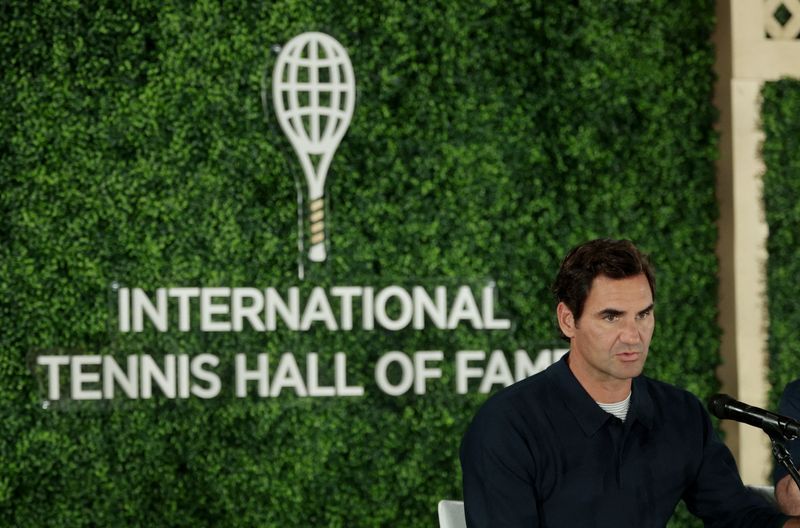
Roger Federer marked a significant milestone in his storied career on Saturday with his induction into the International Tennis Hall of Fame, an honour the Swiss champion characterized as fundamentally different from the trophies and accolades that punctuated his playing days. Speaking at a news conference in Newport ahead of the formal ceremony, the 45-year-old emphasized that this recognition offered him a chance to step back and contemplate the broader scope of his influence on professional tennis, extending far beyond championship victories and ranking points.
Federer's credentials speak to one of sport's most dominant careers. His eight Wimbledon titles remain a men's record, complemented by six Australian Open championships, five U.S. Open crowns, and the 2009 French Open that completed his career Grand Slam. Beyond the majors, he accumulated 103 ATP Tour titles and spent 310 weeks as the world's top-ranked player before retiring in 2022. He also claimed Olympic doubles gold alongside Stan Wawrinka in 2008 and anchored Switzerland's 2014 Davis Cup victory. Yet in reflecting on his Hall of Fame moment, Federer deliberately steered conversation away from these statistical achievements toward a more nuanced assessment of his legacy.
Central to Federer's reflection is his belief that meaningful contribution to tennis transcends individual glory. Working alongside administrators from the ATP, Grand Slam tournaments, and players' councils, he championed structural improvements that have expanded economic opportunities throughout professional tennis. Notably, Federer highlighted the substantial increases in prize distribution across all rounds of competition, not merely for tournament winners. This democratization of earnings has fundamentally altered the financial reality for journeyman professionals competing in early rounds, enabling far more players to sustain careers in the sport. For Southeast Asian readers, this development carries particular significance as it creates viable pathways for emerging talents from Thailand, Malaysia, and Indonesia to generate sustainable livelihoods while developing their games on the international circuit.
Beyond prize money, Federer pointed to his advocacy for improved conditions affecting multiple stakeholders within professional tennis. Enhanced facilities for media personnel, upgraded medical infrastructure, and superior stadium amenities represent investments that Federer believes contribute to the sport's overall professionalization and credibility. These systemic improvements, though less visible than tournament victories, address the foundational quality-of-life issues that determine whether talented players can perform at their peak and whether the sport attracts and retains world-class talent.
Federer's rise from a talented Swiss teenager to global sporting icon carried with it tremendous external pressure. Rather than viewing this as a burden to overcome, he characterized his psychological approach to competition as one of embracing rather than resisting expectations. His stated preference for Centre Court over lesser-known courts reflected an early self-awareness that he possessed both the talent and temperament to thrive under the brightest spotlight. This deliberate cultivation of a winner's mindset, Federer suggested, enabled him to harness pressure as motivation rather than allowing it to corrode his confidence.
However, Federer acknowledged the darker dimensions of elite sports celebrity. The constant external commentary and relentless judgment based solely on victories can create what he described as a overwhelming mental turbulence. For contemporary players navigating social media scrutiny and 24-hour sports coverage, Federer's candid recognition that athletes can lose sight of sport's intrinsic joy carries weight. His claim that he successfully maintained happiness while competing at the highest level suggests a psychological resilience many players might aspire to but struggle to achieve amid mounting external pressures.
Despite formal retirement, Federer has signalled no intention to disappear entirely from professional tennis. His exhibition appearance at Arthur Ashe Stadium ahead of the U.S. Open demonstrated that his connection to the sport remains visceral rather than merely nostalgic. Looking forward, he has left open multiple pathways for continued involvement, including potential roles as a Laver Cup captain, mentor to younger players, or broadcast commentator. These possibilities reflect a determination to remain meaningfully engaged with tennis evolution during its post-Federer era.
Federer's approach to potential future roles prioritizes selectivity. He indicated he attends three to five professional events annually, maintaining sufficient exposure to understand contemporary tennis dynamics without overwhelming personal commitments. This measured engagement, he suggests, provides intellectual stimulation and renewal, keeping him connected to developments within the professional game while preserving the distance that permits honest evaluation of how he might contribute most meaningfully.
The Hall of Fame induction thus represents not a conclusion but a transition for Federer. His willingness to characterize his legacy in terms of systemic contributions rather than trophy counts reflects a maturation in how successful athletes understand their historical significance. For Malaysian and Southeast Asian tennis stakeholders, Federer's demonstrated commitment to expanding economic opportunities and improving professional conditions through governance participation offers a model of how retired champions might leverage their influence toward sport development. As younger Asian players aspire to careers in professional tennis, the infrastructure improvements Federer championed become direct enablers of their ambitions, making his off-court advocacy arguably as consequential as his on-court dominance.

