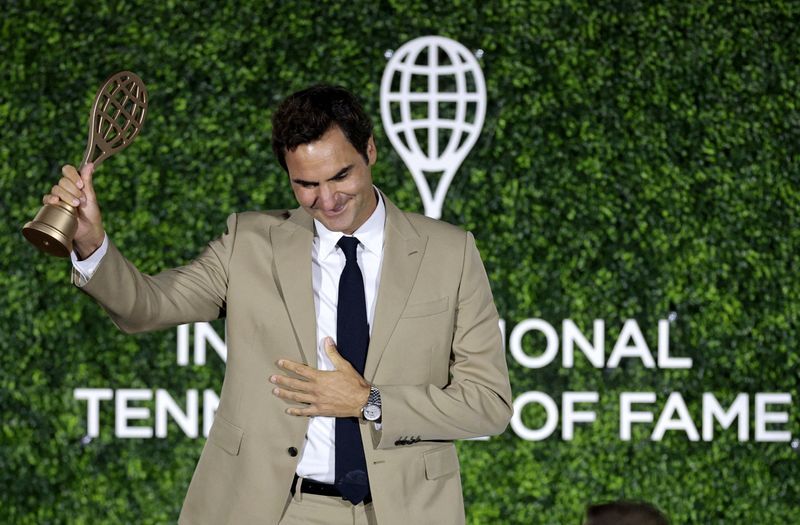
Roger Federer's induction into the International Tennis Hall of Fame at Newport, Rhode Island on Saturday proved to be a deeply moving occasion, with the Swiss legend visibly emotional as he reflected on a career that reshaped modern tennis. The 20-time Grand Slam champion, inducted alongside broadcaster and journalist Mary Carillo, approached the podium not as someone closing a chapter but rather as an artist still engaged with his life's greatest passion. His remarks painted a portrait of an athlete whose connection to the sport transcended trophies and records, instead centering on the values and relationships tennis had enabled him to cultivate across four decades.
Federer's career represents one of sport's most enduring achievements. His eight Wimbledon titles remain unmatched among male competitors, a record that speaks to his particular mastery of grass court tennis and his ability to sustain excellence across an extended career arc. Beyond those achievements, he accumulated six Australian Open crowns, five U.S. Open titles, and a single French Open victory, complemented by 103 ATP Tour titles and a staggering 310 weeks spent as the world number one. These numbers, while impressive, formed only the backdrop to what Federer sought to communicate during his induction speech—that his legacy extended far beyond statistics.
What distinguished Federer's approach to the game was a stylistic elegance that made tennis accessible to audiences who might otherwise overlook the sport. He famously wore signature headbands throughout his career, joking during his speech that the total exceeded 5,000, a detail that underscored how his visual identity became inseparable from professional tennis itself. His consistent choice to wear two pairs of socks and his commitment to serve-and-volley tactics in an era increasingly dominated by baseline power exemplified his determination to inject creativity and unpredictability into the sport. The SABR—Sneak Attack by Roger—his unorthodox return of serve where he would strike the ball between his legs rather than stepping around it, exemplified his willingness to experiment and challenge conventions, transforming potential disadvantages into moments of tactical theatre.
Central to Federer's remarks was his insistence that tennis success encompassed dimensions rarely captured in match statistics. He emphasized that creating something new within the sport mattered as deeply as winning, a mentality that drove him to continually evolve his game rather than rest on established strengths. This perspective suggests a view of sporting excellence as an ongoing dialogue between innovation and tradition, where the pursuit of victory becomes secondary to the pursuit of beauty and authenticity. For Malaysian and Southeast Asian audiences, this philosophy carries particular resonance, as it reframes what constitutes achievement in sport beyond the narrow confines of championship titles.
The personal dimensions of Federer's gratitude became apparent as he addressed his family, coaches, and medical team, with particular emotion directed toward his wife Mirka. His acknowledgment that much of what mattered most happened away from the court reflected a maturity often absent from contemporary athletic discourse, where public personas frequently emphasize dominance and supremacy. Instead, Federer positioned himself as a family man and friend whose professional achievements were meaningful precisely because they enabled deeper human connections and provided opportunities to model character and integrity to his children and peers.
Federer's reflections on his playing contemporaries—from Andre Agassi and Lleyton Hewitt to Andy Roddick, Rafael Nadal, and Novak Djokovic—underscored a generational awareness that enhanced rather than diminished his accomplishments. Rather than viewing rivals as obstacles to be overcome and forgotten, he celebrated the opportunity to compete alongside different eras of tennis excellence. This perspective, uncommon in elite sport, demonstrated an understanding that greatness often emerges through competition rather than despite it, and that the caliber of opponents elevates rather than diminishes a champion's legacy.
A particularly striking element of Federer's address involved his forward-looking vision for professional tennis. Rather than dwelling exclusively on past achievements, he articulated hopes for the sport's evolution, urging emerging players to maintain their authenticity while pushing technical and tactical boundaries. His concern about professional tennis losing its amateur spirit as the game becomes increasingly globalized and athletically demanding reflected anxiety about whether commercialization and specialization might erode qualities that make tennis compelling beyond its competitive structure. For Southeast Asia, where tennis participation and fandom continue developing, Federer's counsel about preserving camaraderie among players and encouraging innovation offers a blueprint for building a sustainable competitive culture.
Federer's characterization of his induction speech as a continuation rather than conclusion of his love letter to tennis provided profound insight into how he views his relationship with the sport post-retirement. Having stepped away from professional competition in 2022, he refuses to position himself as a historical figure whose relevance has passed. Instead, he maintains active engagement with tennis through commentary, exhibition matches, and mentorship, suggesting that retirement from competitive play need not entail retirement from the sport itself. This perspective may inspire Malaysian athletes and sports administrators to think differently about athlete transitions and the continued value retired champions can provide to their sporting communities.
The emotional tenor of Federer's induction speech—bringing him to tears multiple times—demonstrated vulnerability rarely displayed by male athletes in formal settings. This emotional authenticity challenged masculine stereotypes in sport and suggested that the most accomplished athletes need not perform invincibility. For younger players watching globally, including those in Malaysia and Southeast Asia, Federer's willingness to cry publicly while discussing his gratitude and love for tennis offered an alternative model of athletic masculinity centered on emotional expressiveness and relational values rather than stoic dominance.
Federer's induction also carried symbolic weight for Switzerland and global sport more broadly. His reflection on watching tennis as a thirteen-year-old ball boy in Basel, followed by his journey to become the sport's most aesthetically celebrated champion, embodied a particular kind of sporting narrative where talent, dedication, and authentic passion converge to produce sustained excellence. As his name entered the Hall of Fame, he carried Switzerland's reputation with him, a recognition that individual achievement and national pride remain intertwined in international sport.
The broader significance of Federer's induction extends beyond tennis into conversations about how societies honor athletic achievement and what values they choose to commemorate through halls of fame. By elevating not just the championships won but also the manner in which they were pursued and the character demonstrated throughout, the International Tennis Hall of Fame acknowledged that sporting greatness encompasses dimensions of style, integrity, and positive influence. For sports administrators and governing bodies across Southeast Asia, Federer's induction provides a template for valuing holistic excellence that integrates athletic performance with character and contribution to sport's broader development.

