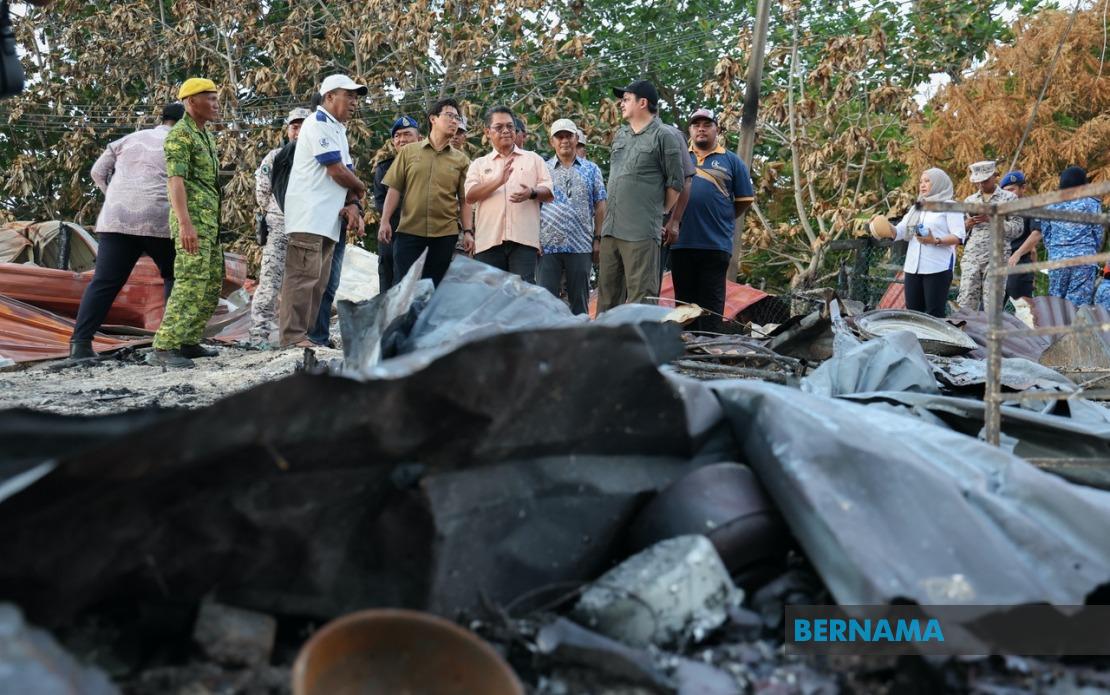
The Federal Government has moved swiftly to support residents of Pulau Nunuyan Laut in Sandakan following a catastrophic fire that swept through the settlement in the early hours of yesterday morning. Acting through the Prime Minister's Department (JPM), authorities distributed initial assistance to 29 heads of households affected by the disaster, which claimed 28 structures and rendered more than 100 people homeless. The blaze, which erupted around 3 am at Kampung Nunuyan Laut, represents a significant humanitarian challenge for the island community and has prompted a coordinated multi-agency response at federal and local levels.
Datak Mustapha Sakmud, the Minister in the Prime Minister's Department responsible for Sabah and Sarawak affairs, outlined the government's immediate priorities during a visit to the fire-affected area. He explained that the department's Implementation Coordination Unit has already commenced relief operations tailored to the most vulnerable residents, notably distributing wheelchairs to elderly victims requiring mobility assistance. This targeted approach reflects recognition that disaster recovery must address not only the immediate loss of shelter but also the specific needs of elderly and infirm community members who may lack resources to secure essential equipment independently.
The minister emphasised the government's commitment to minimising disruption to children's education, a practical concern given the fire's location on an island where maritime infrastructure is critical. Mustapha instructed the Sandakan Municipal Council and associated government bodies to undertake comprehensive needs assessments to identify the full scope of assistance required. Notably, he prioritised urgent repairs to public infrastructure, specifically the jetty utilised by schoolchildren for daily transport to and from educational institutions. By framing infrastructure restoration as integral to preserving educational continuity, the government has signalled that recovery extends beyond individual household replacement and encompasses community functionality.
The coordination framework involves multiple layers of governance and administration. Local authorities, represented by Sandakan Municipal Council president Datuk Walter Kenson, are tasked with facilitating inter-agency collaboration and channelling damage assessments through to federal decision-makers. This hierarchical approach, while bureaucratically complex, distributes responsibility across institutions with distinct expertise and resources. The council president accompanied the federal minister during the on-site inspection, demonstrating visible commitment from municipal leadership to the recovery effort and signalling to affected residents that their concerns are receiving attention from senior officials.
A critical dimension of the recovery strategy concerns the property situation underlying the disaster. Walter disclosed that the fire victims were residing on privately owned land comprising two separate land titles. This revelation introduces a significant complication to reconstruction planning, as relocation and long-term housing solutions require negotiation with private landowners who have not necessarily consented to continued occupation. The involvement of private property interests adds a layer of complexity to what might otherwise be a straightforward government-led relief operation, necessitating diplomatic and potentially financial arrangements to facilitate orderly resettlement.
The Rural Development Department has been designated to determine optimal relocation strategies, with consideration given to village reserve lands as potential resettlement sites. This institutional assignment reflects the technical and planning expertise required to identify suitable locations, assess accessibility, and evaluate suitability for sustainable community rebuilding. The mention of village reserve land suggests authorities may explore relocating residents to publicly held property, thereby circumventing complications associated with private ownership whilst potentially reducing negotiations required with multiple landholders.
Long-term welfare considerations have been incorporated into planning frameworks from the outset. Beyond emergency temporary shelter, authorities have committed to installing foundational services including electricity, water supply, and maritime infrastructure such as jetties. This commitment to comprehensive essential services reflects a development-oriented approach to disaster recovery rather than a purely temporary palliative response. By stipulating that relocated communities receive adequate utilities and transport infrastructure, the government implicitly acknowledges that sustainable recovery requires establishing conditions equivalent to those existing before the fire, or ideally improved.
The Sandakan fire represents a localized but significant test of Malaysia's disaster response mechanisms. Sabah and Sarawak face particular vulnerabilities related to maritime communities, isolated settlements, and limited infrastructure redundancy, particularly in rural and island-based areas. The speed and apparent comprehensiveness of the federal response, including direct ministerial oversight and coordination across multiple government agencies, demonstrates institutional capacity to mobilise resources rapidly when disasters strike. However, the necessity for negotiations with private landowners and the complexity of coordinating relocation underscores ongoing challenges in managing disaster recovery in contexts where land tenure and private property interests complicate government action.
For residents of Pulau Nunuyan Laut, the immediate provision of aid and the articulated commitment to comprehensive reconstruction offer relief following the trauma of losing homes and possessions. The emphasis on preserving educational access and restoring community infrastructure suggests authorities recognise that disaster recovery encompasses not merely individual compensation but restoration of normal social and economic functioning. Whether the multi-agency coordination succeeds in delivering promised services efficiently will become apparent in coming weeks, with particular attention warranted toward resolving property negotiations and establishing relocation timelines.

