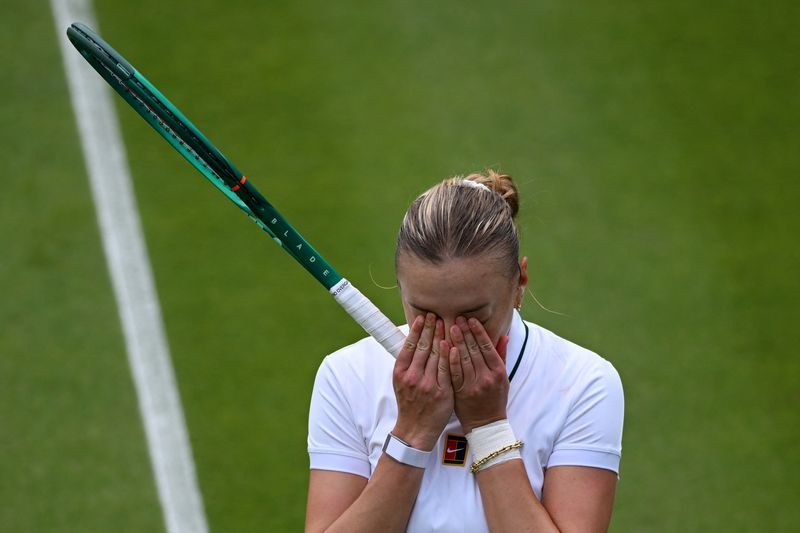
Amanda Anisimova is banking on her support network to fuel another deep run at Wimbledon after a disappointing final loss last year, with the American's family already making travel arrangements in anticipation of extended rounds at the grass-court Grand Slam. The 23-year-old American's presence at the championships has become inextricably linked with her relatives, whose involvement in her tournament experience goes beyond mere spectating, creating an emotional anchor that she credits with helping her perform at her peak.
Anisimova breezed through her opening match on Tuesday, dispatching Lina Gjorcheska 6-3 6-2 to advance confidently into the second round. This victory marks the beginning of what she hopes will be a redemptive campaign following last year's devastating 6-0 6-0 loss to Poland's Iga Swiatek in the final—a scoreline that speaks to the magnitude of her disappointment and her determination to prove she belongs among the sport's elite.
The catalyst for Anisimova's optimism stems substantially from the presence of her immediate family throughout the tournament. Her sister Maria, recognizing the pattern of her sibling's recent success at the championships, has already purchased a flight ticket months in advance, essentially hedging a bet that Anisimova will advance deep into the draw. This forward planning reflects both the family's confidence in her abilities and their commitment to being physically present during crucial moments of her career—a gesture that carries profound psychological weight for the young athlete.
During her run to last year's final, Anisimova's young nephew Jackson emerged as a recognizable fixture in the Wimbledon stands, becoming something of a mascot for her campaign. The child's unbridled enthusiasm and innocent celebration of her quarter-final victory created memorable moments that transcended the usual sporting experience. For Anisimova, these instances of familial joy represent more than just sentiment; they constitute a grounding mechanism that keeps her connected to what matters beyond the competitive arena.
In conversations with reporters, Anisimova articulated how the presence of her extended family—including her in-laws—transforms Wimbledon from merely another Grand Slam venue into something resembling home. This psychological shift holds particular significance for professional athletes who spend much of their year traveling internationally, living out of suitcases, and competing in foreign territories. The ability to retreat after matches to the comfort of loved ones, to debrief victories and defeats within a familiar emotional context, provides therapeutic value that transcends conventional sports psychology.
Anisimova's dual success at major tournaments last year—reaching both the Wimbledon and U.S. Open finals—represented a breakthrough moment in her career trajectory. However, the contrast between her performances at these two Grand Slams suggests that environmental and emotional factors play outsized roles in her championship performance. Her loss to American Aryna Sabalenka at Flushing Meadows demonstrated that reaching major finals is no guarantee of victory, yet the runner-up finishes validated her status as a competitor capable of sustaining excellence across multiple surfaces and venues.
What distinguishes Anisimova's approach to Wimbledon from her other tournament engagements is the deliberate cultivation of a support ecosystem. Rather than adopting the mentality of many touring professionals who minimize personal distractions, she has embraced having friends and family members present as a foundational element of her preparation strategy. This approach reflects a personal philosophy that competition need not entail isolation, and that emotional richness can coexist with professional excellence.
The grass courts of the All England Club have become intimately associated with Anisimova's aspirations following her breakthrough year. Unlike clay specialists or hard court players for whom Wimbledon represents an anomaly in their preferred surface, Anisimova appears genuinely comfortable at the venue. She describes it as a "second home tournament," a phrase that carries weight beyond mere venue preference—it speaks to a holistic sense of belonging that encompasses not just the physical space but the entire ecosystem of support surrounding her presence there.
Looking forward, Anisimova's ability to convert the emotional strength derived from family proximity into tangible tournament results will determine whether she transcends being merely a finalist into becoming a champion. The previous year's experience of reaching a major final, though ending in disappointment, provides valuable lessons about the specific pressures and expectations that accompany deep runs at Grand Slams. Her willingness to lean on her support system rather than adopting a stoic, isolated approach to competition suggests she has chosen a more emotionally integrated path to potential success.
For Southeast Asian tennis enthusiasts and regional sports observers, Anisimova's journey represents a broader narrative about how global athletes navigate the demands of international competition while maintaining personal connections that anchor them. Her commitment to having family present reflects values that resonate across Asian cultures, where familial bonds and collective support systems remain paramount. The contrast between Western narratives of athletic individualism and Anisimova's approach offers an interesting perspective on alternative models of sporting excellence that don't require emotional disconnection from loved ones.

