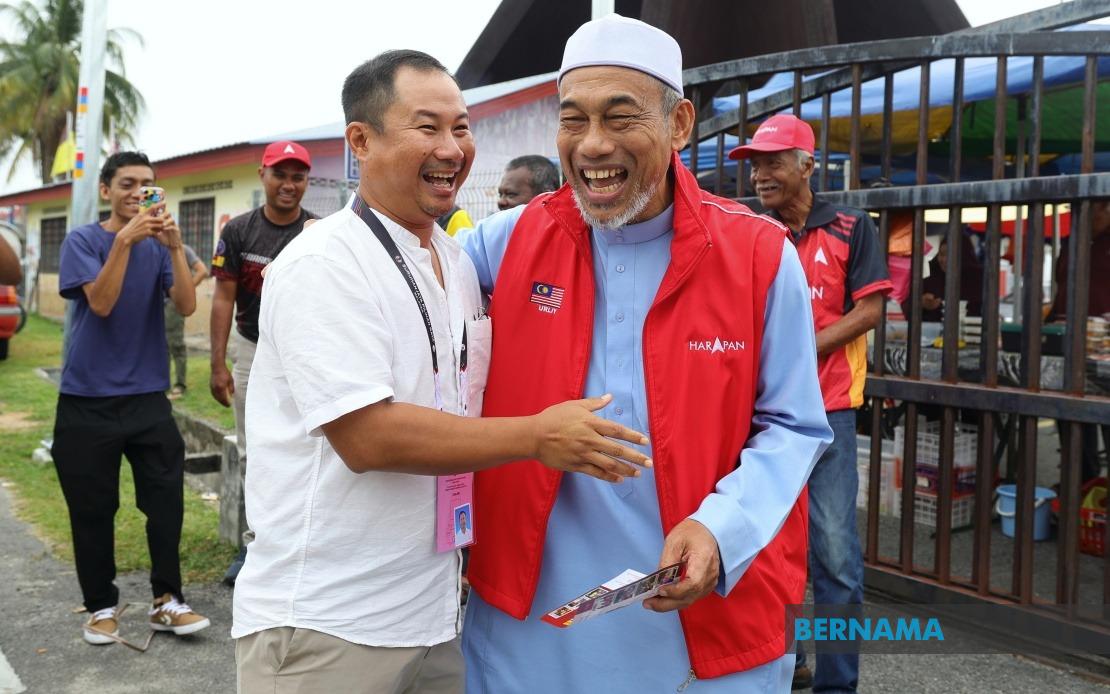
A potentially combustible political encounter unfolded with unexpected grace in Jelebu when two cousins vying for the Klawang state seat crossed paths at a local weekend market, their family ties overshadowed by electoral ambition yet not overshadowed by mutual respect. The scene encapsulated a striking contrast to the sometimes fractious nature of Malaysian electoral contests: Datuk Bakri Sawir, seeking re-election as the Pakatan Harapan incumbent, and Danni Rais, representing Perikatan Nasional's challenge, worked the same market crowd on the second day of campaigning for the Negeri Sembilan State Election without incident or acrimony. Their simultaneous presence drew the attention of voters and traders, many seizing the moment to photograph and exchange words with both candidates as they navigated through different sections of the market.
What could have deteriorated into a family feud played out instead as a lesson in political decorum. Rather than deliberately avoiding one another or manufacturing confrontation for media consumption, the cousins maintained separate campaign efforts while acknowledging each other's presence in a cordial manner, even exchanging light-hearted banter as they encountered the same electorate. The restrained approach reflected a growing recognition among some Malaysian politicians that aggressive tactics and personal attacks, particularly within families, undermine the broader legitimacy of electoral competition and alienate voters increasingly fatigued by divisive rhetoric.
Bakri's perspective on the contest reveals the measured temperament that characterized the encounter. When discussing his electoral challenge against his cousin, he consciously rejected framing it as a personal battle or something warranting special commentary, instead positioning the election itself as a democratic exercise where candidates present their respective visions and track records for public evaluation. His emphasis lay on the mechanics of clean campaigning rather than on the novelty or drama of family opposition, suggesting a deliberate effort to depersonalize what might otherwise become a narrative of familial discord exploited by partisan media outlets seeking sensational angles.
The incumbent's commitment to regulatory compliance provides additional texture to understanding his candidacy. When the Jelebu District Council objected to flag installations on a stadium fence, Bakri's team promptly complied with the directive rather than contesting or ignoring the administrative decision. This responsiveness to local authority reflects either a principled commitment to lawful conduct or a calculated recognition that respecting regulations builds credibility with voters and election officials alike. His articulation of this principle—that candidates cannot credibly ask citizens to observe the law if they themselves disregard it—strikes at fundamental questions about governmental legitimacy that resonate particularly in Southeast Asian contexts where institutional trust remains fragile.
The Klawang state seat presents a competitive three-way race that extends beyond the family drama at its center. Muhammad Adib Musa of Bersatu enters as a third force in a constituency comprising 13,355 registered voters, a number suggesting that vote fragmentation could determine the outcome. In Malaysian state elections, three-cornered fights frequently produce unexpected results as voters navigate complex calculations about which candidate or party best represents their interests. The presence of a Bersatu candidate complicates what might otherwise be a straightforward ideological choice between Pakatan Harapan's progressive-reformist positioning and Perikatan Nasional's more conservative-Islamist orientation.
Negeri Sembilan's electoral dynamics warrant closer examination within the broader context of Malaysian coalition politics. The state has historically demonstrated significant political volatility, swinging between ruling coalitions across successive elections. The Klawang contest embodies this instability: an incumbent from the current federal ruling coalition faces pressure from Perikatan Nasional, which had previously governed Malaysia and retains organizational capacity in certain constituencies. For voters in Jelebu and surrounding areas, the choice represents not merely a local matter but a referendum on national governance directions and which coalition better serves their interests at both state and federal levels.
The Election Commission's scheduling of early voting for July 28 and polling for August 1 provides a concentrated campaign window during Malaysia's monsoon season, when weather patterns and voter mobility could influence turnout. In rural and semi-rural constituencies like Klawang, such environmental factors may disproportionately affect electoral participation, potentially favoring the party organization with more robust ground infrastructure. Bakri's emphasis on orderly and respectful campaigning may also reflect awareness that in communities where interpersonal relationships and social cohesion carry significant weight, excessive political aggression backfires more visibly than in urban constituencies where anonymity buffers political conflict.
The harmonious engagement between the cousins illuminates broader questions about how Malaysian political culture evolves as it matures. Earlier decades witnessed campaigns characterized by greater intensity of personal attacks and confrontational rhetoric, sometimes descending into communal tensions. Contemporary elections increasingly feature instances of candidates maintaining civility even amid fierce competition, suggesting shifting voter preferences for substantive policy discussion over personality-driven conflict. Whether this reflects genuine institutional maturation or merely strategic calculation by politicians aware that voters increasingly penalize overtly aggressive tactics remains debatable, yet the pattern itself represents a meaningful difference from past practice.
For Malaysian observers monitoring state-level politics, the Klawang contest offers insights into how Perikatan Nasional consolidates support outside its traditional strongholds. Fielding candidates in constituencies where Pakatan Harapan holds incumbency requires organizational discipline and strategic resource allocation. The presence of Muhammad Adib Musa as a Bersatu candidate rather than allowing Perikatan Nasional to present a unified opposition front suggests either internal coalition management complexities or Bersatu's distinct organizational positioning independent of the broader Perikatan framework.
The election ultimately tests whether Negeri Sembilan voters view Bakri's incumbency as sufficiently productive to warrant re-election or whether they prefer Perikatan Nasional's alternative vision and governance approach. The civil tone of campaigning provides no indication of likely electoral outcomes, as civility and electoral performance constitute separate dimensions of political competition. Voters may reward either the incumbent's continuity and demonstrated administrative record or the challenger's fresh perspective and platform promises, regardless of how harmoniously the cousins conducted their campaign encounters at local markets.

