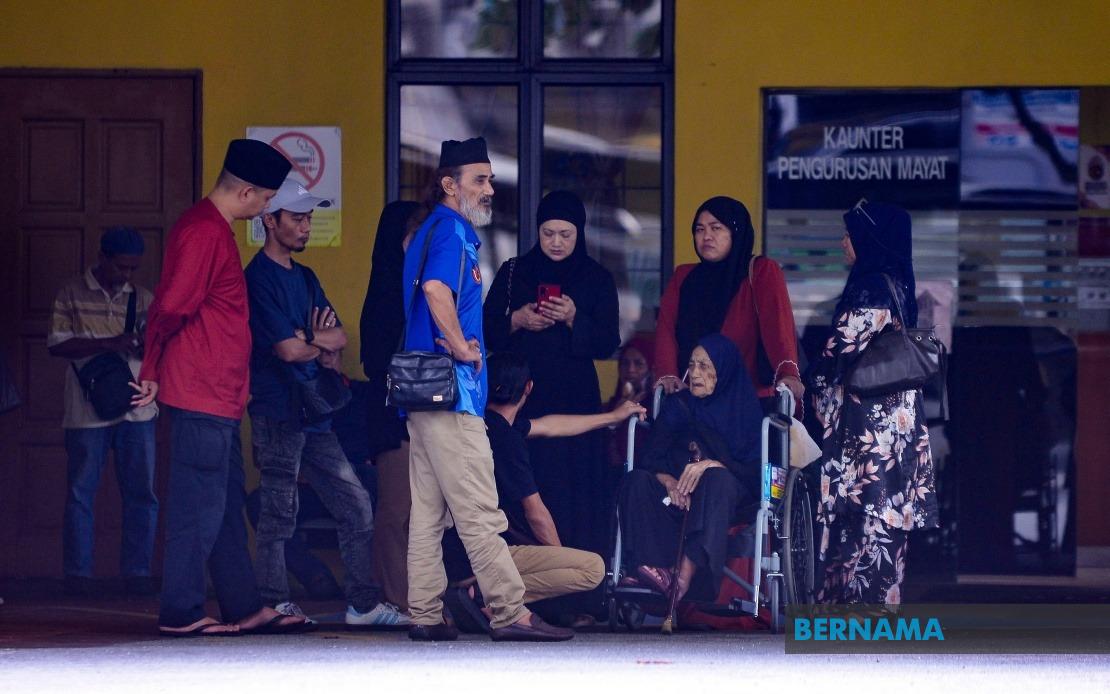
A family member of those killed in an early-morning collision involving a Malaysian Immigration Department lorry at Maju Junction is urging authorities to conduct a thorough and transparent investigation into what happened. Mohd Nadzri Razali, 69, expressed his determination to see justice served for his loved ones following the tragedy that unfolded on Jalan Sultan Ismail in the pre-dawn hours. Speaking from his home in Taman Aman Fasa 2, Mambang Di Awam, Mohd Nadzri stated that preliminary reports suggest the lorry may have proceeded through a red traffic light at the intersection, a detail that has become central to his family's demands for clarity.
The crash claimed the lives of three members of the same family: Shaik Mohd Firdaus Shaikh Yahya, 53, and his daughters Siti Nor Sazlin, 25, and Siti Darwisyah Auni, 12. The fourth family member, Norhayati Razali, 55, the mother and wife of the victims, remains hospitalized in critical condition at Kuala Lumpur Hospital's Intensive Care Unit. Mohd Nadzri disclosed that his younger sister has regained consciousness, offering a glimmer of hope to the devastated family, though her ultimate recovery remains uncertain. The family has begun exploring the possibility of transferring her to facilities closer to home in Perak, either Hospital Ipoh or Teluk Intan, once medical teams determine her condition stable enough for relocation.
The sequence of events leading to the tragedy began around 1 a.m., when an empty Isuzu Black Maria lorry operated by the Immigration Department was en route from the Kuala Lumpur Immigration Office to Chow Kit to conduct operations targeting undocumented migrants. The vehicle approached the Maju Junction intersection with its beacon lights and siren activated, but according to witness accounts and initial investigations, it entered the intersection against a red traffic signal governing its lane. At that precise moment, a Proton Saga traveling on a green light in the perpendicular direction collided with the lorry in what appears to have been an unavoidable impact. The force of the collision sent the immigration vehicle spinning out of control across the intersection, where it struck the family group who were on foot, along with an Inokom Matrix multi-purpose vehicle.
For Mohd Nadzri, the tragedy compounds a recent period of extraordinary grief within the extended family unit. Just over two months earlier, in May, the family had lost another member, leaving them in a state of raw emotional devastation. His proximity to the victims—he lives in the same neighborhood as his sister's family—meant that the initial shock was particularly acute. Reflecting on his last moments with them, Mohd Nadzri recalled seeing the family approximately two weeks before the collision, when they had traveled together to Teluk Bakong in Ayer Tawar to maintain and pay respects at family burial sites. The ordeal of losing three relatives simultaneously has left the family grappling with both immediate practical concerns and profound existential questions.
The family has begun preparations for the final rites, with plans to inter all three deceased in a single grave at the Muslim Cemetery in Kampung Air Hitam Labu, Campar. This decision, made in consultation among surviving family members, reflects both practical considerations and cultural observance. The concentration of their loss in one location underscores the closeness of these family bonds and the magnitude of what has been taken from them. For Mohd Nadzri and other relatives, the burial arrangements have become one of the few domains where they retain agency and control in an otherwise chaotic and traumatic situation.
The incident has triggered an official investigation under Section 41(1) of the Road Transport Act 1987, which governs motor vehicle accidents. This statutory framework provides the legal foundation for examining how and why the collision occurred, though the family's concerns extend beyond mere compliance with investigation procedures. Mohd Nadzri's emphasis on transparency suggests underlying anxiety that the involvement of a government agency—the Immigration Department—might somehow influence how thoroughly or impartially the investigation proceeds. Such concerns are not uncommon in Malaysian cases where government vehicles are involved in civilian fatalities, given historical instances where institutional loyalty has arguably superseded objective fact-finding.
The mechanics of the incident raise important questions about operational protocols within the Immigration Department. The lorry was activated with both visual and auditory warning systems—its beacon lights and siren—which are typically employed to alert other road users and potentially to request right-of-way through busy intersections. However, the presence of such warnings does not legally override traffic signal compliance, particularly in a dense urban area during early morning hours when visibility is reduced. The activation of these systems appears not to have been accompanied by appropriate speed reduction or heightened caution at the junction, contributing factors that may warrant scrutiny during the investigation.
The broader context of this tragedy touches on longstanding road safety concerns in Malaysia's urban centers. Maju Junction, situated along the major Jalan Sultan Ismail corridor, is a high-traffic intersection where multiple lanes converge. The early morning timing—1 a.m.—typically corresponds with reduced traffic volumes, yet paradoxically may create conditions where drivers become less attentive or increase speed, assuming roads are clear. The collision between a large, heavy immigration lorry and a standard sedan passenger vehicle demonstrates the inherent vulnerability of civilian road users when sharing spaces with substantially larger vehicles, particularly in scenarios involving sudden, unexpected movements.
Mohd Nadzri's call for justice reflects not merely a desire for accountability regarding the immediate incident, but a broader aspiration for systemic examination of how such tragedies can be prevented. The family's insistence on transparency suggests they recognize that the true measure of justice extends beyond individual blame assignments to encompassing structural reforms that might prevent similar losses. This perspective, born from personal devastation, represents an important voice in ongoing debates about transportation safety, institutional accountability, and the protection of ordinary citizens navigating shared urban spaces.
The recovery of Norhayati Razali, should she survive her injuries, will present the family with the agonizing challenge of rebuilding life after the simultaneous loss of a spouse and two children. Psychological, physical, and financial recovery from such trauma requires not only immediate medical intervention but sustained societal support structures. The investigation's findings will carry significance for this surviving member of the family, offering either confirmation of negligence that might support compensation claims or outcomes that leave deeper questions unanswered.

