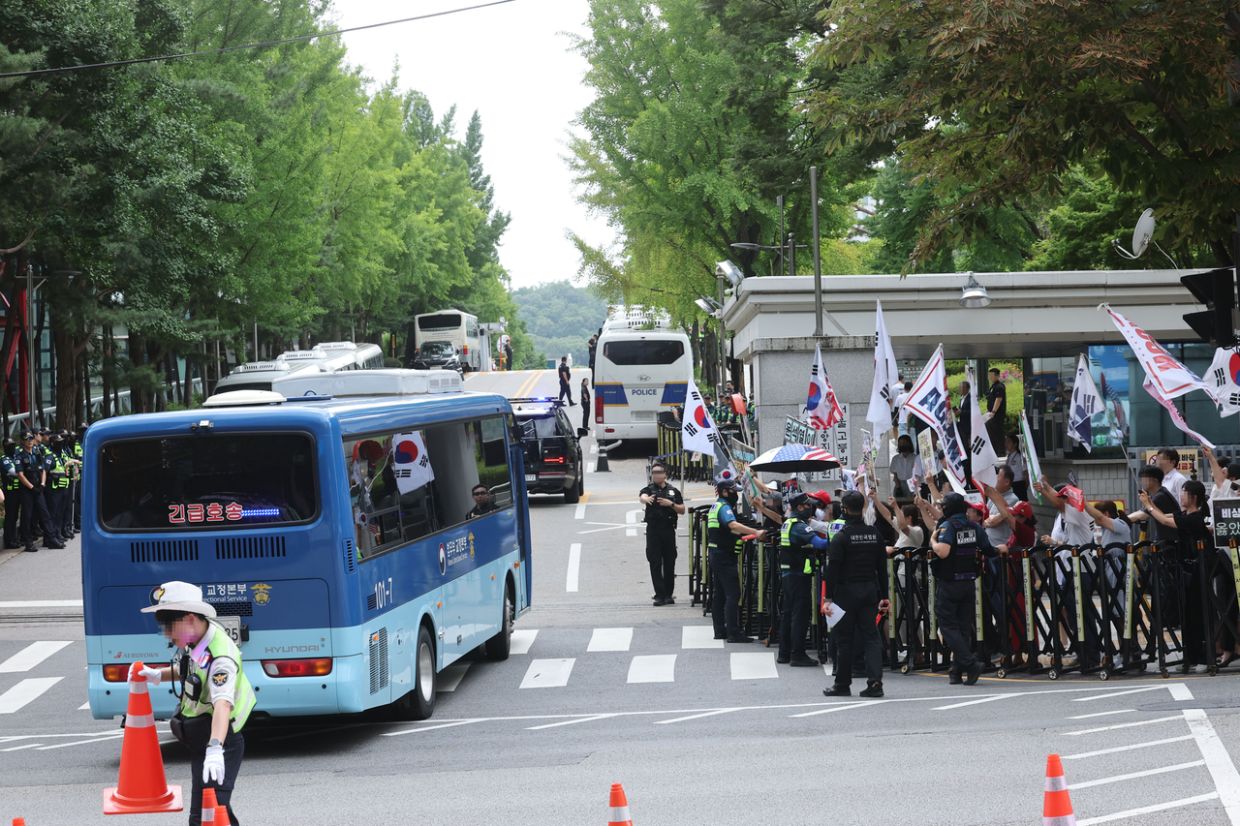
South Korea's former President Yoon Suk Yeol has been handed a two-year prison sentence following his conviction on campaign finance violations stemming from his acceptance of free polling services. The Seoul Central District Court's Monday ruling marks a significant moment in South Korea's ongoing political reckoning, as the nation grapples with questions about the integrity of its electoral systems and the behaviour expected of senior political figures.
The court found that Yoon received 14 surveys worth 27.92 million won (approximately $18,600) from political broker Myung Tae-kyun without proper declaration or payment, thereby breaching the Political Funds Act. Although prosecutors had initially argued for conviction across 58 surveys valued at more than 270 million won, the court determined sufficient evidence existed only for the smaller group. This distinction proved crucial in the ultimate assessment of wrongdoing and the severity of the sentence imposed.
Presiding Judge Lee Jin-gwan emphasized the broader democratic implications of the case, noting that opinion polls carry substantial weight in shaping voter behaviour and public perception. The judge explained that when political actors receive contributions through mechanisms outside those prescribed by campaign finance legislation, and polling firms provide their services in exchange, the integrity of electoral competition faces genuine compromise. The court's reasoning underscores how the misuse of research services can distort the marketplace of political ideas and undermine fair competition among candidates.
The prosecution's case rested on allegations that Yoon conspired with his wife, former first lady Kim Keon Hee, to benefit from the arrangement. Evidence presented to the court indicated that Kim had authorized Myung to control the timing, content, methodology, and dissemination of survey results. Although Yoon was not present for every transaction, the court found that he possessed implicit knowledge of the arrangement and tacitly consented to it, establishing a succession of agreements involving all three parties.
Crucially, the court also established that Yoon had offered quid pro quo benefits to Myung in return for the polling support. Specifically, Yoon promised that former lawmaker Kim Young-sun would receive the nomination of his People Power Party. Subsequently, Yoon exercised his influence over the party's nomination machinery, working through Chang Je-won, his president-elect's chief of staff, to facilitate Kim Young-sun's advancement. However, the court noted that establishing this exchange was not strictly necessary to prove a violation of the Political Funds Act itself.
The conviction carries particular weight given Yoon's historical position as the nation's chief executive. His downfall contrasts sharply with his election victory and highlights the intensifying scrutiny facing South Korean political elites in recent years. The case also reflects broader regional patterns, as Southeast Asian democracies increasingly confront challenges around campaign financing transparency and the potential for wealthy actors to gain disproportionate influence over electoral outcomes.
Myung Tae-kyun, the political broker who facilitated the polling arrangement, received an 18-month prison sentence and was taken into custody immediately following the court's announcement. His involvement demonstrates how intermediaries can become crucial players in schemes that circumvent campaign finance regulations, raising questions about the regulatory frameworks currently in place across the region.
The treatment of Yoon's case differs noticeably from the parallel proceedings against his wife. Kim Keon Hee faced a separate charge related to the same polling services and was acquitted at both trial and appellate levels. The lower courts determined that prosecutors had failed to establish that Kim received a measurable financial benefit equivalent to the surveys' cost, nor could they demonstrate conclusively that the polling arrangement depended on securing the party nomination for Kim Young-sun. Judge Lee acknowledged these distinctions, noting that the allegations in both cases could not be regarded as identical in their legal foundations.
The Supreme Court's involvement adds another layer to this unfolding drama, as South Korea's highest judicial body is scheduled to deliver its definitive ruling in Kim Keon Hee's case this Thursday. That decision may either affirm her acquittal or potentially reverse course, creating further uncertainty about the ultimate legal consequences for the former president's inner circle. The timing of these proceedings generates significant public interest across South Korea and among international observers monitoring the nation's democratic institutions.
For Malaysian observers and other Southeast Asian nations wrestling with similar governance challenges, the Yoon case illuminates the difficulty of policing campaign finance violations that involve service exchanges rather than direct monetary transfers. The sophistication of avoiding explicit cash transactions while maintaining the substantive benefits of a financial contribution presents regulatory difficulties that extend far beyond South Korea's borders. As regional democracies strengthen their own campaign finance frameworks, the strategies employed in the Yoon case and the legal responses it has generated offer valuable cautionary lessons.
The broader political implications remain significant. Yoon's conviction does not automatically resolve questions about his party's future direction or the electorate's confidence in institutional mechanisms designed to check executive power. The case demonstrates that even sitting presidents face potential legal consequences, yet it also reveals the complexity of assembling sufficient evidence and navigating multiple judicial levels before final determination occurs. For democracies across Asia seeking to fortify their institutions against abuse of privilege and ensure genuine electoral fairness, the Seoul court's reasoning provides a useful framework for understanding how campaign finance violations undermine foundational democratic principles and erode public trust.

