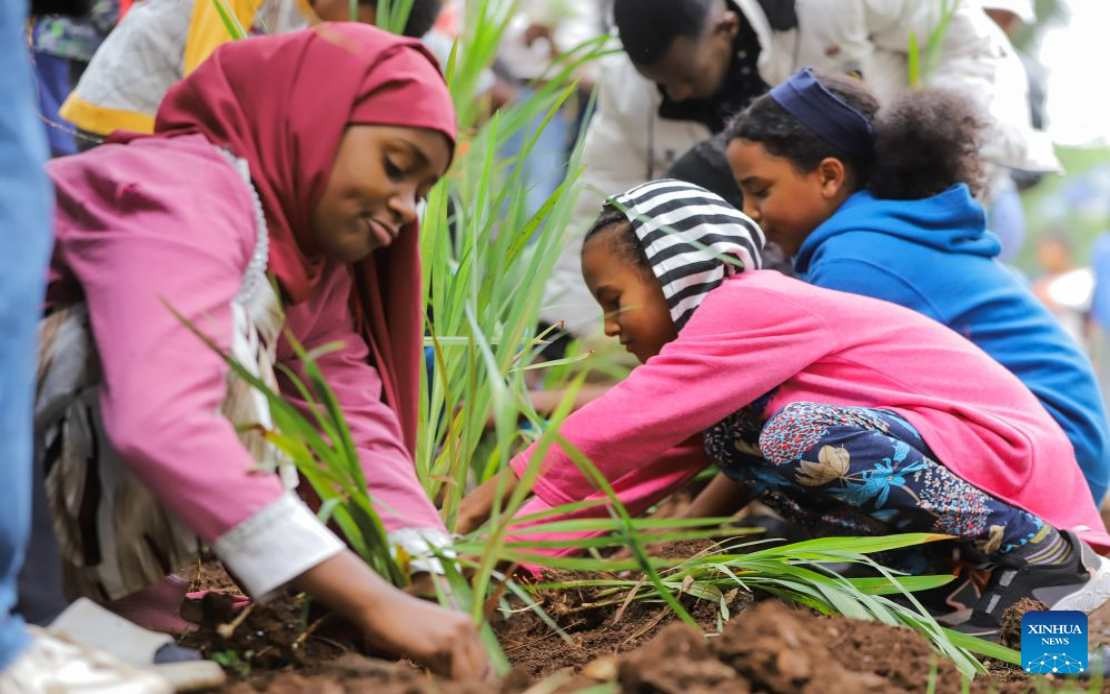
Ethiopia achieved an environmental milestone on Monday when millions of its citizens and foreign nationals participated in a coordinated nationwide tree-planting campaign designed to establish 800 million seedlings within a single 24-hour period. The event represents a dramatic escalation in the country's commitment to large-scale reforestation and positions Ethiopia among nations pursuing aggressive climate adaptation strategies through mass afforestation.
The coordinated effort forms the centrepiece of the Green Legacy Initiative, a government-backed programme initiated by Prime Minister Abiy Ahmed in 2019. This year's edition specifically targets the planting of more than 8 billion seedlings throughout Ethiopia's rainy season, with organisers confident the nation will surpass its overarching goal of establishing 50 billion trees since the initiative's inception. The ambition reflects recognition that reforestation remains among the most cost-effective mechanisms for addressing environmental degradation while simultaneously building climate resilience across the East African nation.
Participation spanned the entire social spectrum, from schoolchildren to healthcare workers and government officials. Edilawit Legesse, a thirteen-year-old from the Alembank neighbourhood on Addis Ababa's periphery, exemplified the grassroots engagement the campaign cultivates. For her third consecutive year, she joined family members and community neighbours in nurturing new seedlings, demonstrating how the initiative has embedded environmental stewardship into Ethiopian cultural practice across generations. Such intergenerational involvement suggests the programme's potential for creating lasting behavioural change regarding land management and conservation.
Professionals equally embraced the opportunity to contribute. Hewan Legesse, a nurse employed at a local hospital, coordinated with 34 colleagues to establish seedlings near Entoto Mountain within the capital. Individual commitment varied, with participants setting personal targets ranging from single digits to dozens of trees per person, yet collective action produced the extraordinary aggregate result. This decentralised model of contribution, wherein each participant adopts voluntary goals within a nationally coordinated framework, distributes responsibility while maintaining centrally organised momentum.
The Green Legacy Initiative has matured into Ethiopia's signature environmental policy, addressing multiple interconnected challenges simultaneously. Beyond simple carbon sequestration, the programme targets landscape restoration in regions where human activity and climate variability have eliminated forest cover over preceding decades. Reforestation efforts directly support biodiversity conservation, as restored landscapes create habitat corridors facilitating species movement and genetic exchange. The initiative simultaneously advances sustainable development objectives by creating employment opportunities in seedling nurseries, plantation establishment, and long-term forest management.
Prime Minister Abiy Ahmed framed the annual one-day campaign as a defining moment for Ethiopian national identity, characterising tree planting as an expression of collective purpose transcending sectarian and regional divisions. His remarks emphasised continuity, noting eight consecutive years of programme implementation and describing the initiative as increasingly embedded within public consciousness. Such political messaging serves functional purposes, reinforcing social acceptance for environmental policy while legitimising government action on climate matters among populations where alternative priorities compete for limited resources.
Ethiopia's environmental strategy carries particular significance for the broader Sub-Saharan region, where deforestation rates remain among the world's highest and climate vulnerability particularly acute. The nation's experience demonstrates that large-scale afforestation can be mobilised relatively rapidly when political commitment aligns with public participation frameworks. For Malaysia and other Southeast Asian nations wrestling with forest loss, Ethiopia's approach offers instructive elements regarding how government initiatives might be structured to achieve widespread participation while building social consensus around conservation objectives.
The economic dimension warrants scrutiny alongside environmental ambitions. Ethiopia's stated objective of constructing a green, lower-middle-income economy reflects recognition that environmental sustainability and economic development need not conflict. Expanded forest cover generates long-term economic value through carbon credit markets, timber production, watershed protection, and tourism development. Initial investments in seedling cultivation and plantation establishment create immediate employment, while mature forests generate sustained livelihoods decades forward. Such framing transforms environmental policy from a cost to be absorbed into an investment generating both ecological and economic returns.
Climate resilience represents perhaps the most urgent motivation driving the initiative. Ethiopia's vulnerability to drought, erratic precipitation patterns, and temperature fluctuations positions reforestation as defensive necessity alongside development opportunity. Trees moderate local climate conditions, increase soil water retention capacity, and reduce vulnerability to the extreme weather events becoming more frequent throughout the Horn of Africa. Communities across rural Ethiopia increasingly experience shortened rainy seasons and extended dry periods, making landscape restoration urgent for agricultural viability and pastoral livelihoods.
The logistics of establishing 800 million seedlings in one day necessitate extraordinary organisational infrastructure. Seedlings must be cultivated in advance through distributed nurseries, then distributed to planting sites across the nation's geography. Coordination requires functioning government mechanisms, community mobilisation capacity, and sufficient transport infrastructure to move materials efficiently. The successful execution suggests Ethiopia possesses administrative capacity exceeding that common across Sub-Saharan nations of comparable development status, potentially reflecting investment in institutional strengthening preceding the initiative's launch.
Sustainability of planted seedlings remains the critical unresolved question. While one-day campaigns generate impressive numerical achievements and public enthusiasm, survival rates determine actual environmental outcomes. Seedlings must be watered during establishment, protected from livestock browsing, and monitored for disease. Post-planting maintenance demands ongoing resource allocation and community vigilance extending years beyond the initial planting moment. Ethiopian officials have not publicly disclosed survival rate data, yet the success of any reforestation programme ultimately depends upon what proportion of seedlings become established trees rather than mortality tallies reported as success metrics.
For Southeast Asian environmental policymakers, Ethiopia's initiative provides both inspiration and caution. The demonstration that national governments can mobilise popular participation around conservation goals carries obvious appeal in regions where environmental degradation accelerates. Simultaneously, scepticism remains warranted regarding whether one-day campaigns addressing systemic deforestation drivers represent substantive policy or symbolic gesture. Effective reforestation requires parallel efforts constraining underlying drivers including agricultural expansion, logging, and infrastructure development. Ethiopia's commitment across these dimensions remains incompletely documented, suggesting the Green Legacy Initiative represents important but necessarily incomplete environmental strategy.

