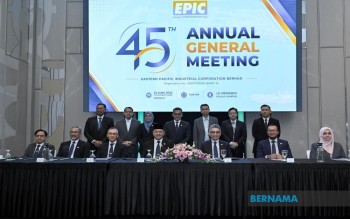
Eastern Pacific Industrial Corp Bhd (EPIC) has unveiled an ambitious five-year roadmap to transform itself into a significantly larger enterprise, targeting annual revenues of RM700 million alongside a net asset value of RM1 billion by 2030. The integrated oil and gas solutions provider announced the strategy after delivering record financial results for 2025, signalling strong momentum heading into a critical expansion phase. The outlined objectives represent substantial growth ambitions, with revenues projected to increase by roughly 70 percent from current levels, whilst the company seeks to strengthen its position across multiple revenue streams spanning hydrocarbon services, port management, and clean energy initiatives.
The Terengganu-based group reported a net profit of RM20.6 million for the year ended December 31, 2025, representing a 24 percent improvement compared to the prior year's RM16.6 million. This performance translated into record revenue of RM411.9 million, up from RM403.8 million previously, cementing what management describes as a consistent upward trajectory commencing from 2022. Group chief executive officer Dr Ts Muhtar Suhaili articulated confidence that the company has built sufficient momentum to sustain growth through the remainder of the decade, underpinned by a diversified portfolio of operations and strategic positioning within Malaysia's energy infrastructure landscape.
The 2025 performance gains originated from multiple operational drivers rather than reliance on a single revenue source. The acquisition of Rahar Niaga Sdn Bhd contributed substantially to the year's results, whilst newly secured contracts expanded the services EPIC could deliver to major clients. Specifically, the company secured the Pan Malaysia Maintenance, Commissioning and Modification and Hook-Up and Commissioning contract, reflecting growing confidence from major operators in EPIC's technical capabilities. Additionally, increased offshore rig arrivals and elevated cargo throughput volumes at facilities under the company's management provided incremental revenue contributions, demonstrating how integrated service provision across multiple infrastructure assets generates resilience.
Looking ahead to 2026, Suhaili indicated that the company expects another record-setting year, driven substantially by a robust contracted work pipeline. The group's approved contract value for its oil and gas division currently ranges between RM1.3 billion and RM1.5 billion, though actual revenue realisation depends on the timing of work orders and purchase orders issued by clients. This distinction carries significance for investors, as it reflects the difference between contractual frameworks and cash-generative activities. Nevertheless, the scale of contracted opportunities provides visibility into medium-term earnings potential and demonstrates strong client relationships spanning multiple regions and operators.
EPIC's geographical reach has expanded markedly beyond its traditional Terengganu operations. The company has successfully penetrated Malaysia's southern region, establishing footholds in Pengerang and Melaka, predominantly through partnerships with Petronas and associated entities. More significantly, the company recently extended its operations into Sabah, previously an underserved market for its service offerings. This geographical diversification reduces dependency on any single operational hub and positions EPIC as a genuinely national service provider capable of supporting Malaysia's dispersed energy infrastructure. The expansion strategy explicitly targets the broader Malaysian landscape whilst maintaining operational excellence at the group's core facilities.
Renewable energy represents a crucial pillar within EPIC's 2030 strategic vision, reflecting the broader energy transition underway in Malaysia and across Southeast Asia. The company is actively participating in competitive bidding for the hybrid hydro-solar project at Kenyir, a collaboration involving its parent company, Terengganu Inc. Success in such renewable projects would enable EPIC to diversify beyond traditional hydrocarbon services, positioning it advantageously as Malaysia's energy sector gradually rebalances toward cleaner generation sources. This initiative signals management's recognition that long-term sustainability requires evolution beyond conventional oil and gas operations, even as the company continues to service legacy energy infrastructure that will remain essential for decades.
International expansion constitutes another dimension of EPIC's 2030 strategy, though with measured ambitions reflecting geopolitical realities. The board has mandated management to pursue opportunities across neighbouring Asian markets, diversifying revenue sources beyond the Malaysian home market. Simultaneously, the company remains attentive to possibilities within West Asia, though explicitly acknowledging the prevailing geopolitical uncertainties characterising that region. This balanced approach seeks growth without excessive exposure to political volatility or regulatory unpredictability that might undermine earnings stability. The strategic direction indicates management's confidence in regional growth trajectories whilst maintaining prudent risk assessment.
A February 2025 collaboration between EPIC's subsidiary EPIC OG Sdn Bhd and Begas Energy Sdn Bhd exemplifies this regional expansion methodology. The partnership focuses on project management services for terminal turnaround, maintenance, and modification operations in Sabah, extending EPIC's capabilities into the eastern Malaysian states. Such collaborations enable EPIC to access new markets whilst leveraging established relationships and complementary expertise. The Sabah and Sarawak engagement represents a significant geographic shift for a company historically centred on peninsular operations, reflecting the board's commitment to becoming a truly integrated Malaysian service provider capable of supporting energy infrastructure across the nation's dispersed geography.
The company's strategic positioning reflects broader dynamics reshaping Malaysia's energy sector. As Malaysia navigates the transition toward renewable energy whilst maintaining substantial hydrocarbon production, service providers occupying the middle ground between conventional and emerging energy infrastructure command significant advantages. EPIC's diversified model spanning oil and gas services, port operations, and renewable energy positioning enables the company to serve clients across this transitional landscape. The RM700 million revenue and RM1 billion NAV targets, whilst ambitious, appear anchored to achievable operational milestones and realistic market conditions rather than speculative assumptions. With record 2025 results providing momentum and a robust contract pipeline supporting visibility into medium-term performance, EPIC exemplifies how Malaysian mid-cap companies can achieve substantial growth by combining operational excellence with strategic geographic and sectoral diversification.

