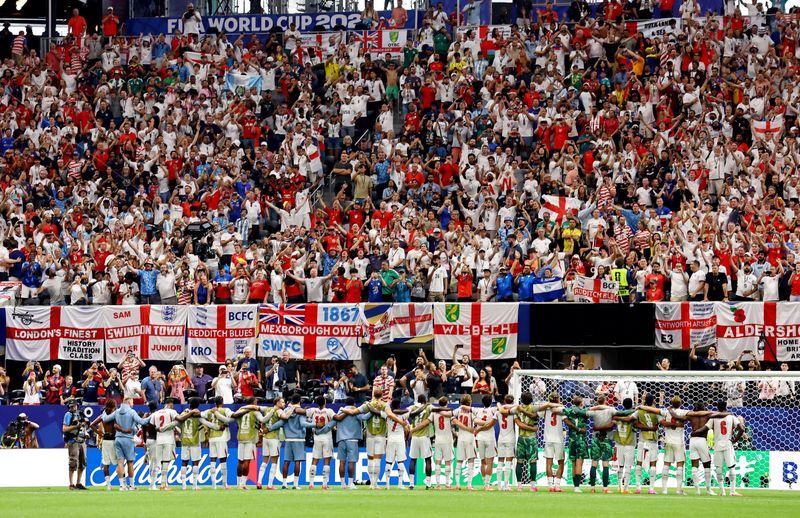
England's journey through the group stage had instilled cautious optimism following their opening victory over Croatia, yet inconsistency had begun gnawing at confidence as the team navigated unconvincing performances against Ghana and Panama. When the knockout rounds commenced on Wednesday in Atlanta, those lingering doubts crystallized into a full-blown crisis within the opening moments. DR Congo's Brian Cipenga's strike in the tenth minute handed the underdogs a shock lead and presented the Three Lions with a scenario they had never previously encountered in World Cup competition—trailing at any stage of the tournament, let alone at halftime.
The implications of England's position extended beyond the scoreline. The team's historical record revealed a troubling pattern: they had never recovered to win a World Cup match after surrendering a first-half advantage. Against a DR Congo side displaying remarkable defensive organization and determination, the mathematical and psychological dimensions of the deficit loomed large. The Congolese goalkeeper Lionel Mpasi had quickly become the focal point of English frustration, producing saves that seemed to defy geometry whenever the ball came into dangerous areas. Meanwhile, England's back line, already compromised by injury and exposed during the group phase, continued to hemorrhage defensive solidity under sustained Congolese pressure.
The atmosphere within Atlanta Stadium captured the precariousness of the moment. Supporters sat frozen, unable to channel nervous energy productively, while television cameras caught the visceral anxiety rippling through the English contingent. DR Congo had arrived in Atlanta not merely to participate but to compete with intensity and tactical discipline that forced England to confront uncomfortable truths about their defensive setup. Yoane Wissa's strike against the post shortly before halftime and the controversial refusal of a penalty appeal involving Harry Kane deepened the sense that the tournament script was conspiring against Thomas Tuchel's men. The interval arrived with England facing a mountain to climb and their World Cup ambitions genuinely imperiled.
Tuchel's adjustments following the restart proved instrumental in fundamentally altering the contest's trajectory. The introduction of Eberechi Eze provided midfield creativity that had been absent during the opening period, whilst the repositioning of Declan Rice to right back offered fresh defensive resources in critical areas. England began to construct sustained attacking sequences, with Jude Bellingham and other attacking players generating a succession of opportunities that tested Mpasi repeatedly. The Congolese keeper responded with a masterclass in shot-stopping, denying Bellingham on multiple occasions and thwarting desperate efforts from Marcus Rashford through a combination of reflexes and fortunate goal-line interventions.
The breakthrough arrived in the 75th minute through Kane's glancing header, a moment that released the accumulated tension within the stadium like a pressure valve giving way. The goal represented not merely an equalization but validation of Tuchel's belief in his team's capacity to impose themselves even when circumstances appeared darkest. Kane's second strike eleven minutes later secured passage to the round of 16 and completed England's escape from what had threatened to become a humiliating exit. The comeback victory carried particular historical resonance, marking the first time since England's quarter-final victory against Cameroon in 1990 that the team had come from behind to win a World Cup knockout match.
Tuchel's post-match analysis highlighted the psychological dimensions of the recovery, emphasizing that maintaining belief during adversity remained fundamental to progressing through knockout football. His comments reflected the reality that successive tournaments have repeatedly punished England for surrendering early advantages and failing to manage pressure situations effectively. The manager's visible frustration throughout the match—including moments where he vocally criticized individual players—underscored his awareness that the margin between elimination and progression had been wafer-thin. Nevertheless, the director's tactical interventions and the squad's resilience had ultimately overcome a genuine threat from opposition that had arrived in Atlanta with limited resources but maximum determination.
Kane's assessment of the challenge ahead introduced an additional layer of complexity to England's preparation. The striker acknowledged that the contest against DR Congo had fundamentally differed from what awaited against Mexico, highlighting that knockout football presents entirely distinct challenges depending on opposition approach and playing philosophy. Whilst England had spent ninety minutes attempting to breach a resolute Congolese defensive formation, Mexico's attacking tradition and pedigree suggested the forthcoming encounter would require different tactical and physical considerations. The statement reflected mature understanding of tournament progression, where teams cannot replicate solutions across successive matches but must instead adapt comprehensively to evolving circumstances.
Mexico City's elevation presents a practical consideration that extends beyond conventional match preparation concerns. The Azteca Stadium's location at more than 2,200 meters above sea level creates atmospheric conditions that directly impact physical performance and technical execution. The ball travels faster through thinner air, oxygen availability diminishes markedly, and players must physiologically adjust to conditions that many have encountered only in training environments if at all. For an England squad already tested mentally by their narrow escape against DR Congo, the environmental variables introduced by Mexico's altitude add another dimension to an already demanding fixture. The contrast between the suffocating tension of Atlanta and the atmospheric demands of Mexico City encapsulates the escalating difficulty levels inherent in World Cup progression.
England's passage beyond DR Congo demonstrated both vulnerability and resilience in equal measure. The defensive frailties that emerged during the group phase remained evident throughout Wednesday's encounter, suggesting that structural issues within the setup cannot be entirely resolved through tactical adjustments and half-time modifications. Yet the team's capacity to marshal greater attacking intent and convert opportunities when required also indicated capabilities that should concern Mexico ahead of their round-of-16 encounter. For Malaysian observers and Southeast Asian followers of international football, the match illustrated how tournament progression rewards not merely technical excellence but also psychological fortitude and adaptability when circumstances shift dramatically. England's survival against DR Congo has set up a genuinely intriguing knockout fixture that will substantially test whether this squad possesses the consistency required to challenge for World Cup honors.

