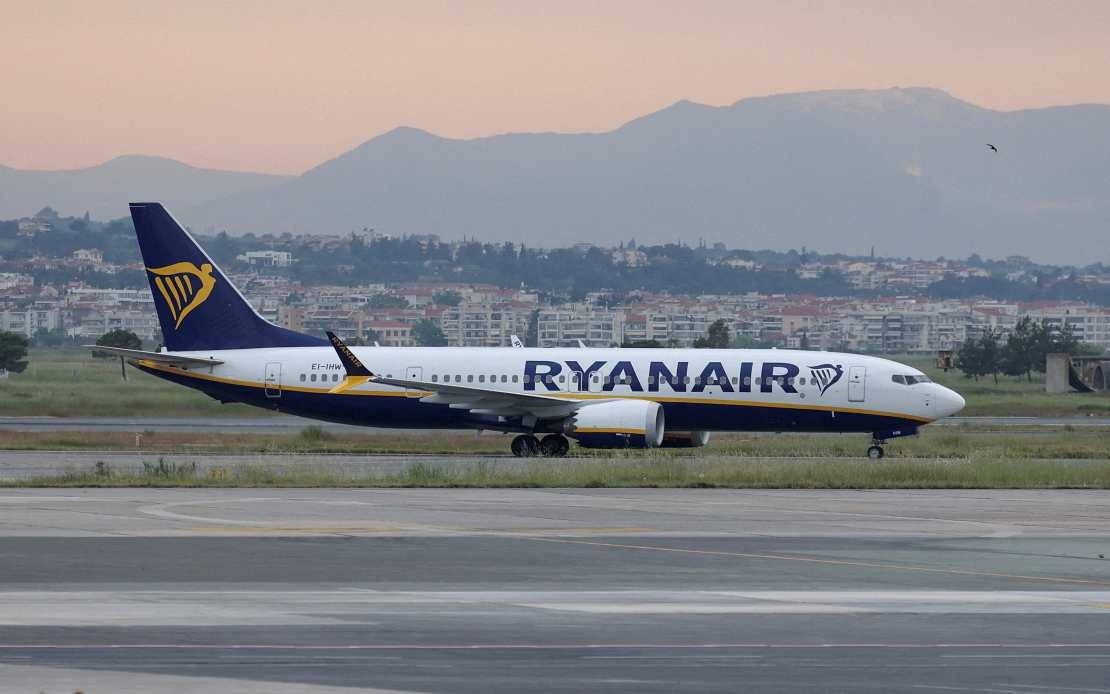
A catastrophic engine failure aboard a Ryanair service last month caused aircraft debris to breach the cabin and partially expel a passenger through a damaged window, according to findings released by aviation authorities on Thursday. The US National Transportation Safety Board documented the alarming incident, which occurred during the aircraft's climb after departing Thessaloniki International Airport in Greece en route to Munich. The investigation reveals the severity of modern aviation hazards and underscores how quickly life-threatening situations can unfold at altitude, even on routine European regional flights that Malaysian travellers frequently use when transiting through European hubs.
The incident involved a Malta Air aircraft operating under the Ryanair brand, which experienced a fan blade separation in its right engine shortly after take-off. This structural failure triggered a catastrophic sequence of events: the separated fan blade fragmented, sending sharp metal pieces violently through the pressurised fuselage at high velocity. The damage path extended across multiple areas of the aircraft, including penetration through the passenger cabin window at row 11 and breaches in the lower fuselage skin located behind the right wing-to-body fairing. Such structural penetrations at cruising altitude represent a critical emergency situation, as the pressurised cabin environment begins to equalise with the external atmosphere, creating sudden decompression effects.
The passenger seated at window position 11F experienced the full force of this decompression event. According to the NTSB report, the occupant became partially wedged in the damaged window frame as the pressure differential attempted to eject them from the aircraft. This phenomenon, while rare in modern aviation, represents one of aviation's most terrifying scenarios. However, the swift action of nearby passengers prevented a fatal outcome. Fellow travellers managed to physically restrain and pull the passenger back into the cabin, demonstrating the unpredictable nature of in-flight emergencies and how human intervention can override catastrophic circumstances that safety systems alone might not prevent.
Investigators uncovered additional evidence pointing toward bird strike as the probable trigger for the fan blade failure. Multiple bird remains, including feathers, were discovered embedded in various engine components following examination. Bird ingestion events represent a persistent hazard in aviation, particularly during take-off and landing phases when aircraft operate at lower altitudes through airspace shared with wildlife. While modern engines undergo rigorous bird-strike certification testing, larger birds or unexpected multiple ingestions can occasionally exceed design parameters. This finding carries particular relevance for Southeast Asian operators, where regional routes often traverse areas with significant bird populations, especially during migration seasons.
The consequences could have been substantially more severe. The passenger sustained injuries from the incident, though the NTSB report did not specify the extent or nature of the trauma. In rapid decompression events, passengers face risks including explosive decompression injuries, hypoxia, and the mechanical trauma of partial ejection. The fact that fellow passengers succeeded in rescue efforts prevented what could have been a fatal outcome. The aircraft itself, despite the structural damage and physiological stress on occupants, managed to maintain sufficient integrity for the crew to execute an emergency return to Thessaloniki International Airport, where emergency response personnel were standing by.
The investigation's findings raise questions about engine containment standards and cabin window structural design. Commercial aircraft windows undergo extensive testing to withstand pressurisation loads and external impacts, yet engine debris travelling at extreme velocity presents a unique challenge. Modern turbofan engines incorporate containment rings designed to prevent fan blade fragments from exiting the engine casing, but this protective system evidently failed or was overwhelmed in this instance. For Malaysian passengers and regional operators, the incident underscores the importance of adhering to maintenance schedules and engine inspection protocols, particularly for airlines operating older or heavily-utilised fleets.
Ryanair operates one of Europe's largest low-cost networks, carrying millions of passengers annually on regional routes throughout the continent. The airline's aggressive expansion and high aircraft utilisation rates have occasionally drawn scrutiny from safety advocates, though the carrier maintains accident and serious incident rates consistent with European aviation industry standards. This particular event, while serious, was successfully managed through a combination of aircraft design features, crew training, and passenger response. The rapid return to Thessaloniki allowed medical personnel to treat the injured passenger and prevented the situation from deteriorating into an emergency at cruising altitude far from diversion airports.
The broader implications for aviation safety focus on the intersection of mechanical reliability and human factors. Engine failures remain statistically rare events, particularly single-engine failures on twin-engine aircraft, thanks to decades of engineering refinement and regulatory oversight. However, the investigation demonstrates that even with redundant systems and advanced monitoring, unexpected failures can occur. For Southeast Asian carriers operating similar aircraft types on comparable regional routes, the case study offers valuable lessons regarding emergency response training, cabin crew procedures, and the critical importance of swift passenger communication during in-flight crises.
The incident also highlights the evolving nature of aviation risk management. Modern commercial aviation has achieved remarkable safety records through systematic elimination of common failure modes, meaning that remaining accidents and serious incidents often involve rare combinations of circumstances or novel failure mechanisms. Bird strikes, while documented threats, rarely propagate into serious incidents given modern engine design. When they do, the consequences cascade rapidly, leaving crews minimal time to diagnose and respond. The Ryanair incident exemplifies this reality and reinforces why aviation authorities worldwide maintain rigorous investigation standards and information-sharing protocols that allow the global aviation community to learn from individual events.
Looking forward, the investigation findings will likely inform ongoing discussions about engine certification standards, particularly regarding bird strike resistance and fragment containment. Aviation regulators, including those governing Southeast Asian carriers, monitor such investigations closely and may incorporate findings into maintenance directives or operational procedures. For passengers, the incident offers both reassurance and perspective: while flying remains statistically safer than driving, rare emergencies do occur, and aircraft design and crew training are specifically engineered to manage them. The successful rescue of the passenger at row 11F, enabled by fellow travellers' quick thinking and the aircraft's structural integrity, demonstrates that modern aviation safety systems operate across multiple layers, with human intervention remaining a crucial final safeguard when mechanical systems face unprecedented stresses.

