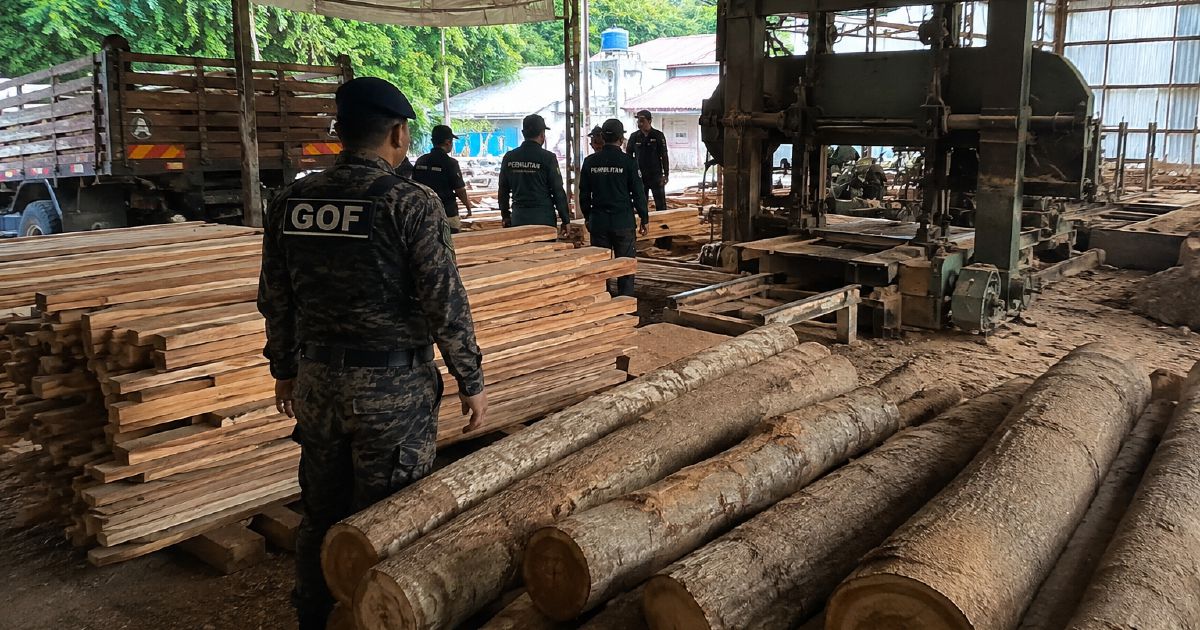
The General Operations Force has targeted an unlicensed timber-processing facility in Kuala Berang, Terengganu, in a crackdown on illegal forest-product operations. The single-day operation yielded the confiscation of timber stocks and industrial machinery collectively valued at RM640,510, alongside the arrest of a 20-year-old man at the site. The enforcement action underscores the persistent challenge facing Malaysian authorities in combating unauthorised timber harvesting and processing, particularly in Terengganu and other timber-rich states along the Peninsula's east coast.
Unlicensed sawmill operations represent a significant legal and environmental concern throughout Malaysia. Beyond the direct loss of government revenue from unpermitted timber processing, such facilities often operate without the safety certifications, pollution controls, and forest management compliance protocols mandated for legitimate operators. Workers in informal settings face heightened injury risks, whilst unregulated discharge of sawmill waste—including bark, dust, and processing liquids—can contaminate local waterways and degrade riparian ecosystems that many rural communities depend upon for water supplies and fishing livelihoods.
Terengganu's prominence in this particular enforcement action reflects the state's historic role as a major timber-producing region. The east coast state has long grappled with balancing legitimate commercial forestry interests against unlicensed extraction and processing operations that undercut licensed competitors and circumvent environmental safeguards. The frequency of such raids suggests that porous border controls, dispersed settlement patterns across forested areas, and the relative ease of establishing rudimentary processing equipment have made Terengganu an attractive base for informal timber operators seeking to evade regulatory oversight.
The monetary value of assets seized—RM640,510—provides a tangible measure of the operational scale involved, though it likely understates the economic losses incurred through illegal processing across the state. Processing equipment capable of producing finished or semi-finished timber products for domestic or export markets represents substantial capital investment. Authorities' ability to quantify and publicise such seizures serves both as a deterrent to would-be operators and as evidence to the broader public of enforcement momentum, though persistent recurrence suggests that penalties and confiscation alone may not suffice to eliminate the phenomenon entirely.
The arrest of a 20-year-old individual raises questions about labour dynamics within informal timber operations. Young workers, often lacking formal employment history or educational credentials, may find such operations accessible sources of income despite their legal and safety risks. Understanding whether the detainee acted as owner, manager, or labourer—and whether additional individuals remain involved with the facility—becomes relevant both to prosecution strategy and to assessing the operation's broader network of supply chains and distribution contacts.
Malaysia's timber enforcement framework involves multiple agencies operating at federal, state, and local levels. The General Operations Force, traditionally focused on internal security and counter-insurgency, has in recent years been increasingly deployed for natural-resource law enforcement, including timber and wildlife protection operations. This diversification reflects both the perceived gravity of forest-resource crimes and resource constraints within more specialised forest-management agencies, suggesting institutional adaptation to evolving security priorities.
The Kuala Berang operation fits within a broader pattern of enforcement activity across Peninsular Malaysia's timber-producing regions. Perlis, Kedah, and Pahang have similarly seen periodic seizures and arrests linked to unlicensed logging and sawmill operations. Regional variation in enforcement intensity sometimes reflects shifting political priorities, funding allocation, and co-operation levels between state governments and federal agencies. For operators and communities in timber-dependent localities, such variability creates uncertainty around which violations authorities will aggressively pursue in any given month or year.
From a trade perspective, illegal timber processing affects both domestic and export markets. Unregulated operators can undercut licensed mills on price, potentially distorting market conditions for legitimate businesses investing in compliance infrastructure and certification systems. If finished products from illegal mills enter export channels—whether shipped regionally through Southeast Asian ports or further afield—they may contravene timber certification requirements demanded by developed-market importers, thereby tarnishing Malaysia's reputation for regulated forest commerce and complicating legitimate exporters' market access.
The confiscated material itself becomes subject to government disposition procedures, which vary by state and the specific origin of the timber. Some seized stocks may be auctioned to licensed processors or sold to government agencies, whilst other material may be used for public purposes such as infrastructure repair or community development projects. Transparency in how confiscated assets are managed remains important for public confidence that enforcement efforts generate tangible public benefit rather than disappearing into administrative channels.
Moving forward, sustaining timber law enforcement against unlicensed operations will require sustained investment in field patrols, intelligence networks, and inter-agency co-ordination. Technology adoption—including satellite monitoring of forest areas, GPS tracking of timber movements, and data analytics to identify suspicious supply patterns—could complement traditional inspection methods. Enhanced penalties and prosecution rates may amplify deterrence, particularly if publicised outcomes reach communities considering engagement in the informal timber economy.

