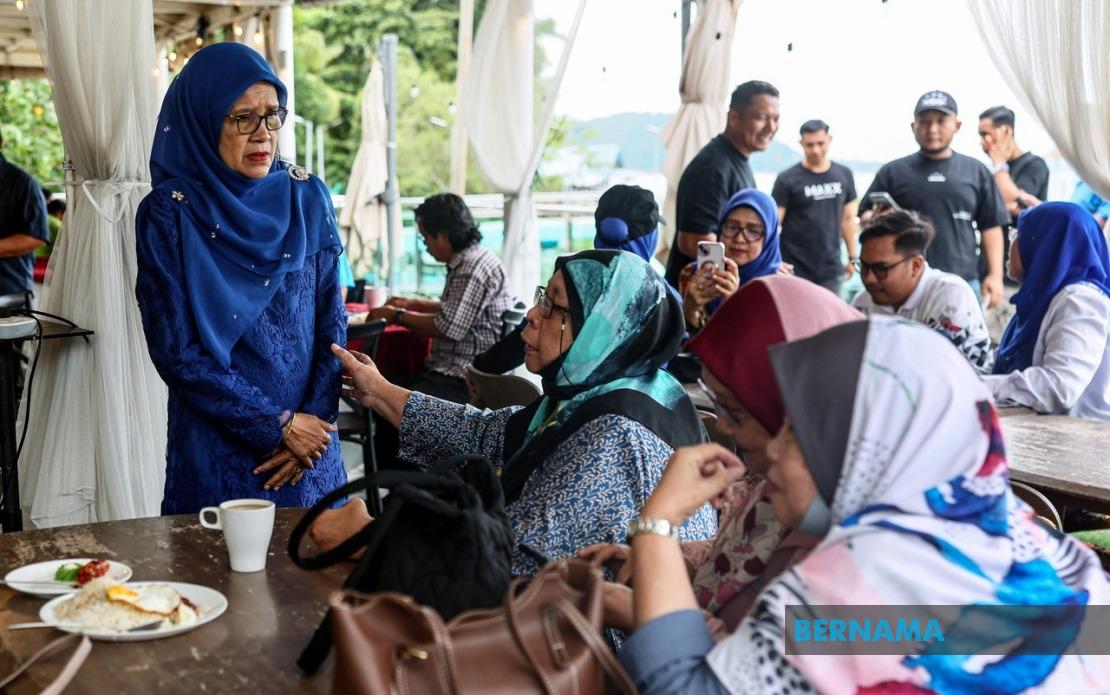
The Endau state constituency is emerging as a microcosm of competing visions for rural development in Johor, where voters must weigh the tangible achievements of an incumbent against the intellectual framework of a reform-minded challenger. Alwiyah Talib, the Barisan Nasional incumbent widely known as Kak Awi, stands for incremental advancement built on her two terms of service, while Pakatan Harapan's Saiful Nizam Samat, a 42-year-old economist pursuing doctoral studies, represents a more systemic reimagining of how constituencies like Endau can tackle structural challenges in fisheries, agriculture and education. The four-way contest also includes Perikatan Nasional's Hasnul Hakimi Hussien and Parti Orang Asli Malaysia candidate Jati Awang, though the race appears centred on the BN-PH dynamic.
Alwiyah's campaign rests solidly on the foundation of visible progress. She emphasises that her previous work has identified and begun exploiting Endau's latent potential in inland tourism, a sector her analysis suggests has been overshadowed by the constituency's reputation as merely a transit hub to island destinations. Her strategic focus on homestay development in locations like Kampung Stay@Teluk Buih, Penyabong and Tanjung Resang reflects a granular understanding of where tourism infrastructure already generates weekend occupancy rates approaching saturation. Rather than pursuing flashy megaprojects, she is channelling resources into upgrading the perception and positioning of lesser-known spots such as Pulau Mawar, Pantai Air Papan and Teluk Gorek as sustainable hospitality destinations. This approach would leverage existing visitor flows while distributing economic benefits more widely across the constituency.
The incumbent's education agenda addresses what she identifies as a critical bottleneck in the local schooling landscape. Endau currently relies on a single secondary institution, Sekolah Menengah Kebangsaan Ungku Husin, to serve all upper secondary students in the area. Alwiyah's commitment to constructing a second secondary school in Pekan Endau responds to genuine capacity constraints, though the timeline and funding certainty for such a project remain subjects that voters will scrutinise. Her broader educational philosophy stresses ensuring that development benefits flow across all levels, from primary through tertiary education, suggesting an awareness that rural constituencies often experience education gaps that perpetuate generational inequality. This incremental approach to addressing infrastructure deficits has allowed her to position herself as a custodian of sustained progress rather than a proponent of radical change.
Saiful Nizam enters the contest with a markedly different intellectual posture. His doctorate in economics provides him with a framework for systemic analysis, and his campaign platform explicitly signals this orientation through its emphasis on interconnected policy areas rather than isolated projects. The centrepiece of his economic vision is the 'Fishermen's Economy 2.0' agenda, which moves beyond traditional fisher welfare schemes to position the fishing sector as an engine for broader economic multiplier effects. His theory holds that strengthening fishery incomes and practices creates spillover benefits for suppliers, processors and service providers in surrounding communities, thereby generating employment opportunities that might otherwise drive youth migration to urban centres. This logic mirrors economic development thinking that has gained traction in Southeast Asian policy circles, where the goal is to create resilient local economies rather than manage the symptoms of rural decline.
The reform candidate's educational strategy diverges fundamentally from Alwiyah's infrastructure focus. Rather than proposing a new school building, Saiful Nizam is advocating for skills-based interventions including Technical and Vocational Education and Training, STEM programmes and English language training designed to improve employability and competitiveness in modern labour markets. He also proposes an Endau Children's Education Fund to provide means-tested financial assistance, addressing the reality that infrastructure alone cannot ensure equitable access to education in communities where household poverty remains a significant barrier. These measures reflect a view that the education challenge in rural constituencies is less about supply of classroom space and more about equipping students with skills and removing financial obstacles to progression.
Youth retention emerges as a unifying concern across both campaigns, though they prescribe different remedies. Alwiyah's tourism and education developments are framed as creating local opportunities that might reduce the incentive to migrate. Saiful Nizam's approach is more direct: his 'Fishermen's Economy 2.0' scheme and SME empowerment initiatives explicitly target the problem that young people leave rural areas because viable livelihoods do not exist locally. Both candidates recognise that Endau, like many rural Malaysian constituencies, faces demographic challenges as younger residents relocate to cities for employment. The election in some sense becomes a referendum on whether incremental improvements to existing economic structures or fundamental restructuring of livelihood systems offers the more credible path to reversing this trend.
The food security dimension of Saiful Nizam's platform addresses another gap that development-focused discourse often overlooks. His advocacy for modern farming methods connects to Malaysia's broader strategic interest in reducing import dependency and strengthening agricultural productivity. For Endau specifically, this could mean introducing aquaculture innovations, precision farming techniques or value-added agricultural processing that transforms primary production into higher-margin goods. This framing positions agricultural development not as a nostalgic return to traditional livelihoods but as a modernisation imperative aligned with national food security objectives. Alwiyah's campaign does not explicitly address agricultural productivity, instead anchoring Endau's future more fully in tourism and service sectors.
Infrastructure advocacy spans both campaigns but with different priorities. Saiful Nizam commits to elevating concerns around roads, fishing facilities and broadband internet connectivity to relevant federal and state agencies, suggesting a brokerage role rather than direct project implementation. This positioning acknowledges the reality that state assembly members operate within a system where budget allocation and strategic direction often flow through ministerial channels. Alwiyah's more concrete school-building commitment reflects confidence that her political standing and longevity will translate into resource access. Both approaches carry inherent risks: Saiful Nizam's advocacy model could produce symbolic action without material change, while Alwiyah's reliance on project delivery depends on sustained political favour and adequate appropriations.
Alwiyah's political journey itself constitutes part of her campaign narrative. She initially won the Endau seat under the Perikatan Nasional banner in 2022 before rejoining Barisan Nasional, a transition that her opponents will likely use to question consistency and party loyalty. She has characterised electoral contests as demanding battles requiring sincerity without hypocrisy, a framing that implicitly acknowledges the political fluidity of recent Malaysian politics and perhaps signals her awareness that maintaining voter trust requires demonstrating commitment rather than merely reciting promises. This self-reflexivity distinguishes her from candidates who present unblemished narratives.
The Endau contest occurs within the broader Johor state election framework, where 172 candidates are contesting 56 seats on July 11, with early voting on July 7. The 28,767 registered voters in Endau represent a medium-sized constituency, neither a marginal seat nor a safe stronghold, suggesting that campaign intensity and voter engagement will likely determine the outcome. The composition of the electorate—divided between urban and rural settlement patterns, with economic bases spanning tourism, fishing and agriculture—creates a microcosm where competing developmental philosophies can be tested. The four-way nature of the contest introduces additional complexity, as second-preference voting patterns and potential tactical voting could materialise.
For Malaysian observers, the Endau election offers a window into how rural constituencies are responding to the tension between consolidation and reform. Tourism-led development models like Alwiyah's reflect a particular vision of rural modernisation that has gained traction across Southeast Asia, premised on leveraging natural and cultural assets for hospitality revenues. Saiful Nizam's framework, by contrast, emphasises economic restructuring and skills development as preconditions for sustainable livelihoods. Neither candidate is proposing industrial development or large-scale infrastructure projects; instead, both operate within the constraints of what modern rural economies can realistically offer. The Endau voters' choice will signal whether constituencies facing outmigration and economic stagnation prioritise deepening existing sectors or fundamentally reconfiguring their economic base. This dynamic will likely echo in rural constituencies across Malaysia as development pressures intensify and younger populations continue evaluating whether remaining in their home communities offers viable futures.

