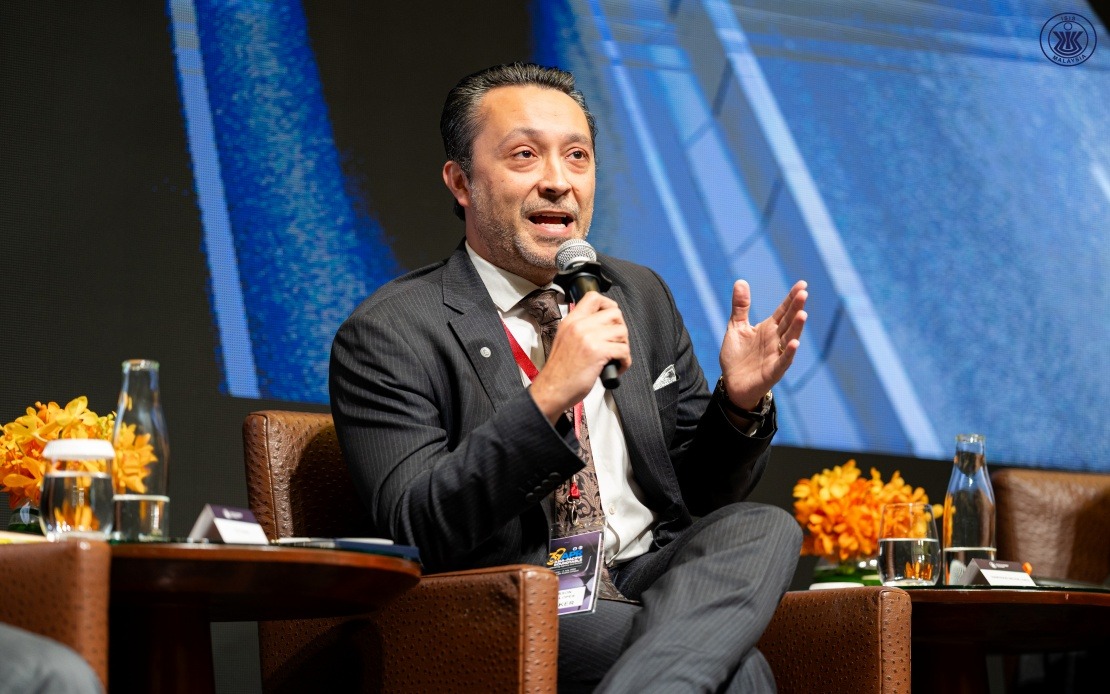
The international system that has dominated global affairs since 1945 is undergoing fundamental transformation, creating both risks and opportunities for emerging economies across the developing world. At the 39th Asia-Pacific Roundtable in Kuala Lumpur, leading scholars and policy experts warned that countries like Malaysia, Brazil, India, Indonesia, Turkiye, and Mexico face a critical choice in how they navigate this period of systemic change. Rather than deferring to the preferences of established middle powers or attempting to preserve a system that has never fully served their interests, these rising economies should instead assert their own strategic priorities and leverage newfound institutional platforms that offer genuine alternatives.
Dr Dawisson Belém-Lopes, a professor of international and comparative politics at Federal University of Minas Gerais in Brazil, challenged the notion that all middle powers share common interests or should be treated as a cohesive bloc. His intervention at the roundtable session titled "Rogue World Order: Power, Principles, and Pragmatism" underscored a fundamental reality often overlooked in international relations scholarship: emerging and established middle powers occupy vastly different positions within the global hierarchy and possess distinct historical grievances. Countries from the Global South have harboured long-standing dissatisfaction with the architecture of the post-war liberal international order, viewing it as a structure designed to perpetuate Western dominance while constraining their own development trajectories. This discontent is not merely rhetorical; it reflects decades of experience with institutions and rules that have frequently worked against the interests of developing nations.
Belém-Lopes emphasised that emerging middle powers cannot simply adopt the agenda of their established counterparts because their underlying political realities differ fundamentally. These nations carry distinct historical experiences shaped by colonialism, post-colonial development challenges, and asymmetrical integration into global markets. Brazil's experience in regional diplomacy differs markedly from that of countries like Germany or Canada, just as Indonesia's security concerns in Southeast Asia cannot be directly mapped onto those of Australia or New Zealand. The diversity of priorities among Global South powers—ranging from infrastructure development needs to resource sovereignty to technological sovereignty—means that no single strategy can serve all their interests equally. Recognising this heterogeneity is essential for these countries to develop coherent policies rather than allowing themselves to be divided or manipulated through appeals to spurious unity.
A significant shift appears underway in the material conditions underpinning Global South diplomacy. Belém-Lopes noted that emerging economies now possess greater resources and have developed institutional platforms previously unavailable to them. The expansion of forums such as BRICS, the African Union, the Association of Southeast Asian Nations, and various regional development banks represents a tangible expansion of strategic optionality. Malaysia itself has witnessed the benefits of participating in multiple institutional frameworks—from ASEAN mechanisms to regional forums to the broader developing world caucuses. These platforms provide channels through which countries can coordinate positions, pool resources, and negotiate with established powers from positions of greater collective strength than would be available to them individually.
Peter Varghese, former secretary of Australia's Department of Foreign Affairs and Trade and current Chancellor of the University of Queensland, offered a complementary perspective by characterising the contemporary moment as a transitional period in which the existing post-war order has begun unravelling while a replacement system has not yet crystallised. The retreat of American leadership from its traditionally hegemonic role is not merely a function of current political choices in Washington, he suggested, but reflects deeper structural shifts that any future administration will struggle to reverse. The economic ascendancy of China, the redistribution of technological capabilities, and the emergence of genuine multipolarity in various domains have created conditions in which no single power can dictate terms to the international system as the United States once did. Simultaneously, the erosion of the Washington Consensus—the policy framework that prescribed liberalisation and privatisation for developing economies—has opened intellectual space for alternatives that better reflect diverse national contexts.
Varghese cautioned, however, that the absence of clear hierarchical order need not produce a more equitable system. The period between established orders often witnesses instability, miscalculation, and conflict as multiple powers jostle for advantage. Building effective multilateral institutions capable of managing collective action problems requires not merely the exercise of agency by individual countries but sustained diplomatic labour and genuine commitment to cooperative frameworks. The challenge for emerging powers lies in constructing regional and cross-regional cooperative mechanisms that do not simply mirror the hierarchies and exclusions of the existing order. Malaysia's experience within ASEAN provides one model for how middle powers can coordinate to preserve space for manoeuvre, though expanded mechanisms will be necessary to address global-scale challenges including climate transition, pandemic preparedness, and technological governance.
Professor Ken Jimbo of Keio University in Japan injected an important regional dimension into these discussions, emphasising that Asia will remain central to the evolving global order despite significant shifts in the orientation and capacity of American foreign policy. Even under frameworks prioritising national interest, the United States will likely continue to depend on regional partnerships to project influence and advance strategic objectives in the Indo-Pacific. This dynamic creates leverage for countries like Japan, South Korea, the Philippines, and others in the region who retain security partnerships with Washington. For non-aligned or more independent nations like Malaysia and Indonesia, this situation presents opportunities to extract concessions from multiple great powers competing for influence rather than facing pressure to choose permanent allegiances.
The significance of these expert observations extends beyond academic analysis. Malaysia sits at the intersection of multiple great power competitions and institutional frameworks. The country maintains significant stakes in freedom of navigation through the South China Sea, the preservation of multilateral institutions including ASEAN, and the successful management of economic transitions including decarbonisation. By asserting its own interests rather than deferring to established middle powers or aligned with any particular great power bloc, Malaysia can maximise its influence over outcomes that directly affect its citizens. This requires clarity about Malaysian interests—what trade arrangements best serve domestic development, which security arrangements genuinely enhance regional stability, which institutional frameworks provide genuine voice for Southeast Asian concerns.
The practical implications of pursuing independent strategic courses become apparent when examining specific policy domains. Climate transition financing, digital technology governance, and supply chain resilience all present areas where emerging powers have distinct interests that may diverge from both Western preferences and Chinese priorities. Malaysia's position as a significant producer and consumer of advanced materials, as a major Southeast Asian trading hub, and as a nation vulnerable to climate impacts creates policy space for autonomous action. Rather than accepting prescriptions from established powers, Malaysian policymakers can leverage their position to shape outcomes aligned with genuine national interests—whether that involves negotiating differential responsibilities in climate commitments, preserving policy space for industrial development, or securing fair terms for technology transfer.
The transformation in global order ultimately depends not on the acquiescence of emerging powers to predetermined outcomes but on their active participation in constructing new frameworks. The 39th Asia-Pacific Roundtable itself exemplifies how institutions like ISIS Malaysia contribute to this process by convening diverse perspectives and enabling rigorous debate about strategic alternatives. As the international system continues its transition, countries from the Global South possess unprecedented opportunities to shape emerging institutions and norms—provided they maintain strategic clarity and resist fragmentation. For Malaysia and comparable emerging powers, the imperative is clear: assert your own interests, leverage available institutional platforms, and engage in genuine coalition-building based on shared concerns rather than subordination to others' agendas.

