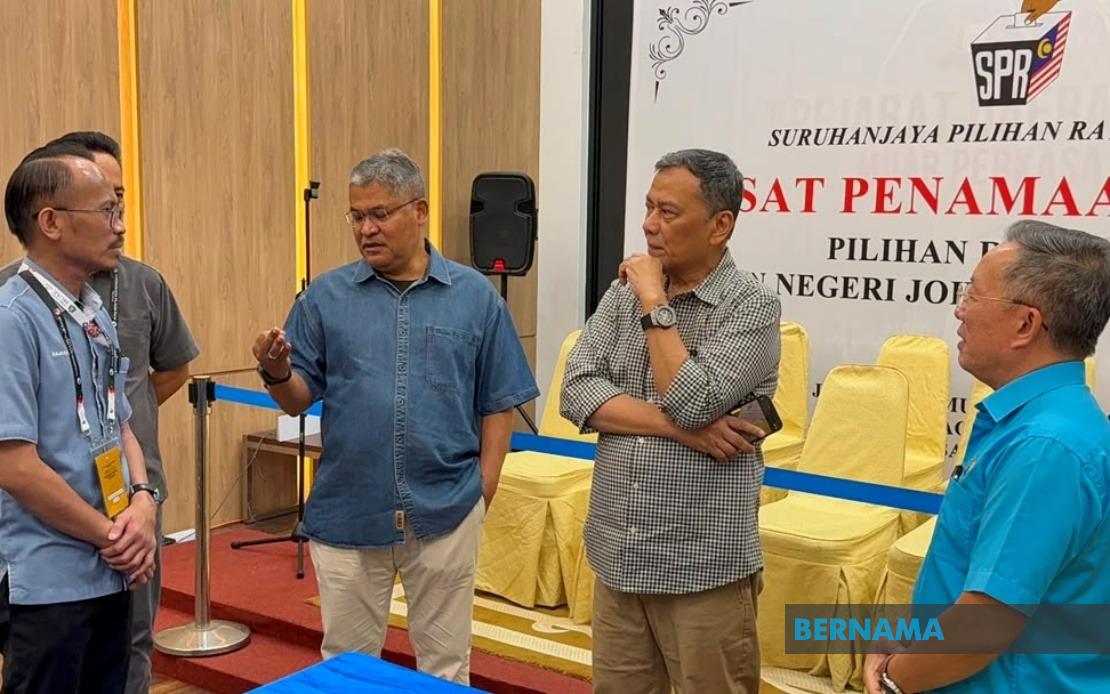
The Election Commission is putting the finishing touches on its preparations for tomorrow's nomination proceedings in the Johor state election, with returning officers confirming that all candidate nomination centres are operationally ready. A survey conducted across multiple nomination centres in Johor Bahru revealed that technical preparations are largely complete, though some final administrative work continues at various locations. The electoral authority is aiming for a seamless nomination day that will launch the formal campaign phase of what promises to be a closely watched state poll in Malaysia's southern region.
At the Perling state constituency nomination centre housed in Dewan Jubli Intan Hall, returning officer Nazatul Shima Mohamad expressed confidence that all systems are in place for tomorrow's proceedings. She emphasised that venue layouts have been finalised and simulation exercises conducted with all participating agencies have been completed, indicating a comprehensive dress rehearsal of tomorrow's operations. The returning officer's statement underscored the collaborative effort between the Election Commission and other government bodies working to ensure procedural efficiency. Her message to prospective candidates stressed the importance of arriving early, bringing identification documents, and having their nomination deposit money ready—practical reminders that could prevent delays or complications during the nomination process.
Security and crowd management have emerged as central considerations in the final planning stages, particularly given expectations that candidate supporters will congregate at nomination centres. The Kota Iskandar nomination centre, located at the Iskandar Puteri City Council's Main Hall in Medini, exemplifies the comprehensive security framework being implemented. Returning officer Shahrulizam Abdul Rashid outlined a multi-layered approach involving police coordination to manage the anticipated gatherings of party supporters. The arrangements include tactical road closures around each nomination centre, a 50-metre buffer zone restricting supporter access to the immediate vicinity of the venue, temporary tent structures positioned outside nomination halls, and physical barriers designed to segregate supporters of competing parties.
These security measures reflect lessons learned from previous Malaysian elections where nomination days occasionally witnessed heated confrontations between rival party factions. The establishment of physical separation zones represents a deliberate strategy to prevent direct contact between opposing supporters while permitting legitimate campaign presence and civic participation. The Election Commission's emphasis on maintaining order during the nomination process carries significance beyond mere procedural administration—it sets the tone for the broader campaign period and demonstrates the electoral authority's commitment to managing competitive political activity within orderly parameters. Public advisories urging supporters to exercise restraint and avoid provocative behaviour suggest awareness that nomination day's atmosphere could influence public perceptions of the election's legitimacy.
The scope of tomorrow's nomination proceedings is substantial, involving 2,727,926 registered voters across the state. This electorate comprises 2,703,175 ordinary voters alongside 12,041 military personnel and their spouses, and 12,710 police personnel and their spouses. The inclusion of security force votes reflects Malaysia's constitutional provisions permitting military and police participation in state-level elections, a feature that distinguishes Malaysian electoral practice from some regional counterparts. The large voter base underscores why meticulous preparation of nomination procedures matters—any confusion or administrative breakdown on nomination day could reverberate throughout the subsequent campaign period and potentially affect public confidence in the electoral process itself.
Nomination proceedings will unfold across 56 designated centres, with the nomination window running from 9 to 10 am tomorrow morning. This concentrated two-hour window requires precise coordination across multiple venues to prevent bottlenecks while allowing sufficient time for proper documentation and verification of each nomination. The Election Commission's decision to conduct nominations simultaneously across all centres reflects a standardised approach that prevents any locality from gaining procedural advantages. Following the completion of nominations, returning officers will make official announcements confirming which candidates are eligible to contest, effectively determining the final composition of candidate pools across all state constituencies.
The timeline established for the Johor state election reflects the constitutional and procedural frameworks governing state electoral contests in Malaysia. The State Legislative Assembly was dissolved on June 1, triggering the election sequence. Tomorrow's nomination day marks the formal commencement of the candidate selection phase, followed by early voting scheduled for July 7 and the main polling day on July 11. This timeline provides approximately two weeks for campaigning between nomination day and the polling date, a window considered standard for state-level elections in Malaysia. The compressed timeframe requires candidates and parties to mobilise rapidly after tomorrow's nominations are confirmed.
For Malaysian observers and participants following the Johor election, tomorrow's nomination proceedings carry broader significance beyond the immediate state context. Johor remains Malaysia's second-largest state by population and an economically important region encompassing the manufacturing and services sectors. Electoral outcomes in the state have historically influenced national political calculations, as state government composition can affect federal-state relations and shape broader political coalitions. The conduct of tomorrow's nomination day—its orderliness, efficiency, and legitimacy in the eyes of all participants—may influence how smoothly subsequent election phases proceed and how comprehensively electoral results are ultimately accepted.
The Election Commission's completion of physical and logistical preparations addresses only one dimension of electoral readiness; the enthusiasm and discipline of candidates, parties, and supporters will determine whether tomorrow actualises the smooth process that returning officers envision. The messaging from election officials balances firmness about procedural requirements with appeals to civic responsibility. By publicly confirming that all systems are prepared while simultaneously reminding candidates about documentation needs and appealing to supporters to maintain composure, the Election Commission is attempting to establish mutual accountability where officials, candidates, and citizens all recognise their roles in producing a credible electoral event. The test of these preparations comes tomorrow when thousands of candidates, supporters, and observers converge at 56 nomination centres across Johor.

