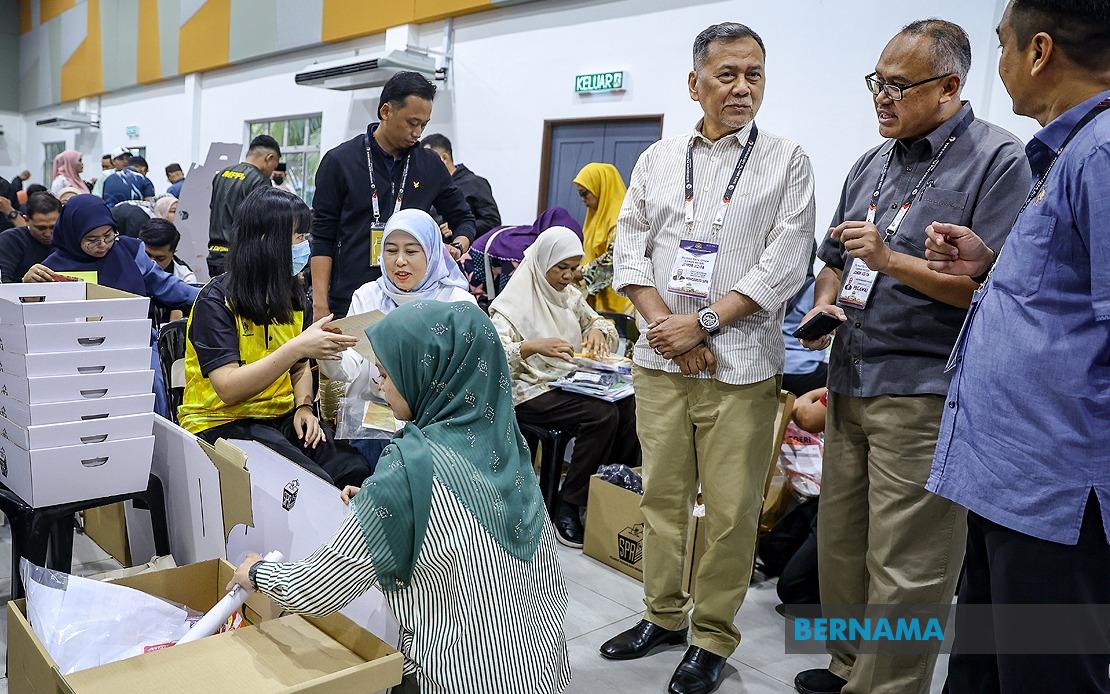
The Election Commission has completed its final round of preparations across Johor, with personnel at all 56 state constituency polling centres and vote-tallying stations putting finishing touches to facilities ahead of tomorrow's 16th Johor State Election. The intensive logistical operation represents a critical juncture in the electoral calendar for the southern state, which boasts the nation's third-largest voting population and remains politically significant as a traditional stronghold for multiple parties.
Election Commission Chairman Datuk Seri Ramlan Harun confirmed that comprehensive verification of ballot boxes and all election machinery destined for the state's 56 seats had been finalised, ensuring operational readiness across the board. This inspection regime constitutes one of the most stringent safeguards in the electoral process, providing assurance to both administrators and the electorate that systems are functioning as intended. The chairman's emphasis on completion of these protocols underscores the commission's commitment to maintaining institutional integrity during a contest that has drawn considerable national attention.
With approximately 2.7 million eligible voters across Johor expected to participate, election officials have stressed the importance of orderly conduct and voter compliance with administrative guidance. The commission has urged constituents to arrive during their designated polling time slots to manage crowd flow and prevent bottlenecks at individual stations. Additionally, voters have been reminded to bring valid identification documents and to adhere carefully to instructions provided by election personnel stationed at each venue. These measures reflect lessons learned from previous elections and represent an evolving approach to voter management in Malaysia's democratic process.
Visits to multiple polling facilities across the state revealed extensive ground-level preparation work underway. At Sekolah Kebangsaan Bukit Mutiara, teams were engaged in systematic labelling of materials, arrangement of furniture, and installation of navigational signage to guide voters through the process. The Puteri Wangsa state constituency polling centre, overseen by supervisor Mohd Rasib Ngadiman, demonstrated the scale of the undertaking, with 12 classrooms being converted into separate voting streams supported by 74 election personnel and a police contingent of 12 officers. The commission has also ensured accessibility provisions, including wheelchairs for elderly voters and persons with disabilities, reflecting a commitment to inclusive electoral participation.
Similar preparations unfolded across multiple locations in the state's interior regions. In Kluang's Sekolah Kebangsaan Kampong Melayu, supervisor Kamarul Zaman Ahmad oversaw the meticulous setup of five polling streams designed to accommodate approximately 3,000 voters within the Mahkota state constituency through the coordinated work of 30 personnel. The Batu Pahat district, specifically at Sekolah Menengah Kebangsaan Dato' Seth in Yong Peng, prioritised comfort and accessibility for elderly citizens, new voters, and individuals with mobility challenges. These localized efforts demonstrate the election commission's attention to demographic diversity and the varying needs of Johor's electorate.
The most complex logistical challenge confronted election officials in the Mersing district, where the Tenggaroh state constituency encompasses four separate islands requiring maritime transport. The operation to deliver ballot boxes to Pulau Aur, Pulau Pemanggil, Pulau Sibu, and Pulau Tinggi necessitated coordination among approximately 50 election personnel working from Mersing Jetty, accompanied by robust security arrangements involving both the Marine Police Force and district police headquarters. This island-based voting scenario illustrates how Malaysia's geographic diversity creates distinct administrative hurdles that election authorities must navigate to uphold democratic participation across remote communities.
The 16th Johor State Election has attracted substantial competition, with 172 candidates competing for the 56 available seats. The major coalitions—Pakatan Harapan and Barisan Nasional—have fielded candidates in all constituencies, positioning themselves as comprehensive alternatives. Perikatan Nasional presents a significant third force with 33 candidates across the state, while smaller parties including Parti Bersama Malaysia, MUDA, ASLI, and PSM collectively field 21 candidates. Six independent candidates also entered the race, creating a fragmented but dynamic electoral environment. This multi-party contestation has elevated stakes and intensified campaign activities throughout the state in recent weeks.
The breadth of candidate participation reflects evolving political dynamics in Johor, a state historically pivotal in Malaysian electoral outcomes. The presence of three major coalition blocs competing simultaneously introduces tactical complexity for voters navigating between established institutions and emerging political movements. Smaller parties' participation, though numerically limited, signals attempts to capture niche voter demographics dissatisfied with conventional political offerings. The independent candidacies further illustrate growing interest in non-partisan representation at the state level.
Election officials' meticulous attention to procedural detail and accessibility suggests the commission is determined to prevent logistical failures that might undermine voter confidence or participation rates. The emphasis on prior voter notification regarding time slots, identity document requirements, and compliance protocols indicates a learning-oriented approach informed by previous electoral cycles. By addressing congestion management, accessibility needs, and security arrangements in advance, the commission has positioned itself to respond flexibly to on-the-day contingencies that inevitably arise in large-scale democratic exercises.
The completion of these preparatory phases represents a transition from administrative setup to the operational reality of voting. Johor's election tomorrow will test whether the commission's extensive groundwork translates into smooth voter experiences across constituencies ranging from urban centres like Johor Bahru to island communities in the east. The results will likely influence not only Johor's governance trajectory but also broader perceptions regarding institutional capacity in Malaysia's electoral management, with implications extending throughout the region where election administration remains a closely watched indicator of democratic health.

