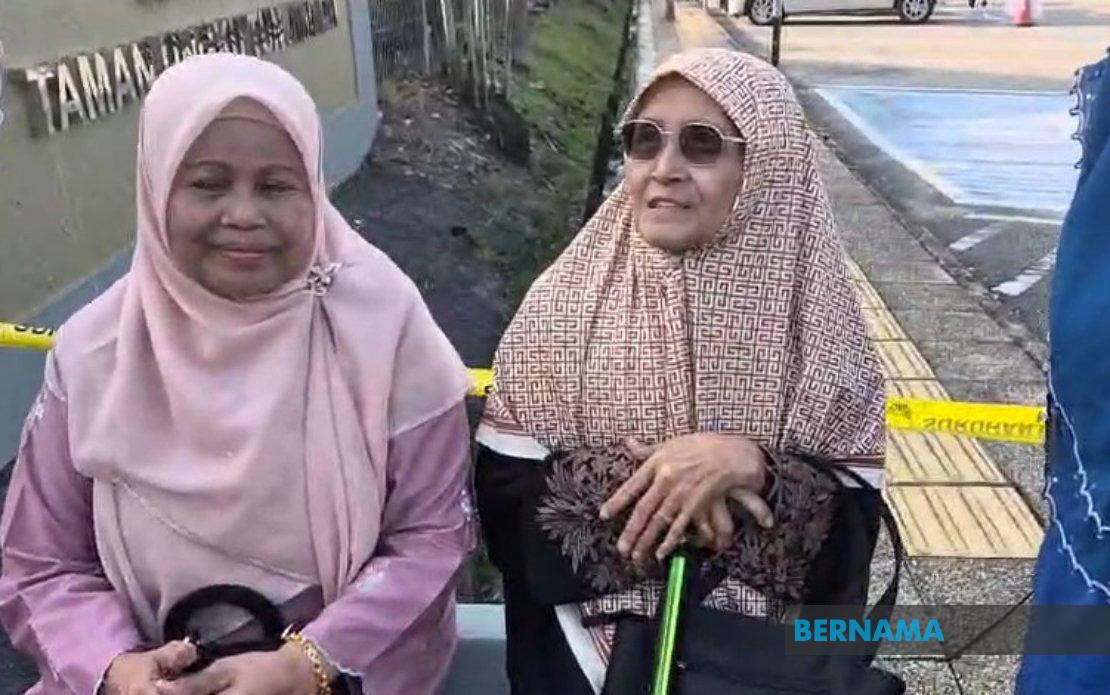
The 16th Johor State Election witnessed an impressive turnout of elderly voters who demonstrated unwavering commitment to their democratic responsibilities, arriving at polling stations well before official opening hours despite inclement weather and personal mobility constraints. Across multiple constituencies throughout the state, senior citizens—many relying on mobility aids—prioritised casting their ballots, setting an example of civic engagement that transcended age-related challenges and weather disruptions.
Surveys conducted at various polling centres throughout Johor Bahru and surrounding districts revealed a consistent pattern of early arrival among elderly voters, with many arriving before 7 am to navigate the voting process during quieter periods. The strategy reflected a pragmatic approach to voting during rain-prone conditions, allowing voters to complete their civic duty without exposing themselves to extended periods of adverse weather. This behaviour underscores the particular importance elderly Malaysians place on participating in electoral processes, viewing it as a fundamental responsibility rather than a mere formality.
At the Sekolah Jenis Kebangsaan (SJKC) Kulai Besar polling station in the Bukit Batu constituency, 70-year-old Gan Hin exemplified this commitment by arriving at 6.40 am, having coordinated with his employer at a farm in Indahpura to accommodate his voting schedule. His punctuality reflected not only personal dedication but also the accommodation shown by employers recognising the importance of electoral participation. The early arrival strategy proved efficient, allowing him to complete his voting before heading to work, demonstrating how planning and flexibility can enable broader electoral participation across different socioeconomic groups.
Sapiah Abdul Rahman, a 74-year-old voter, articulated an important dimension of early voting beyond practical convenience—the festive, community-oriented atmosphere surrounding electoral occasions. Her characterisation of the polling experience as resembling Hari Raya celebrations highlighted how elections function as significant social occasions in Malaysian communities, opportunities for citizens to gather and engage in their collective democratic processes. This perspective positions voting not as a solitary civic duty but as a communal event that strengthens social bonds, particularly among seniors who cherished the chance to reconnect with friends and neighbours.
In Johor Bahru, the determination of elderly voters manifested in more dramatic form when 84-year-old Rohani Sohod, navigating with a wheelchair, was recorded among the earliest arrivals at Sekolah Kebangsaan (SK) Seri Melati. Her presence exemplified how physical limitations did not deter participation, with elderly voters employing various adaptive strategies to ensure they could exercise their franchise. Such scenes reflected broader questions about electoral accessibility and the dignity with which democratic systems accommodate voters with diverse mobility needs.
Salma Wahid, who has maintained a voting record since 1981, brought generational perspective to the election, expressing particular concern about youth participation in Johor's democratic processes. Her observation that younger Malaysians should recognise voting as essential for shaping the state's future direction represented an intergenerational dialogue about democratic responsibility. At 74 years old, having voted for more than four decades, Wahid embodied the consistency required to sustain healthy democratic institutions, while simultaneously encouraging younger voters to engage with the same seriousness.
The impact of weather conditions on the 16th Johor State Election proved significant, with heavy rain beginning around 4 am on polling day and intensifying throughout the morning. Private sector retiree P. Gunasekaran, 63, described his strategic response to these challenging conditions, waking at 4 am and departing his home at 6 am to reach the Sekolah Menengah Kebangsaan (SMK) Seri Muar polling centre in Muar by 7 am. His recollection that comparable rainfall during the previous state election had proven burdensome motivated him to depart even earlier this time, demonstrating how electoral experience informs subsequent voting behaviour. His account revealed the real logistical challenges posed by Malaysian weather patterns during elections, yet his and others' persistence highlighted the priority given to participation.
Rokiah Yunos, an 80-year-old retiree from Muar, exemplified how religious observance integrated with electoral participation for many Malaysian voters. After completing her dawn prayers, she deliberately chose to leave her home around 7.30 am, strategically timing her departure to manage both spiritual obligations and weather concerns. Her relief at finding the polling gates already open upon arrival and the immediate ability to vote illustrates how early arrival strategies, when coordinated across many voters, can produce smoother electoral administration. Significantly, she indicated never having missed a voting opportunity, suggesting that electoral participation represented a lifelong commitment and responsibility she had maintained consistently.
The logistical challenge of accommodating 2.7 million registered voters across 1,076 polling centres throughout Johor for selecting 56 state representatives among 172 candidates created the complex infrastructure within which elderly and other voters navigated the 16th state election. This substantial electoral undertaking, spanning the entire state, required coordination across multiple constituencies and communities, each with distinct demographic characteristics. The successful participation of elderly voters despite weather challenges and physical constraints speaks to both the resilience of Johor's electorate and the functional capacity of electoral administration to manage large-scale democratic exercises.
The early arrival pattern demonstrated by senior citizens carried broader implications for understanding Malaysian electoral behaviour and demographic participation patterns. Elderly voters, having accumulated decades of electoral experience and formed deep habits regarding voting, appeared to approach elections with greater preparation and flexibility than their younger counterparts. Their willingness to wake early, brave adverse conditions, and strategically time their participation reflected both the intrinsic importance they attributed to voting and their practical experience managing logistical challenges associated with democratic participation. This pattern suggests that voter maturity and electoral experience correlate strongly with participation consistency and adaptability.

