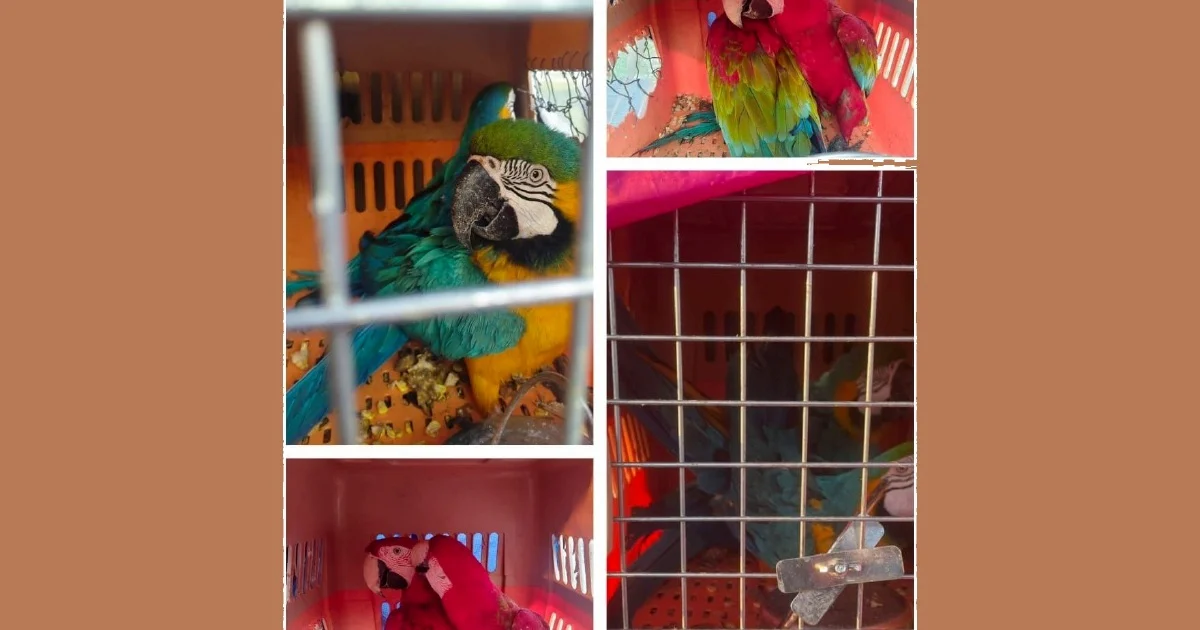
Authorities in Tumpat, Kelantan have made a significant seizure in the ongoing battle against wildlife trafficking, apprehending two men during an enforcement operation along Jalan Bandar Tumpat. The pair, described as close companions, were caught red-handed transporting eight protected macaws valued at approximately RM400,000—a sum reflecting the substantial black-market demand for exotic birds in Southeast Asia and beyond.
The operation underscores the persistent challenge of illegal wildlife trade in Malaysia, an issue that extends far beyond isolated incidents to represent a concerning regional phenomenon. Macaws, native to Central and South America, have become increasingly targeted by smuggling networks operating across the Asian market, where they command exceptionally high prices among collectors willing to circumvent international conservation regulations. The specific value assigned to this shipment indicates these were likely premium specimens, with breeding pairs or rarer colour variants commanding the steepest prices in underground trading circles.
Malaysia's strategic position along major transnational trafficking routes makes it vulnerable to becoming both a transit hub and destination market for smuggled wildlife. The arrest in Tumpat reflects broader patterns observed across the country, where enforcement agencies have detected systematic attempts to move protected species through relatively accessible transportation corridors. Jalan Bandar Tumpat, as a main arterial route, provides the kind of traffic volume that smugglers exploit, banking on the difficulty authorities face in conducting comprehensive inspections of all vehicles passing through regional checkpoints.
Protected species trafficking represents one of the world's most lucrative criminal enterprises, ranking alongside drug smuggling and arms trafficking in terms of monetary value. For individual traffickers, the markup between acquisition costs and street prices creates powerful financial incentives that persistently overwhelm deterrence mechanisms. The RM400,000 valuation suggests this particular consignment was destined for either local collectors prepared to pay premium prices for rare animals or was intended as part of a larger pipeline toward neighbouring markets or international destinations.
The involvement of two companions raises questions about organisational structures within trafficking networks. Such operations typically involve multiple participants playing different roles—procurement, transport, financing, and distribution—suggesting that these two individuals were likely components within a larger criminal enterprise rather than independent actors. Their arrest may provide investigators with intelligence about upstream suppliers and downstream buyers, potentially disrupting connections within trafficking chains.
Conservation advocates have long emphasised that effective enforcement requires sustained investment in detection technologies, trained personnel, and inter-agency coordination. The seizure demonstrates that enforcement agencies continue identifying trafficking activities, yet experts contend that apprehensions represent only a fraction of actual trafficking volumes. For every successful interception, estimates suggest multiple shipments successfully navigate through checkpoints or alternative smuggling routes, whether by air cargo, mail systems, or through less-monitored border crossings.
The species involved carries particular significance for conservation efforts. Macaws face declining wild populations in their native habitats due to habitat loss and poaching, yet their striking appearance and intelligence have transformed them into highly desirable captive animals. This dynamic creates perverse incentives where conservation status and market value move in opposite directions—endangered species command higher prices precisely because they are becoming rarer. The eight birds seized represent individuals removed from potential breeding populations in declining wild communities, though the majority had likely been bred in captivity or previously captured for trade.
From a regional perspective, wildlife trafficking in Malaysia cannot be examined in isolation. Enforcement successes in one jurisdiction may simply redirect trafficking flows toward borders with less stringent enforcement regimes. Kelantan shares boundaries with Thailand, and enforcement operations must account for cross-border smuggling patterns where traffickers select routes based on perceived vulnerability. Coordinated international efforts involving Thailand, Vietnam, China, and other regional actors have proven more effective than purely domestic operations, though such cooperation remains inconsistent and resource-dependent.
The case also illuminates the demand side of wildlife trafficking. While enforcement focuses on supply disruption through arrests and seizures, the underlying market that creates demand for illegally traded animals remains largely unaddressed. Public education campaigns, stricter penalties for purchasers, and targeted interventions with high-risk buyer communities have shown limited success compared to traditional enforcement approaches, yet addressing demand remains essential for long-term reduction of trafficking volumes.
Moving forward, this seizure should inform broader policy discussions about wildlife trafficking penalties, enforcement resource allocation, and interagency coordination within Malaysia. The RM400,000 value demonstrates that trafficking generates sufficient profit to sustain criminal operations despite enforcement risks. Substantially increasing penalties, improving detection capacity at transport nodes, and establishing dedicated wildlife trafficking investigation units remain underdeveloped in many jurisdictions across Southeast Asia. For Malaysian authorities and the wider region, sustained commitment to dismantling trafficking infrastructure—rather than episodic enforcement operations—represents the only viable pathway toward reducing the hemorrhaging of protected species into illegal markets.

