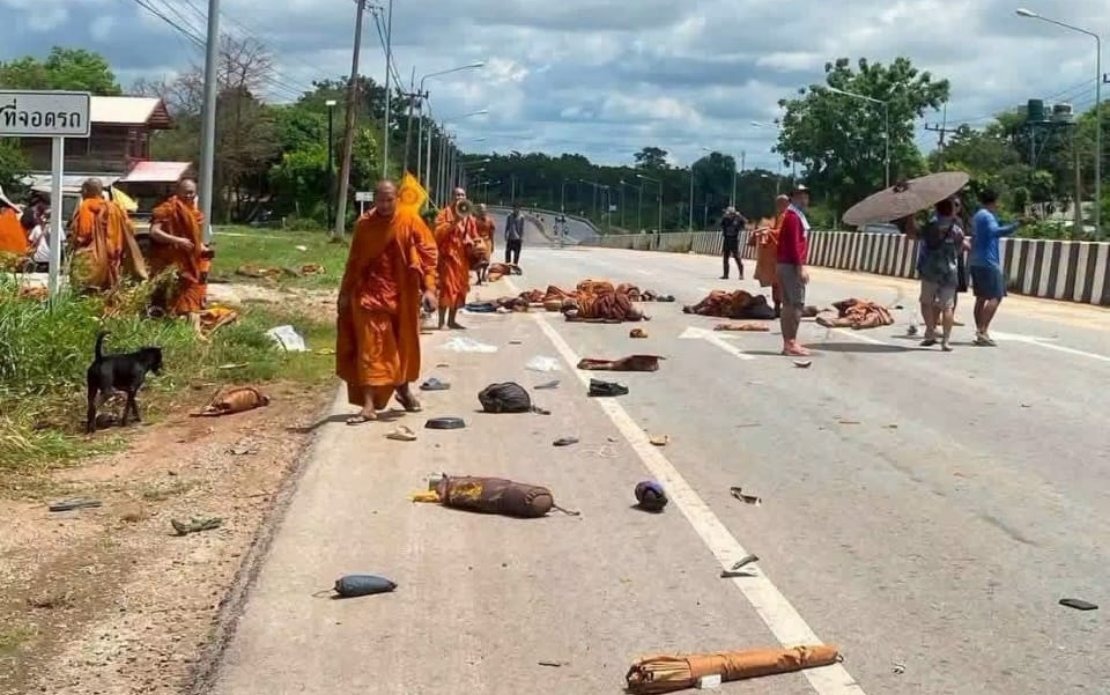
A tragic vehicular accident in Thailand's Mukdahan province has claimed the lives of eight Buddhist monks and left 14 others wounded after an out-of-control pickup truck struck a walking pilgrimage group on Thursday morning. The incident has raised fresh concerns about road safety in the region and juvenile driver regulations, particularly in rural areas where oversight of young drivers remains inconsistent.
The monks had embarked on a religious pilgrimage beginning around 11 am, making their way on foot from their temple towards Nam Khun district in the neighbouring Ubon Ratchathani province. Following standard pedestrian safety protocols, the group deliberately walked against the flow of traffic along Ban Na Si Nuan Road in Mueang district, positioning themselves to face oncoming vehicles and maintain visibility. Despite these precautions, the tragedy unfolded when the pickup truck lost control and veered sharply onto the roadside.
According to accounts provided by eyewitnesses interviewed by authorities, the first five monks in the procession managed to quickly move out of the vehicle's path and avoid collision. However, the remaining members of the group, positioned approximately two metres from the road's edge, were unable to escape the vehicle's trajectory. Five monks died at the scene, while three additional victims succumbed to their injuries after being transported to hospital facilities in the province. The rapid escalation of casualties highlighted the severity of the impact and the limited time available for those in the vehicle's path to react.
Mukdahan Provincial Public Health Chief Dr Narong Chankaew confirmed that four victims sustained injuries classified as critical, while a further ten experienced moderate trauma. The hospital ultimately admitted 23 patients in total—comprising 22 monks and a single layperson. The scale of hospitalisation reflected the intensity of the collision and underscored the challenges faced by medical facilities in the province in managing mass casualty incidents. Mukdahan Hospital subsequently made an urgent appeal for blood donations to support the ongoing treatment of the injured survivors.
Investigations by Mukdahan authorities revealed that the pickup truck driver was a juvenile under 15 years of age, immediately raising questions about how such a young individual gained access to and control of a vehicle. Mukdahan Provincial Police Commander Police Major General Phairoj Thaiputra stated that the driver had been taken into custody pending further investigation. Police investigators initiated a thorough examination of the incident, including questioning the driver's parents regarding the circumstances that allowed their underage child to operate the vehicle.
The legal implications of the accident extend beyond the juvenile driver alone. Investigators indicated they were considering whether the parents could face negligence charges for permitting their underage child to drive the vehicle. This approach reflects growing recognition in Thai law enforcement circles that parental responsibility and supervision play critical roles in preventing accidents involving underage drivers. The case may establish important precedent regarding parental liability in such circumstances.
Mukdahan Governor Warayan Boonnarat oversaw the initial investigation and coordinated the response. His office worked to reconstruct the sequence of events that led to the tragedy, examining factors such as vehicle mechanical condition, driver behaviour, and road conditions. The loss of vehicle control appeared to be the critical factor, though investigators continued gathering physical evidence and technical details to determine whether mechanical failure, driver error, speed, or other factors contributed to the crash.
The incident occurs within a broader context of road safety challenges across Thailand and Southeast Asia more broadly. Thailand consistently ranks among the countries with the highest traffic fatality rates globally, with both pedestrian and motorcycle accidents contributing significantly to annual death tolls. The involvement of an underage driver adds another dimension to this safety concern, reflecting gaps in enforcement of regulations preventing minors from driving vehicles.
From a regional perspective, this tragedy also carries implications for Malaysia and other Southeast Asian nations that share similar road safety vulnerabilities. The accident serves as a stark reminder of the importance of stringent enforcement of juvenile driving regulations, comprehensive driver education, and regular vehicle safety inspections. Malaysian authorities and road safety advocates may draw lessons from this incident in reinforcing their own regulations governing young drivers and ensuring adequate parental supervision.
The religious and cultural dimensions of this tragedy have also resonated widely. The targeting of monks on an active religious pilgrimage—a culturally significant activity in Buddhist communities—has heightened the emotional impact within Thailand and across Buddhist-majority nations in the region, including Cambodia, Laos, and Myanmar. Religious organisations and cultural groups have expressed solidarity with the affected monastic community and the families of the deceased.
As investigations continue, authorities in Mukdahan face the challenging task of determining whether criminal charges beyond potential negligence will be pursued, and what additional preventative measures might be implemented. The case demonstrates how a single moment of lost vehicle control can transform a routine day into a multi-casualty tragedy, affecting entire communities and raising urgent questions about regulatory frameworks designed to protect vulnerable road users and prevent unauthorised juvenile driving.

