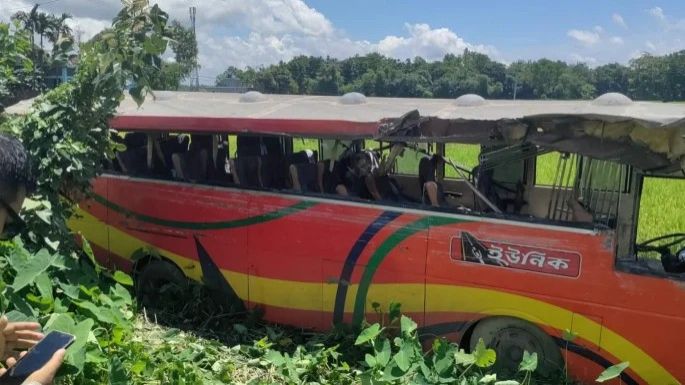
A devastating head-on crash between two intercity buses in northeastern Bangladesh claimed eight lives and left a further 25 people hospitalized on Friday morning, highlighting persistent safety concerns on the country's transport corridors. The collision occurred at approximately 7:30 a.m. in the Sylhet region, some 240 kilometres northeast of Dhaka, when the vehicles struck each other at high speed while traveling in opposite directions along the same stretch of road.
The immediate aftermath saw emergency responders mobilize quickly to the accident scene in Osmani Nagar. Golam Mostafa, the officer-in-charge of the local police station, confirmed the fatality count and casualty figures to journalists at the site, noting that rescue operations continued into the morning as medical teams worked to stabilize the injured. The severity of the collision suggested considerable force at impact, with both buses sustaining substantial structural damage that would require extensive investigation to determine exactly what precipitated the tragedy.
Authorities have initiated a full inquiry into the circumstances leading to the collision, though preliminary findings were not immediately available. The timing of the accident—early Friday morning when many workers and commuters use intercity buses to travel between Dhaka and regional centres—ensured that both vehicles were likely carrying significant numbers of passengers. The investigation will focus on determining whether driver error, mechanical failure, visibility issues, or other factors contributed to the vehicles occupying the same lane simultaneously.
The incident underscores a troubling pattern in Bangladesh's road safety record, which ranks among the worst globally in terms of fatality rates relative to vehicle numbers. Experts and safety advocates attribute the consistently high toll from transport accidents to a confluence of systemic failures spanning infrastructure, vehicle maintenance standards, and enforcement capacity. The country's highway network, while expanding in recent years, often features inadequate lane markings, poor shoulder construction, and insufficient separation between opposing traffic streams—conditions that transform even moderate speed collisions into fatal incidents.
Vehicle quality represents another critical vulnerability within Bangladesh's transport sector. Many intercity buses operating on long-distance routes are aging, with brake systems, steering mechanisms, and tyres frequently in questionable condition due to cost-cutting measures by operators seeking to maximize profits. Regular maintenance schedules are often neglected, and the absence of rigorous pre-journey mechanical inspections means that vehicles with significant defects can legally operate on public roads. When combined with long driving hours and driver fatigue, mechanical vulnerabilities create perfect conditions for catastrophic failures.
Driver behavior and training standards compound these structural problems. Many professional drivers, while experienced in navigating local conditions, receive minimal formal instruction in defensive driving techniques or emergency vehicle handling. Traffic rules designed to prevent head-on collisions—such as maintaining proper lane discipline and adapting speed to visibility—are frequently disregarded with minimal consequence. The culture of reckless overtaking, particularly on two-lane highways where head-on collisions are inevitable if timing proves unfortunate, persists despite the obvious dangers.
Government oversight and traffic law enforcement remain chronically insufficient throughout Bangladesh. The traffic police department operates with limited resources, personnel, and technology compared to the scale of the country's growing vehicle fleet. Regular checkpoints and speed monitoring are sporadic, and penalties for serious violations are often modest enough that drivers view them as acceptable business expenses rather than genuine deterrents. Without consistent enforcement presence, even drivers who understand the risks have reduced incentive to comply with safety regulations.
For Malaysian observers, the situation in Bangladesh serves as a cautionary illustration of how rapidly developing nations must balance economic growth in transportation with corresponding investments in safety infrastructure and regulation. Southeast Asia's road fatality rates, while generally lower than Bangladesh's, nevertheless remain concerning, and the underlying risk factors—aging vehicle populations, driver training deficiencies, and patchy enforcement—are not unique to Bangladesh. Malaysia and other regional nations have made substantial progress in reducing accident rates through campaigns, infrastructure upgrades, and stricter vehicle standards, yet complacency could allow conditions to regress.
The immediate response to Friday's collision will likely focus on victim compensation and medical care, with the government promising improved safety measures. However, meaningful change would require sustained commitment to comprehensive reforms addressing every element of the transport system simultaneously. Without intervention at the infrastructure level, genuine improvements to driver training programs, and consistent enforcement of safety regulations, Bangladesh will continue experiencing preventable tragedies that devastate families and drain social resources.

