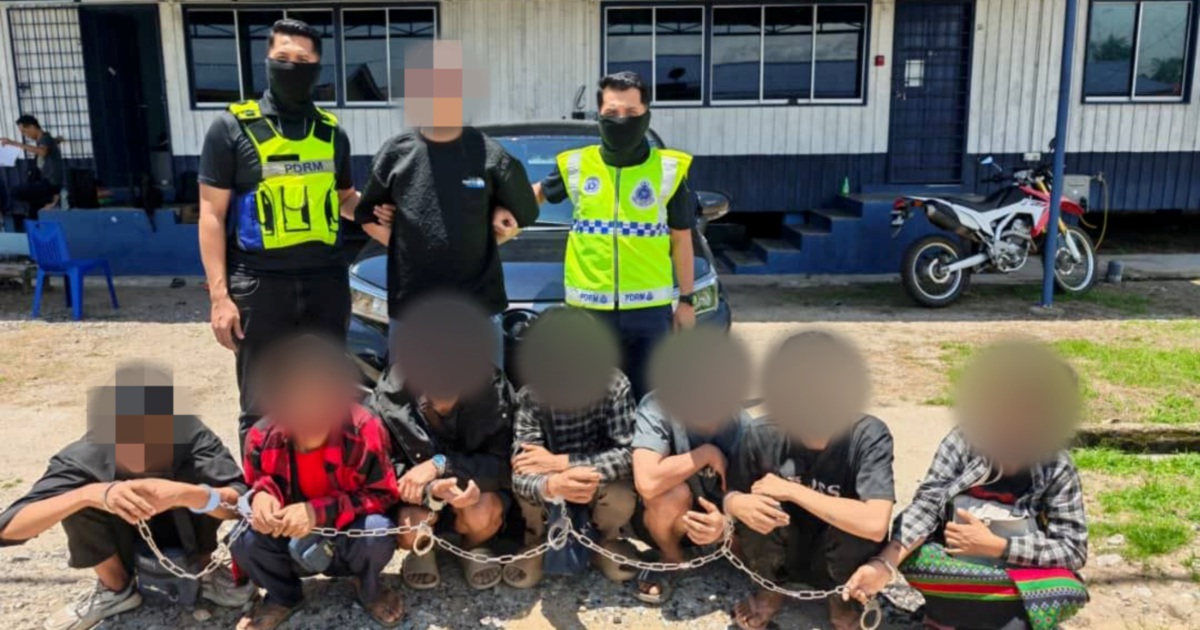
The Royal Malaysia Police arrested eight suspects in Kota Baru following an early morning operation targeting a suspected migrant smuggling operation. Among those detained was a Malaysian man allegedly responsible for transporting seven undocumented nationals from Myanmar in a vehicle. The arrests underscore intensifying police action against human trafficking networks operating within Kelantan and across Malaysia's porous borders.
The operation reflects the mounting challenge of illegal migration through Malaysia's northern states, where proximity to Thailand and limited border enforcement have created conditions favourable to smuggling syndicates. Kelantan, situated along Malaysia's eastern coast with significant cross-border transit routes, has emerged as a critical junction for migrant movements. The region's geographic positioning makes it particularly vulnerable to human trafficking activities, with networks exploiting established trafficking corridors that extend into Thailand and across Southeast Asia.
The seven Myanmar nationals recovered during the operation represent a fraction of the estimated tens of thousands of undocumented migrants circulating throughout Malaysia at any given time. Myanmar's ongoing civil and political instability since the 2021 military coup has intensified migration pressures, with many nationals seeking refuge or economic opportunity abroad. Malaysia remains a primary destination, though the journey through informal channels exposes migrants to exploitation, abuse, and trafficking at the hands of organised criminal networks.
Smuggling operations typically involve multiple layers of coordination, from brokers arranging passage to transport operators like the detained Malaysian suspect. The involvement of Malaysian nationals in such operations complicates enforcement efforts, as local participants provide the vehicles, routes, and safe houses essential to successful trafficking. Police investigations into the arrested Malaysian man's connections will likely extend to dismantling broader operational networks and identifying upstream organisers coordinating cross-border movements.
The eight detainees will face investigation under relevant immigration and human trafficking legislation. Malaysia's legal framework criminalises both people smuggling and the harbouring of undocumented migrants, with penalties increasing in severity for organisers and repeat offenders. However, prosecutors often struggle to secure convictions that reflect the gravity of trafficking operations, particularly when distinguishing between smuggling and trafficking—the former involving voluntary migration movement, the latter involving coercion or exploitation.
The Kelantan arrest comes amid heightened police attention to migrant movements following recent high-profile cases across northern states. Perlis and Kedah have similarly recorded significant smuggling operations, indicating systematic trafficking patterns across Malaysia's northern tier. Intelligence agencies increasingly view migrant smuggling not merely as an immigration concern but as a security matter linked to organised crime, document fraud, and potential exploitation of vulnerable populations by extremist groups.
International cooperation remains critical to disrupting smuggling networks. Thailand, Myanmar, and Malaysia share responsibility for controlling the broader trafficking ecosystem, yet coordination remains inconsistent. Cross-border law enforcement cooperation, intelligence sharing, and harmonised prosecution approaches could substantially reduce trafficking prevalence, though geopolitical tensions and resource constraints often impede such collaboration.
For Myanmar nationals, the risks of utilising smuggling services extend beyond legal consequences. Migrants frequently endure overcrowding, unsanitary conditions, deprivation of food and water, and violent abuse during transit. Women and children face heightened vulnerability to sexual exploitation. Upon reaching Malaysia, undocumented migrants become prey for further exploitation by employers and landlords, often trapped in forced labour conditions while fearing police discovery.
The broader context of Malaysia's migrant population presents complex policy challenges. An estimated 2.3 million documented foreign workers contribute significantly to Malaysia's economy, yet a substantial undocumented population exists in legal limbo, vulnerable to exploitation and incapable of accessing healthcare or legal recourse. This underground economy relies on smuggling networks to sustain supply, creating interdependence between criminal syndicates and employers exploiting undocumented labour.
Stakeholders including the International Labour Organisation, civil society organisations, and regional governments increasingly argue that addressing root causes—Myanmar's political instability, poverty, limited regional job prospects—offers more sustainable solutions than enforcement alone. Simultaneously, Malaysia must strengthen port security, border controls, and coordination with neighbouring states while improving conditions for documented migrant workers to reduce incentives for undocumented migration.
The Kelantan operation demonstrates police capability in disrupting individual smuggling operations, yet systematic reduction in trafficking requires sustained resource commitment, intelligence-led policing, and prosecution of higher-level organisers. The detained Malaysian suspect's eventual prosecution may provide opportunities to uncover connections to broader smuggling networks, potentially yielding intelligence that informs future enforcement strategies and international cooperation.

