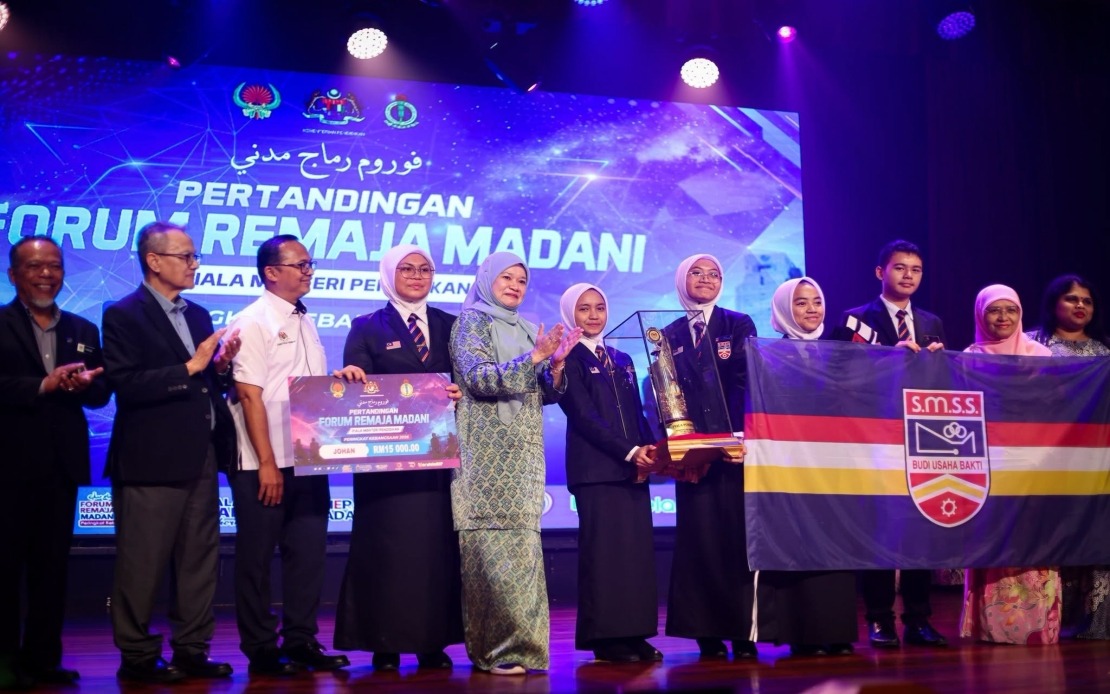
Education Minister Fadhlina Sidek has articulated a vision for Malaysian character education that extends beyond traditional virtue-building to encompass the development of articulate, intellectually engaged citizens capable of navigating societal disagreement constructively. Speaking in the wake of observations at the National MADANI Youth Forum, Fadhlina outlined an educational philosophy centred on enabling young people to voice their perspectives with confidence while maintaining respect for those who hold different positions.
The minister's remarks reflect a significant reframing of what character education should accomplish in contemporary Malaysia. Rather than conceiving moral development as a one-directional transmission of predetermined values, Fadhlina envisions a more dynamic process where young people learn to formulate, articulate, and defend their own positions. At the forum, she observed participants engaging in precisely this manner—thinking through complex issues, considering alternative viewpoints, and presenting substantive arguments. This model of character education prioritises the development of intellectual independence alongside ethical conduct.
Central to Fadhlina's vision is the notion that a healthy democratic society requires citizens capable of disagreeing productively. She explicitly rejected the premise that national maturity corresponds to widespread consensus, arguing instead that genuine development emerges from generations trained in the mechanics of respectful disagreement. This positioning carries particular resonance for Malaysia, where social cohesion and managing diversity remain ongoing challenges requiring nuanced approaches to civic engagement.
The minister identified a crucial connection between character education and language development, specifically the strengthening of Malay as a medium for contemporary expression. She posited that the Malay language would gain vitality when younger generations perceived it as a vehicle capable of expressing their authentic thoughts and current concerns. This linkage suggests that linguistic renewal cannot be imposed through prescriptive measures alone but must emerge through lived experience of the language as functionally relevant to youth discourse.
Fadhlina's framework deliberately distinguishes between two distinct educational functions: the cultivation of knowledge on one hand, and the fostering of courtesy and listening skills on the other. She emphasized that educators should not position themselves as arbiters of what young people should communicate, but rather as facilitators ensuring that when youth do speak, they possess the intellectual tools to construct coherent arguments and the social competence to engage others respectfully. This distinction reflects a move away from paternalistic models toward more empowering pedagogical approaches.
The emphasis on listening—not merely as passive reception but as an active practice requiring discipline and humility—represents an often-overlooked component of character education in Malaysian contexts. Fadhlina's articulation suggests that respectful disagreement hinges not only on the ability to express oneself clearly but equally on the capacity to genuinely consider and engage with opposing perspectives. This reciprocal dimension proves essential for transforming abstract tolerance into functional civility.
The timing of these remarks carries significance given ongoing discussions about the direction of Malaysian education policy. Educational systems across Southeast Asia have grappled with balancing social stability concerns against the need to develop citizens equipped for complex, pluralistic societies. Fadhlina's position suggests a ministry approach that views critical thinking and respectful discourse not as threats to social cohesion but as prerequisites for sustainable national development and resilience.
For regional observers, the minister's statements offer insights into how Malaysia conceptualises youth development amid broader geopolitical and technological change. The emphasis on articulate expression and intellectual engagement speaks to recognition that younger Malaysians will inherit an increasingly complex information environment requiring sharp discernment between quality argument and rhetorical manipulation. Character education framed this way becomes not a luxury for elite institutions but a necessity for all citizens.
The practical implications of Fadhlina's vision extend across multiple educational domains. Implementation would require teacher training emphasising facilitation and dialogue skills rather than content transmission. Curriculum structures would need revision to create regular opportunities for structured debate, collaborative problem-solving, and exposure to diverse perspectives. Assessment methods would necessarily evolve to measure not merely knowledge retention but also reasoning quality and interpersonal competence in disagreement.
Stakeholders in Malaysian education—including parents, educators, civil society organisations, and young people themselves—will likely engage differently with this vision depending on their existing perspectives on educational purpose. Some will appreciate the emphasis on youth agency and intellectual development, while others may harbour concerns about potential erosion of traditional values or social stability. Managing these varied expectations while maintaining pedagogical coherence represents a substantive challenge for ministry implementation.
The invocation of MADANI—Malaysia's development framework emphasising prosperity, unity, and integrity—as context for these youth forum observations underscores ministerial intent to position critical thinking and respectful disagreement as aligned with rather than antagonistic to official development priorities. This framing attempts to reconcile sometimes-perceived tensions between liberal democratic values and communitarian or stability-focused governance approaches.

