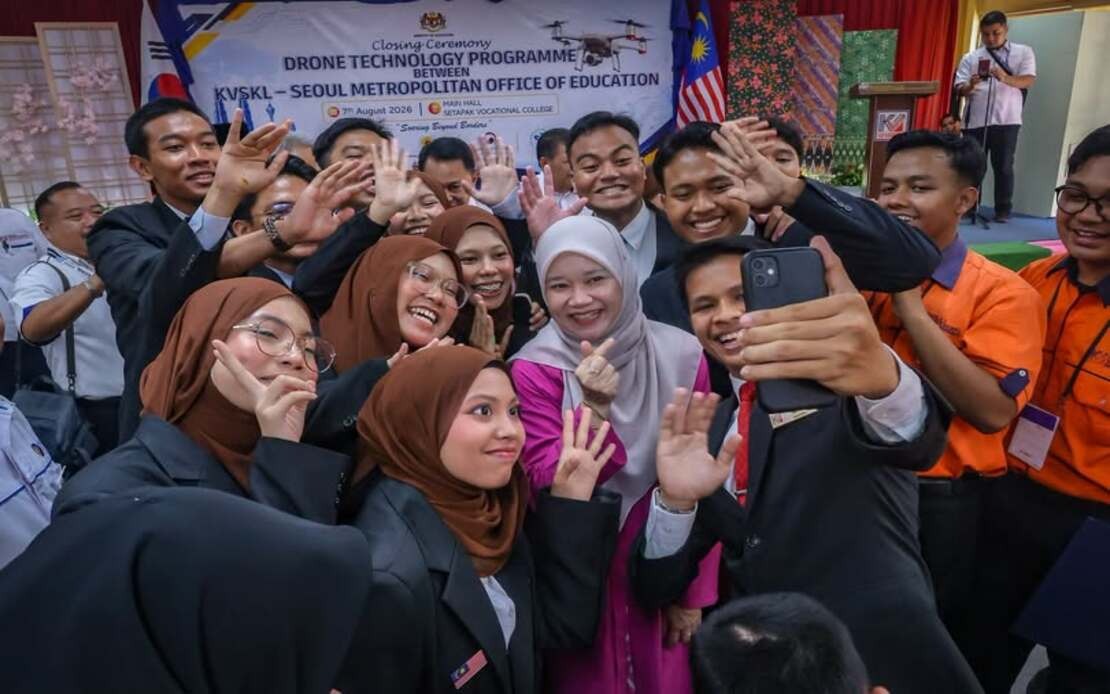
Education Minister Fadhlina Sidek has set an ambitious target for students at Setapak Vocational College, asking them to harness drone technology for real-world security solutions on their campus. The challenge, announced during a joint initiative with the Seoul Metropolitan Office of Education, requires participants to develop and present concrete proposals within a 30-day window, marking a shift towards problem-solving education rooted in emerging technologies.
The collaboration programme, which drew South Korean Ambassador to Malaysia Yeo Seung-bae, represents a growing educational partnership between Malaysia and South Korea focused on technology transfer and skills development. Rather than limiting students to theoretical knowledge, the initiative encourages hands-on experimentation with robotics and drone systems, using Korean expertise as a foundation for exploring practical applications.
Fadhlina's decision to impose this challenge reflects a broader conviction about the direction of vocational education in Malaysia. She emphasised that technological competency is no longer a luxury but an essential component of workforce readiness, particularly as robotics, drone systems, and artificial intelligence become embedded in modern employment landscapes. The minister stressed that Malaysian educational institutions must evolve alongside industry demands rather than lagging behind technological change.
During her visit, Fadhlina observed students operating drones and robots firsthand, witnessing both successes and failures in real time. Rather than viewing mishaps as setbacks, she interpreted them as integral learning moments—a pedagogical perspective that encourages risk-taking and experimentation among younger learners. This observation-based approach to technical education contrasts with traditional examination-focused methodologies, signalling a shift in how Malaysia's vocational sector might evaluate student progress.
The challenge itself carries particular significance for Malaysian readers concerned with domestic security and technological sovereignty. Campus safety remains an ongoing concern across Malaysian educational institutions, and repositioning students as problem-solvers in this domain accomplishes multiple objectives: it develops technical skills, encourages critical thinking about real institutional needs, and potentially yields practical innovations that could be implemented institution-wide or scaled across the vocational college network.
For vocational colleges specifically, this initiative underscores their evolving role beyond traditional trades training. Malaysian vocational institutions have increasingly positioned themselves as sites for digital innovation, competing with mainstream higher education for students interested in technology pathways. By framing vocational study as a venue for addressing actual institutional challenges, Fadhlina strengthens the perceived relevance and prestige of such institutions among prospective learners and their families.
The South Korean dimension adds credibility and external validation to Malaysia's technological ambitions. South Korea's reputation for technological excellence and its track record in education exports position this collaboration as a legitimate pathway to capability-building. However, the deeper implication concerns technology adaptation: Malaysian students are not simply importing South Korean solutions but learning methodologies and principles they can apply to their own environmental context, a more sustainable model of knowledge transfer than direct adoption.
Fadhlina's emphasis on problem-based learning aligns with international best practices in technical education, where students learn most effectively when addressing authentic challenges rather than hypothetical scenarios. The one-month timeline creates realistic project parameters, avoiding both the oversimplification of overnight challenges and the indefiniteness that sometimes characterises open-ended assignments. This temporal constraint encourages prioritisation and practical decision-making—skills equally valuable in professional settings.
The challenge also carries implications for Malaysia's broader digital economy trajectory. As the nation seeks to position itself as a regional technology hub, nurturing a pipeline of young people comfortable with drone technology and autonomous systems becomes strategically important. Vocational college students, who often enter employment more directly than their university-bound counterparts, can serve as early adopters and implementers of emerging technologies across various sectors.
Beyond campus security specifically, the underlying message encourages students to think systematically about how technology solves human problems. This conceptual shift—from technology as an end in itself to technology as a means addressing identifiable needs—represents mature technological literacy. Whether proposed solutions involve perimeter monitoring, crowd management detection, or emergency response coordination, students must first interrogate actual security gaps before designing technological interventions.
The initiative also demonstrates the minister's willingness to use her office for direct engagement with educational institutions and students. Rather than policy pronouncements from distant bureaucracy, Fadhlina's physical presence at Setapak and her direct challenge to students suggests a more responsive leadership approach within the education portfolio. For Malaysian education stakeholders, this signals potential receptivity to grassroots innovation and student-centred initiatives.
Looking forward, outcomes from this challenge could inform broader vocational curriculum development across Malaysia. Successful drone applications might become case studies for other colleges, while failures yield valuable learning about realistic implementation constraints. Either way, the exercise creates documented evidence of student capability that can inform industry partnerships and employment pathways. As Malaysia increasingly competes for skilled technical talent, demonstrating that vocational students can tackle contemporary challenges becomes a powerful recruitment and retention tool.

