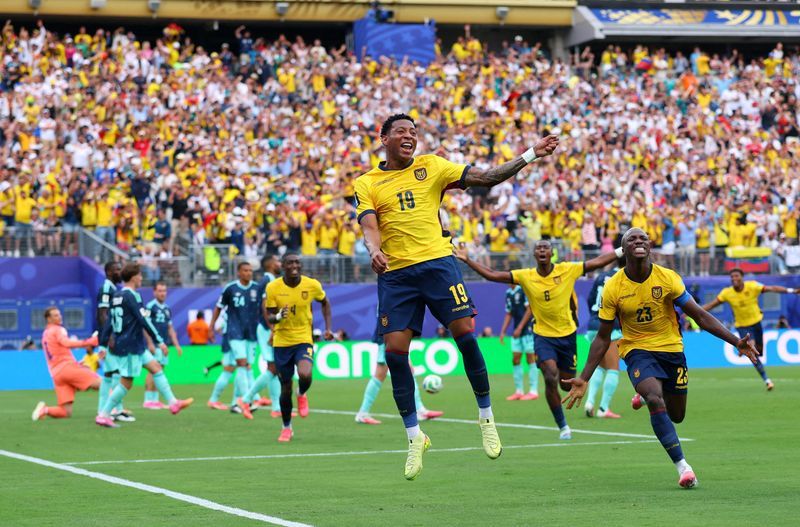
Ecuador's World Cup dream remained alive on Thursday after an improbable 2-1 victory over Germany at the MetLife Stadium in East Rutherford, New Jersey. Facing elimination ahead of their final Group E encounter, the South American side produced a stirring second-half performance to overturn an early deficit and qualify for the knockout stages as one of the strongest third-placed finishers. The result capped a remarkable turnaround for a squad that had arrived at the match under intense scrutiny following a defeat to Ivory Coast and a goalless draw with Curacao.
Ecuador's task appeared impossible when Germany, already assured of progression, struck within seconds of kickoff. Leroy Sane collected the ball from a clever assist by Florian Wirtz following a quick throw-in and finished confidently with his left foot in the second minute. The goal marked Sane's maiden strike at a major international tournament after 15 previous appearances, yet it also exposed defensive frailties that would ultimately cost Germany dearly. Ecuador's protests that Aleksandar Pavlovic had committed a foul in the build-up fell on deaf ears as referee Tori Penso allowed the goal to stand, setting the tone for a controversial encounter.
What distinguished Ecuador's response was their immediate reaction to adversity. Rather than capitulating, they levelled proceedings just seven minutes later when Nilson Angulo produced a moment of genuine quality. The midfielder collected possession at the edge of the penalty area and curled the ball beyond Manuel Neuer with a technique that belied Ecuador's status as the tournament's lowest-ranked remaining side. The equaliser held profound significance beyond the scoreline, as it ended Ecuador's remarkable 39-shot drought—a statistic that underscored their earlier struggles to convert chances into goals. The goal ignited the yellow-clad Ecuador support and fundamentally shifted the psychological balance of the match.
The second half brought further controversy when referee Penso awarded Germany a penalty after Kai Havertz appeared to be brought down by Joel Ordonez. However, a VAR review intervened to overturn the decision, with officials identifying a prior infringement by Germany during the buildup. This moment proved pivotal in Ecuador's trajectory, as it maintained their slender advantage and prevented Germany from extending their lead. The reversal also illustrated how technology can intervene to correct on-field decisions, though the controversial nature of the original call continued to dominate post-match discussion.
The decisive moment arrived in the 78th minute when Ecuador completed their remarkable turnaround. Gonzalo Plata reacted sharply after substitute Kevin Rodriguez flicked a corner kick toward the near post, stabbing the ball past Neuer and igniting scenes of unrestrained celebration among Ecuador's travelling support. The second goal exemplified the clinical finishing that had eluded Ecuador throughout the tournament, and it ultimately sealed their passage to the knockout round as one of eight third-placed teams advancing from the group stage.
Germany's defeat proved particularly frustrating given their status as group winners with six points accumulated from two prior victories. The loss ended their quest for a third consecutive win from Group E matches and interrupted a run of 12 consecutive victories in competitive fixtures. More troublingly for German manager Julian Nagelsmann, the result demonstrated persistent defensive vulnerabilities that had plagued the squad throughout the group stage—Germany conceded in all three matches, a concerning trend heading toward knockout football where fine margins determine progression.
Ivory Coast secured second place in the group after defeating Curacao 2-0, finishing level with Germany on points but separated by goal difference. This outcome meant Ecuador's unlikely advancement came at Germany's expense, as the Ecuadorian side leapfrogged the African representatives and secured the final qualification slot available from Group E. The mathematical permutations created by this result illustrated the unpredictable nature of group-stage football, where late matches and simultaneous results can dramatically reshape tournament narratives.
From a broader perspective, Ecuador's qualification carries significant implications for South American football representation. The nation's passage to the knockout stages, achieved against considerable odds and without the resources available to traditional World Cup powerhouses, demonstrated that tournament success depends less on historical pedigree than on tactical discipline and moment-taking ability. For Malaysian and regional Southeast Asian audiences, Ecuador's example offers instructive lessons about tournament football's inherent unpredictability and the importance of competitive resilience when circumstances demand immediate results.
The victory also highlighted the emotional and psychological dimensions that separate successful World Cup campaigns from disappointing ones. Ecuador's squad, assembled from a relatively modest talent pool and competing against established European sides, nevertheless demonstrated the determination necessary to overcome setbacks. Germany's complacency, perhaps understandable given their group qualification was already secured, ultimately proved costly in a tournament where every match carries consequences regardless of advancing teams' prior achievements.
Looking forward, Ecuador's passage to the knockout round presents fresh challenges against the tournament's strongest qualifiers and most experienced sides. However, their ability to recover from the brink of elimination suggests they possess the psychological fortitude necessary to compete effectively in the business end of the competition. Meanwhile, Germany must reassess their defensive organisation and intensity heading into knockout fixtures where a single error cannot be recovered through the buffer of group-stage matches.

