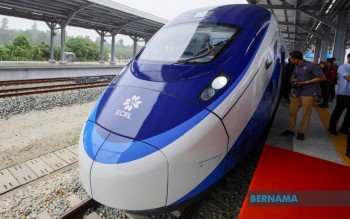
The East Coast Rail Link (ECRL) represents far more than a conventional transportation infrastructure project for Malaysia's eastern states. According to Deputy Minister of Economy Datuk Mohd Shahar Abdullah, the megaproject is fundamentally reshaping the regional economic landscape by creating an integrated ecosystem that encompasses the entire supply chain—from construction through to operation and maintenance—thereby generating cascading benefits for entrepreneurs operating within Pahang, Terengganu, Kelantan and Selangor.
The transformation extends beyond merely connecting cities with rail corridors. Datuk Mohd Shahar, who represents Paya Besar in Parliament, emphasised that the ECRL's strategic framework incorporates three complementary development models: transit-oriented development, cargo-oriented facilities, and dedicated industrial parks. This multifaceted approach creates what economists term a "spatial cluster effect," where concentrated infrastructure investment generates multiplier benefits across logistics, warehousing, and manufacturing sectors that will flourish along the 645-kilometre route.
One of the most compelling advantages for small and medium-sized enterprises is the dramatic reduction in supply chain costs. By leveraging rail transport instead of road haulage, businesses can substantially lower their per-unit logistics expenses whilst simultaneously extending delivery timeframes across wider geographical markets. This cost advantage proves particularly transformative for price-sensitive sectors including manufacturing and consumer goods, where marginal reductions in operational expenses directly translate into enhanced competitiveness in both regional and domestic markets.
The economics of scale represent another critical dimension. As Datuk Mohd Shahar illustrated, the difference between producing 10,000 units and 20,000 units fundamentally alters a company's unit cost structure and market positioning. The ECRL facilitates this expansion by removing geographical constraints that traditionally limited entrepreneurs to local markets. With improved logistics capabilities and reduced transportation friction, manufacturers can confidently increase production volumes, knowing they possess reliable infrastructure to reach distant consumer bases. This virtuous cycle—where lower costs enable larger production runs, which further reduce per-unit costs—has historically been instrumental in transforming regional economies across Asia.
Beyond manufacturing, the ECRL generates substantial downstream opportunities in ancillary sectors. The logistics industry itself will experience unprecedented demand for warehousing facilities, distribution centres, and value-added services. Construction companies benefit from immediate project work, whilst maintenance contractors secure long-term revenue streams throughout the operational phase. Additionally, the emergence of industrial parks along the corridor attracts manufacturers seeking modern facilities with seamless rail connectivity, further consolidating the region's position as an integrated economic zone.
The tourism dimension merits particular attention for Southeast Asian economies seeking to diversify revenue streams. Enhanced rail connectivity typically stimulates domestic and international tourism by reducing travel times and improving accessibility to previously remote attractions. Malaysia's East Coast possesses distinctive cultural assets—from Kelantan's renowned batik industry to Terengganu's maritime heritage—that currently remain underexploited due to connectivity constraints. Improved rail access unlocks tourism potential, benefiting small traders, food vendors, handicraft artisans, and local product manufacturers who can scale operations to accommodate larger visitor volumes.
However, Datuk Mohd Shahar injected a cautionary note regarding entrepreneurial readiness. Industry participants must fundamentally reassess their operational models, embracing digital technologies and modern supply chain management systems rather than perpetuating conventional business practices. The ECRL's potential remains contingent upon entrepreneurs' capacity to adapt. Companies that merely expand existing workflows without incorporating logistics technology, data analytics, and e-commerce capabilities risk squandering the infrastructure windfall. This represents a critical challenge for Malaysian policymakers: ensuring that business support services and digital transformation programmes run parallel to infrastructure deployment.
The project's progress trajectory indicates imminent realisation of these opportunities. As of April this year, the overall megaproject recorded 93.66 per cent completion, with the Pahang segment achieving 97.33 per cent progress. The December completion target positions the ECRL to commence commercial operations during a critical period for Malaysia's economic recovery, coinciding with anticipated regional trade normalisation and increased regional integration through agreements like the Regional Comprehensive Economic Partnership (RCEP).
From a regional perspective, the ECRL's completion carries implications extending beyond Malaysia's borders. Enhanced connectivity across the East Coast creates a more competitive supply chain hub within Southeast Asia, potentially diverting manufacturing and logistics investment flows from neighbouring countries. For ASEAN member states, particularly Thailand and Indonesia, Malaysia's infrastructure advancement reinforces the region's attraction as an integrated manufacturing and distribution platform, whilst accelerating the broader shift toward Southeast Asian supply chain regionalisation.
The infrastructure's transformative potential ultimately hinges upon implementation execution and complementary policy support. Whilst the ECRL itself represents engineering excellence, maximising its economic impact requires coordinated efforts in regulatory harmonisation, skills development, and digital infrastructure. Malaysian entrepreneurs equipped with modern technology and connected to a reliable rail network possess genuine capacity to compete regionally. Conversely, those clinging to traditional operational models risk finding themselves disadvantaged despite possessing superior infrastructure access. The coming years will reveal whether Malaysian business communities can execute this necessary transformation.

