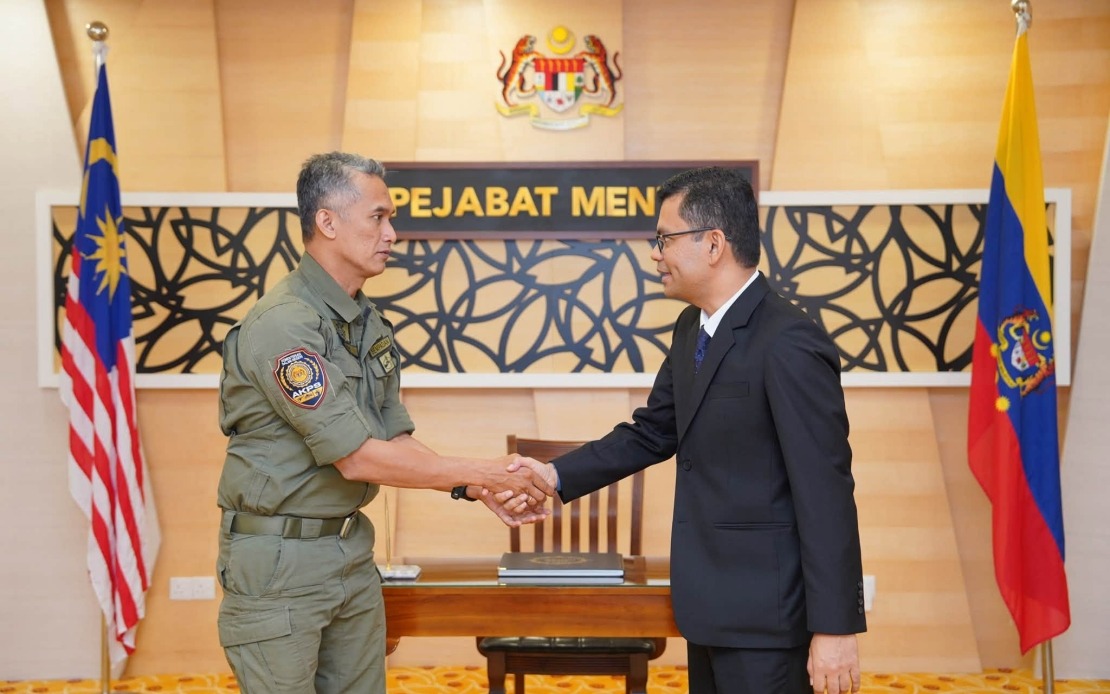
The Malaysian government is intensifying efforts to transform its border management capabilities through a collaborative push between the Economy Ministry and the newly established Malaysian Border Control and Protection Agency (AKPS). During a meeting in Putrajaya, Economy Minister Akmal Nasrullah Mohd Nasir and AKPS Director-General Datuk Seri Mohd Shuhaily Mohd Zain discussed the budgetary requirements needed to elevate border operations across the nation's entry points, signalling a renewed commitment to modernizing what has long been a fragmented approach to border control.
The timing of these discussions reflects the critical early phase of AKPS operations, which commenced on January 1, 2025. The agency represents a significant administrative consolidation, bringing together border enforcement responsibilities that were previously distributed across six separate organizations. The Immigration Department, Royal Malaysian Customs Department, Malaysian Quarantine and Inspection Services Department, Health Ministry, Department of Wildlife and National Parks, and Road Transport Department have all transferred relevant functions to AKPS, creating a unified command structure intended to eliminate duplication and improve coordination at border checkpoints.
Central to the ministry's engagement with AKPS are plans to upgrade physical infrastructure at entry points nationwide. The Economy Ministry has acknowledged that meaningful progress on border security and trade efficiency depends fundamentally on adequate investment in tangible assets—ranging from checkpoint facilities to monitoring systems. Such infrastructure investments are particularly vital for a country like Malaysia, which serves as a regional transit hub with multiple international airports, seaports, and land borders that handle enormous volumes of passenger and cargo traffic daily.
Equally significant is the strategic pivot toward technology adoption that featured prominently in discussions between the two organizations. AKPS has already identified smart border technology as a priority, with particular emphasis on integrated biometric systems that can rapidly verify traveler identities and flag security concerns. The agency is also pursuing automated cargo scanning capabilities, which would substantially accelerate the processing of goods while enhancing detection of contraband and prohibited items. These technological layers are underpinned by real-time data integration powered by artificial intelligence, allowing border officials to make faster, more informed decisions based on comprehensive intelligence.
For Malaysia's trade competitiveness, the implications of these modernization efforts are substantial. Border delays directly translate to increased logistics costs and reduced attractiveness for regional investment. By streamlining operations through technology and better coordination, AKPS can theoretically reduce processing times at critical junctures like the Kuala Lumpur International Airport, Port Klang, and land crossings with Thailand and Singapore. Enhanced efficiency at these chokepoints would benefit importers and exporters alike, particularly small and medium-sized enterprises that operate on tight margins and cannot absorb lengthy delays.
The development of strategic assets mentioned in the discussions encompasses physical infrastructure improvements and the acquisition of specialized equipment. This might include advanced screening technology, secure holding facilities, and communication systems that enable real-time coordination across multiple border locations. Such investments require careful prioritization given budget constraints, making the dialogue between the Economy Ministry and AKPS crucial for ensuring resources are allocated to the highest-impact initiatives.
Enhancing operational capacity represents another dimension of AKPS's developmental agenda. This involves building human resource capabilities across the merged agency, requiring comprehensive training programs to ensure staff from the six predecessor organizations can work effectively within the new unified structure. AKPS leadership, under Mohd Shuhaily, has already signaled that strengthening integrity and operational efficiency are foundational to the agency's evolution. Without investment in staff development and institutional alignment, even the most sophisticated technology can underperform.
The Economy Ministry's position that AKPS capability-building will support smoother trade reflects an understanding that border management exists at the intersection of security and commerce. National security concerns—preventing smuggling, terrorism, and illegal migration—must be balanced against the imperative to facilitate legitimate cross-border movement. The integrated approach AKPS represents potentially achieves this balance more effectively than the previous multi-agency system, where competing priorities sometimes created bottlenecks or inconsistent enforcement.
For Southeast Asian regional dynamics, Malaysia's border modernization has broader implications. The country serves as a gateway for goods moving between China and India, and between Asian producers and Western markets. Any improvements to border efficiency ripple through regional supply chains. Similarly, enhanced border security contributes to the Association of Southeast Asian Nations' collective efforts to combat transnational organized crime, particularly drug trafficking and human smuggling—persistent challenges across the region.
The structured development planning Mohd Shuhaily referenced suggests AKPS is moving beyond immediate operational concerns toward longer-term strategic positioning. A multi-year roadmap would enable sustained investment rather than ad-hoc funding decisions, allowing the agency to plan major technology implementations and infrastructure projects with confidence. This approach also facilitates performance measurement, enabling stakeholders to assess whether investments are delivering the efficiency and security gains they promise.
Looking forward, the success of this Economy Ministry-AKPS partnership will likely depend on political commitment to sustained funding and the agency's ability to implement complex technological systems effectively. The transition from six separate agencies to one integrated body, though administratively sound, inevitably involves coordination challenges and resistance from entrenched interests. Overcoming these obstacles while simultaneously modernizing operations represents a significant management challenge. Nevertheless, the willingness of senior leadership to engage seriously with these issues suggests a genuine effort to transform Malaysia's border infrastructure for the twenty-first century.

