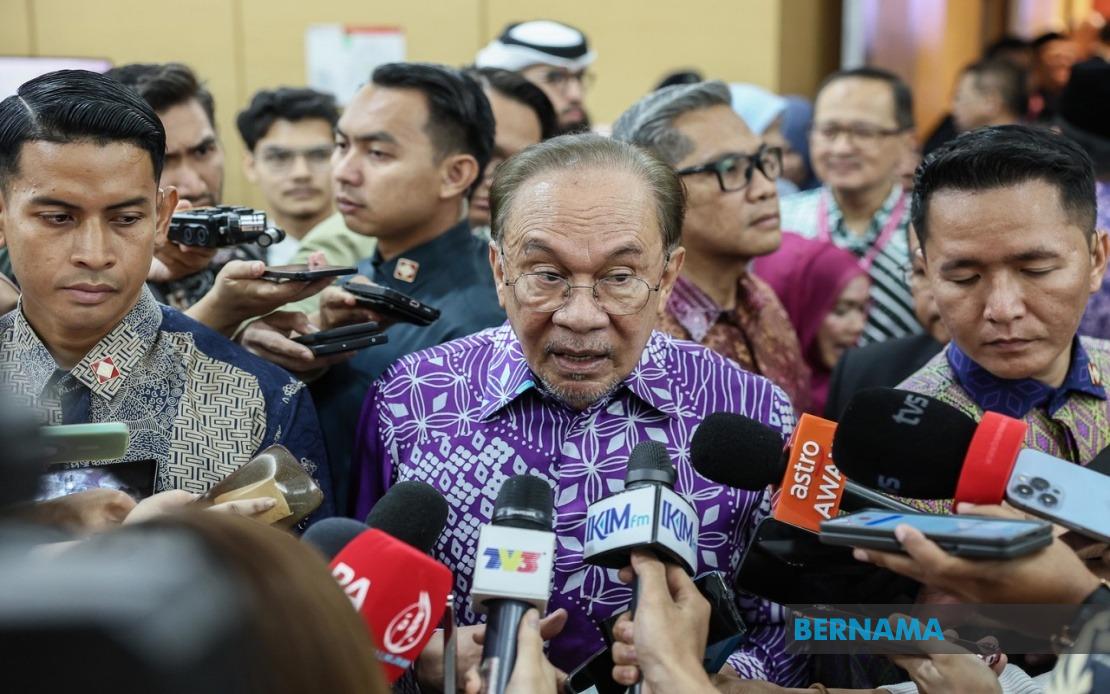
Prime Minister Datuk Seri Anwar Ibrahim has articulated a vision for Malaysian economic development centred on human values and moral responsibility, moving beyond the traditional metrics of growth that have long dominated policy discourse. Addressing the Humane Economy Global Discourse (HEGD) 2026 in Kuala Lumpur on July 23, Anwar challenged policymakers to fundamentally reconsider how the nation measures progress and success, arguing that technological advancement and financial performance mean little if they fail to improve the dignity and wellbeing of ordinary citizens.
The Prime Minister's remarks come at a pivotal moment for Malaysia as the country navigates the pressures of competitive globalisation and rapid technological disruption. He acknowledged that the world is undergoing profound transformation driven by artificial intelligence, renewable energy expansion, advanced manufacturing capabilities, and biotechnology innovation. These forces are reshaping economies and labour markets across the region, creating both unprecedented opportunities and significant challenges for countries seeking to maintain competitiveness without sacrificing fundamental human values.
Anwar's intervention signals a deliberate shift in the government's policy framing, one that explicitly rejects the notion that economic growth automatically translates into improved living standards or social cohesion. The Prime Minister underscored that Malaysia must remain attractive to investors and maintain productivity, but he insisted this cannot come at the cost of reconnecting the economy to broader moral and ethical principles. This formulation represents a conscious attempt to chart a middle path between unrestricted market-driven development and centrally planned alternatives, seeking instead a model where economic activity serves clearly defined social objectives.
The concept of the "humane economy" that framed the discourse reflects growing recognition across Asia and globally that traditional development paradigms have generated winners and losers with increasing severity. In Malaysia's context, rapid growth has coexisted with rising inequality, affordability crises in housing and essential services, and widespread concerns about environmental degradation. By positioning humanity and moral purpose as central rather than peripheral to economic policy, Anwar is attempting to address public anxieties about whether development actually benefits ordinary Malaysians or merely enriches a narrow elite.
The Prime Minister's emphasis on recovering humanity as a guiding principle carries particular weight given Malaysia's multicultural and multifaith composition. His framing suggests that economic policies should reflect shared values around human dignity that transcend religious and communal boundaries, potentially offering a unifying narrative in a society occasionally fractured by identity-based divisions. This approach implicitly argues that prosperity divorced from ethical foundations becomes hollow and ultimately unsustainable, as it fails to generate the social cohesion necessary for long-term stability.
Technological transformation presents both the urgency and the opportunity for Malaysia to pursue this reoriented approach. Artificial intelligence and automation will inevitably displace workers across sectors, creating pressures for rapid reskilling and redeployment. A genuinely humane economic model would need to ensure that these transitions do not leave behind vulnerable populations, that the benefits of technological productivity gains are more equitably distributed, and that new economic opportunities align with community needs rather than purely corporate imperatives. Renewable energy and advanced manufacturing offer pathways toward innovation-led growth that could theoretically be organised around broader social benefit rather than shareholder maximisation alone.
The Minister in the Prime Minister's Department (Religious Affairs) Dr Zulkifli Hasan's presence at the event underscores the government's intention to frame economic morality within Malaysia's Islamic heritage and values. This positioning allows the narrative to draw on established religious frameworks that emphasise justice, equity, and stewardship, potentially resonating with Malaysia's Muslim majority while remaining accessible to other faith communities through universal concepts of human dignity. The inclusion of Prof Datuk Dr Saadiah Mohamad, representing the Forum Ekonomi Manusiawi and serving as HEGD 2026 director, indicates formal institutional commitment to developing this intellectual and policy framework beyond rhetoric.
For Malaysia's business community and policymakers, translating these principles into concrete policy represents a significant challenge. The Prime Minister's challenge to reconnect economic life to moral purpose implies that current investment regulations, tax structures, labour policies, and social safety nets may require substantial revision. Companies operating in Malaysia would need to understand how this philosophical reorientation might translate into regulatory expectations, environmental standards, labour practices, and community engagement requirements. The government will need to develop practical mechanisms for measuring and incentivising morally-guided economic behaviour rather than simply calling for it.
Regionally, Anwar's intervention resonates with broader Southeast Asian discussions about sustainable and equitable development. Countries across ASEAN are grappling with similar tensions between attracting foreign investment and managing the social consequences of rapid change. Malaysia's articulation of a humane economy framework could influence regional policy conversations and offer a middle-income country perspective on balancing growth with social responsibility. This positions Malaysia potentially as a leader in development thinking within Southeast Asia, offering an alternative to purely efficiency-focused or state-capitalist models.
The timing of this discourse also reflects Malaysia's recovery and strategic positioning following recent economic and political challenges. By elevating moral and humanitarian concerns, the government signals that stability and inclusive growth matter more than maximising headline GDP figures. This messaging may help rebuild public confidence in economic governance and government capacity to manage future disruption in ways that protect ordinary Malaysians rather than privileging corporate or elite interests. The success of this reorientation will ultimately depend on whether rhetoric translates into measurable policy changes that demonstrably improve living standards and opportunity across Malaysian society.

