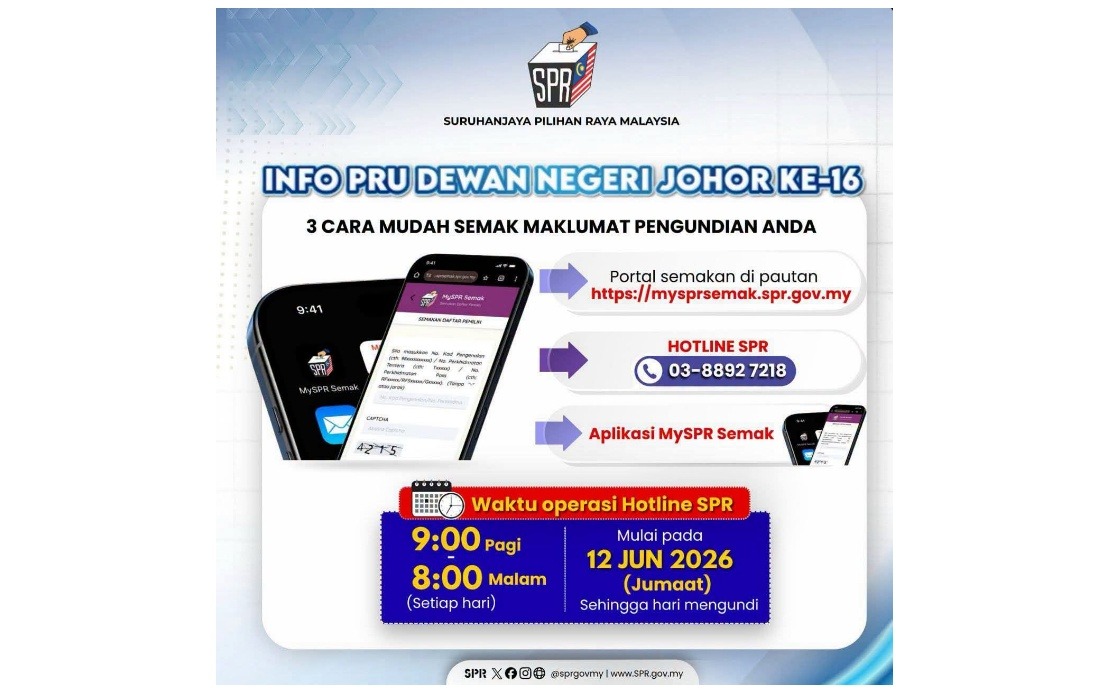
As Johor prepares for its 16th state election this Saturday, the Election Commission has issued a timely advisory reminding all registered voters to verify their polling locations and voting streams in advance. The move reflects the electoral body's commitment to ensuring a smooth and efficient voting process across the state, where nearly 2.7 million eligible ordinary voters are expected to participate in selecting 56 state assembly representatives for the next legislative term.
Voters can access their designated polling centre information through two convenient channels: the MySPR Semak online portal or the dedicated MySPR Semak mobile application. This digital approach aligns with Malaysia's broader push toward paperless civic engagement and reduces the need for voters to make separate inquiries at local electoral offices. The EC's public messaging emphasizes that fulfilling one's responsibility as a voter is a fundamental aspect of democratic participation, framing the election not merely as a political event but as a civic duty.
The electoral landscape in Johor is notably competitive this cycle. A total of 172 candidates are contesting across the 56 state seats, reflecting intense interest from multiple political coalitions and parties. The major players—Pakatan Harapan and Barisan Nasional—have each fielded a full slate of 56 candidates, signalling their respective commitments to capturing the state. Perikatan Nasional presents a formidable third force with 33 candidates, while newer entrants including Parti Bersama Malaysia with 15 candidates and MUDA with four candidates add further diversity to the ballot.
Beyond these larger groupings, the election also features representation from smaller parties pursuing alternative political visions. Parti Orang Asli Malaysia and Parti Sosialis Malaysia have joined the fray, alongside six independent candidates who are running outside established party structures. This fragmented candidate pool underscores the evolving complexity of Malaysian electoral politics, where traditional two-coalition contests increasingly give way to multi-polar competition that can significantly alter seat distributions and bargaining dynamics.
Early voting has already commenced, with 19,471 personnel from security and defence forces exercising their franchise ahead of the main polling day. This cohort included 7,960 military personnel and their spouses, alongside 11,511 police officers—encompassing members of the General Operations Force and their families. These advance polls, conducted last Tuesday, represent a standard provision within Malaysia's electoral framework designed to accommodate those whose duties prevent them from voting on the designated Saturday. The turnout among early voters provides an initial snapshot of anticipated participation levels across the broader electorate.
For Malaysian voters, particularly those in Johor, the verification process carries practical importance beyond mere formality. Incorrect or outdated polling centre assignments can inadvertently disenfranchise voters if they arrive at wrong locations unaware of the error. By proactively checking their details through MySPR Semak, voters can identify any discrepancies and address them through proper channels before Saturday arrives. This preventative approach reduces confusion on election day itself, when polling stations operate under time pressure and administrative staff cannot accommodate address corrections on the spot.
The election holds significance beyond Johor's state boundaries. As one of Malaysia's most populous and economically important states, Johor's political orientation influences broader national dynamics. The state has traditionally been a stronghold for Barisan Nasional, though recent electoral cycles have demonstrated growing support for opposition coalitions. The 2023 federal election, which preceded this state poll, suggested shifting voting patterns among Johor residents, making this 16th state election a crucial test of whether those trends have solidified or whether voters are reverting to traditional preferences.
The presence of multiple coalitions and independent candidates reflects deeper transformations within Malaysian politics. The rise of Perikatan Nasional as a credible electoral force, particularly following recent defections and reorganizations, has fragmented the opposition vote in some constituencies while consolidating it in others. MUDA's participation, though with limited candidate numbers, represents the aspirations of younger voters seeking alternatives to established political structures. These developments suggest that simple binary contests between government and opposition coalitions are increasingly giving way to complex, multi-dimensional political competition.
For Southeast Asian observers, Johor's election demonstrates how Malaysia's democratic institutions continue to function amid evolving political realignments. The Election Commission's routine but essential reminder about checking polling details might appear mundane, yet it reflects institutional efforts to minimize administrative barriers to voting. In the context of regional concerns about electoral integrity and accessibility, such measures underscore Malaysia's commitment to enabling broad-based participation, even as the country grapples with the complexities of managing elections in an increasingly multipolar political environment.
Voters should note that the MySPR Semak system provides not only polling centre locations but also information about their assigned voting streams, which determine the specific voting queue they will join on the day. This prevents unnecessary crowding at individual polling stations and streamlines the voting process. Given that 2.7 million voters are expected to cast ballots across 56 constituencies, efficient organization becomes critical for maintaining orderly procedures and ensuring that all eligible voters can exercise their franchise without excessive waiting times.

