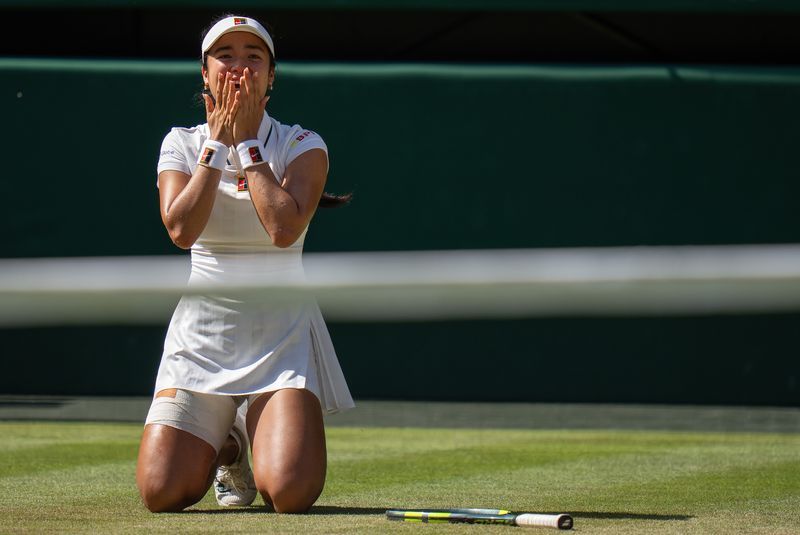
Alexandra Eala has become the latest Filipino athlete to capture global attention, but the 21-year-old Filipina tennis player sees her Wimbledon breakthrough as more than personal achievement. Following her victory over Poland's Iga Swiatek on Saturday, Eala expressed hope that her rise would galvanise young Filipinos to pursue their own sporting ambitions rather than simply emulate her career. Her progression to the fourth round of the Grand Slam represents a watershed moment for Filipino tennis on the international stage.
The emergence of Eala on the professional women's tennis circuit has been one of the sport's most engaging narratives in recent seasons. Her distinctive blend of fearless court play and genuine warmth has attracted substantial crowds at major tournaments, making her matches compelling viewing experiences. Beyond the statistical achievements, Eala's authenticity and accessibility have resonated with tennis followers worldwide, transforming her into more than just an athlete competing for titles and ranking points.
Philippine sports culture has historically revolved around boxing, with Manny Pacquiao remaining the dominant figure in national sporting consciousness for decades. However, Eala's trajectory suggests that Filipino excellence in tennis could establish a parallel tradition of achievement in a different sport altogether. Her potential as a national icon extends beyond tournament victories; she represents the possibility of success in disciplines where the Philippines has not traditionally held global prominence. This diversification of national sporting heroes could reshape how Filipinos view international competition and their country's place in global athletics.
During her post-match press conference, Eala articulated a philosophy that transcends conventional athlete messaging. Rather than positioning herself as a template for younger players to copy, she expressed a desire to inspire self-determination and individual path-finding. "I want them to look at me and say, 'Wow, I want to be the first me. I want to make my own path'," she explained, emphasising authenticity and personal values. This perspective reflects maturity uncommon in athletes of her age and demonstrates her awareness of the responsibility accompanying her elevated platform.
Eala's approach to managing public attention reveals deliberate psychological balance. She has cultivated consistency in being genuine in public interactions while maintaining competitive intensity on the court. The exposure accompanying her rise has become an opportunity for self-reflection rather than a distraction. She recognises that people across the Philippines and beyond follow her career with considerable interest, and this knowledge shapes her decisions about how to conduct herself both in competition and in public settings. This mindfulness suggests a player capable of handling the pressures accompanying sustained success at the highest levels of professional tennis.
Her immediate reaction to defeating Swiatek—dropping to the ground in tears—conveyed the emotional weight of reaching her first Grand Slam fourth round. Yet Eala was careful to distinguish between celebrating an important victory and allowing that satisfaction to compromise her competitive hunger. She held back tears during the on-court interview, demonstrating emotional regulation even in a moment of triumph. This capacity to acknowledge achievement whilst maintaining forward-looking intensity suggests a temperament suited to the demands of elite tennis, where the ability to move mentally from one match to the next determines career longevity.
Eala's next opponent, Jasmine Paolini, reached the Wimbledon final as the 29th seed in 2024, representing a significant challenge for the young Filipino player. As the 29th seed herself, Eala faces an opponent with recent Grand Slam experience and proven capability at the highest level of competition. The quarterfinal matchup will test whether her breakthrough against Swiatek represents genuine advancement or a temporary peak. Regardless of the outcome, her mere presence at this stage of the tournament validates her development as a serious competitor rather than merely a promising prospect.
Eala attributed her ability to compartmentalise emotional celebration and competitive focus to her natural character rather than deliberate training. However, she also recognised that maintaining this mental sharpness represents a skill requiring ongoing development. The capacity to switch mental states between celebrating victories and preparing for subsequent challenges is not innate but requires consistent practice and refinement. This self-awareness about the psychological dimensions of professional tennis suggests that Eala brings not only talent but also intellectual rigour to her career development.
The broader implications of Eala's success extend across Southeast Asia and the wider region. Her achievements demonstrate that tennis players from the Philippines can compete effectively against Europe's established stars, challenging preconceptions about which nations produce elite tennis talent. For Malaysian readers, Eala's trajectory offers relevant perspective on regional sporting potential. Malaysian tennis has experienced its own notable achievements, yet Eala's rise illustrates how individual athletes can elevate national sporting profiles significantly. Her success may inspire fresh examination of investment, training infrastructure, and talent identification across Southeast Asian tennis programmes.
Eala's insistence that young people pursuing their own paths rather than copying her specifically reflects contemporary thinking about inspiration and role modelling. Rather than creating followers, she hopes to catalyse independent achievement across diverse domains. This philosophy resonates particularly with Philippine youth facing limited examples of excellence in sports beyond boxing and basketball. By positioning herself as an inspiration to self-directed ambition rather than as a definitive model, Eala acknowledges the diversity of talent and potential within her generation of Filipinos and Southeast Asians.
As Eala prepares for her quarterfinal contest against Paolini, she carries the attention of millions who see in her victory over Swiatek evidence that new possibilities exist for Philippine sports. Her measured responses to success and clear articulation of values suggest an athlete capable of sustaining excellence over time rather than experiencing a meteoric but brief peak. Whether she ultimately wins the tournament or exits in the next round, Eala has already achieved something significant: she has shown that Filipino tennis can command global stages and inspire meaningful conversations about aspiration, authenticity, and individual determination. Her presence at Wimbledon's business end represents not merely a personal accomplishment but a potential inflection point for how Southeast Asian sports are perceived internationally.

