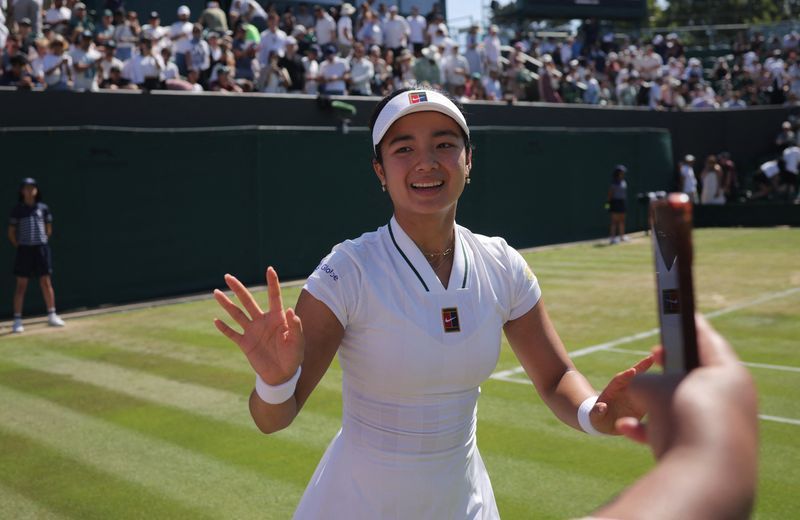
Alexandra Eala has etched her name into Philippine sports history by becoming the first player from her nation to advance to the third round of a Grand Slam tournament. The 21-year-old from Quezon City produced a commanding display at Wimbledon on Thursday, overturning a slow start to defeat Australia's Maya Joint 3-6 6-2 6-0 in a match that showcased her growing confidence on grass courts. Joint had earlier in the week claimed the scalp of seven-time Grand Slam champion Serena Williams in the opening round, making Eala's victory all the more impressive. Now seeded 29th at the championship, Eala will confront an even steeper challenge on Saturday when she meets Iga Swiatek, the defending champion and six-time Grand Slam winner from Poland.
The milestone represents far more than a mere statistical achievement for Philippine tennis. For a nation with limited representation at the sport's highest levels, Eala's breakthrough carries symbolic weight that extends beyond the All England Club's hallowed grass courts. Her achievement arrives at a moment when Southeast Asian players remain underrepresented at Grand Slam tournaments, making her advancement particularly significant for the region's tennis aspirations. The win against Joint, though lopsided in the final two sets, demonstrated the capacity of a young player to elevate her performance when the stakes mount, a quality that separates contenders from champions in professional tennis.
Despite acknowledging the difficulty that awaits against Swiatek, Eala approached the prospect with measured confidence. Speaking to reporters following her victory, the teenager indicated her determination to compete at the highest level without intimidation, while remaining realistic about the challenge. "I think it's going to be tough for me. I'm going to try to make it tough for her, as well," she remarked. Her composed demeanour reflected maturity beyond her years, suggesting that the mental fortitude required for sustained success at the professional level is developing alongside her technical capabilities. This is only her sixth Grand Slam appearance, yet she has already demonstrated the adaptability necessary to perform across different surfaces, a rarity among emerging players.
Eala's connection to her cultural identity plays a central role in her approach to professional tennis. Inscribed on the back of her sun visor at Wimbledon was a Tagalog phrase—"Kapag lumago, hindi na hihinto"—which translates loosely as "once it grows, it cannot be stopped." This personal motto appears to encapsulate her philosophy on her career trajectory and her commitment to continuous improvement. The slogan was incorporated into her kit through collaboration with her sponsor Nike, reflecting how international brands are increasingly attuned to athletes' desires to express their heritage on global platforms. For Eala, this is not mere marketing but a genuine expression of her values.
The integration of Philippine cultural symbols into her equipment extends beyond simple branding. During her Wimbledon debut last year, Nike provided her with a custom hair tie adorned with a sampaguita bloom, the national flower of the Philippines. These touches, small in themselves, carry outsized emotional significance for Eala. She articulated the profound meaning of representing her nation on tennis's grandest stages, describing it as "sentimental" to carry parts of her culture with her during competition. This emotional dimension to her tennis serves a dual purpose: it grounds her in her identity while simultaneously elevating her performance through the added motivation of representation.
Eala's trajectory within professional tennis has been notably steep. She broke into the top 50 rankings last year and has maintained an upward trajectory throughout 2024. Her particular comfort on grass surfaces, demonstrated by her title victory in Birmingham last month and her semi-final appearance in Berlin, suggests that she may have found a surface that suits her playing style and temperament. Wimbledon, with its emphasis on serve-and-volley traditions and fast court conditions, appears to bring out the best in her game. This specialisation could prove valuable in future championships, positioning her as a potential contender during the summer grass season.
Being the sole representative from the Philippines in the Wimbledon main draw has amplified the responsibility Eala feels to perform. She acknowledged the weight of this distinction while emphasising that her achievements remain fundamentally personal. "It sounds super impactful when you say it like that," she noted when confronted with the historical significance of her advancement. Yet she was careful to frame her success as the culmination of personal goals and individual effort rather than solely as a burden of national representation. This balance between personal ambition and collective pride appears to be a source of motivation rather than pressure for the young athlete.
The pathway that lies ahead for Eala involves competing against some of the sport's elite practitioners. Swiatek represents the contemporary standard of excellence in women's tennis, and facing her will provide Eala with a benchmark for improvement. While the immediate challenge on Saturday seems formidable, the broader trajectory of Eala's career suggests a player still discovering her capabilities. Her refusal to compromise her values or to imitate other players indicates a maturity in approach that often proves valuable in sustained career development.
For Malaysian readers and Southeast Asian tennis enthusiasts, Eala's breakthrough carries implications beyond individual achievement. The Philippines has historically produced strong athletes across various sports, yet tennis representation at the elite international level has remained limited. Eala's success may catalyse increased investment in tennis development programmes throughout the region, potentially benefiting talented young players across Southeast Asia. Her presence at Wimbledon represents not just a personal triumph but a signal that the region can produce competitive Grand Slam participants. As she continues to accumulate experience at tennis's highest level, the long-term impact of her achievements may extend far beyond her own career, opening pathways for future generations of Southeast Asian tennis players.

