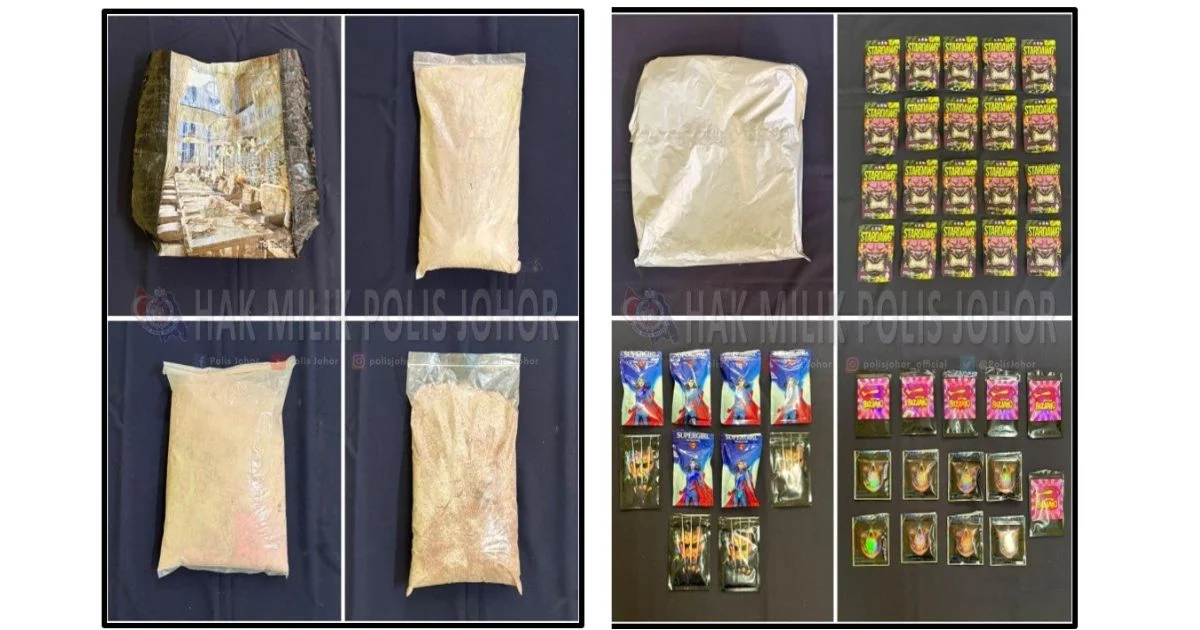
Law enforcement authorities in Johor Baru have successfully concluded a major operation targeting organised drug trafficking, culminating in the arrest of a married couple and the confiscation of narcotics worth approximately RM3.59 million. The operation, conducted in the Kulai district, represents a significant blow to the region's drug supply chains and underscores ongoing efforts by Malaysian police to combat the proliferation of illicit substances across the state.
The investigation leading to the arrests appears to have formed part of a broader strategy by the Royal Malaysia Police to dismantle networks responsible for large-scale drug distribution. Kulai, situated in the southern corridor of Johor near major industrial and transportation hubs, has historically been identified as a strategic location for drug trafficking operations due to its proximity to supply routes and consumer markets. The timing and execution of this particular bust suggest that intelligence gathering and surveillance had been tracking the couple's suspected involvement for some period before the intervention.
The seizure of drugs valued at RM3.59 million indicates that authorities were dealing with more than a simple possession case. Such substantial quantities typically suggest an operation geared towards wholesale distribution rather than personal consumption, and the involvement of a married couple raises questions about the operational structure and roles within the suspected syndicate. Whether the individuals were primarily involved in storage, distribution, or coordination of supply networks remains a matter for ongoing investigation and potential court proceedings.
For the Johor region specifically, which has struggled with persistent drug-related challenges, this operation provides a measure of enforcement activity. The state's strategic location as a corridor between Peninsular Malaysia and Singapore, combined with its industrial landscape and port facilities, has made it attractive to drug trafficking organisations seeking to establish supply chains and distribution networks. Each successful enforcement action serves as both a deterrent and a demonstration of police capability.
The arrest raises broader implications for anti-narcotics policy in Malaysia. The involvement of civilians in what appears to be a significant trafficking operation underscores how drug syndicates continue to recruit individuals from various backgrounds to facilitate their operations. This pattern has consistently complicated enforcement efforts, as it expands the potential pool of offenders and requires law enforcement to identify and disrupt supply chains at multiple points rather than targeting a small core group.
The confiscation of RM3.59 million worth of drugs removes a substantial quantity from circulation, potentially affecting the availability and pricing of narcotics in downstream markets served by this particular operation. However, enforcement experts note that the removal of one distribution network, while valuable, typically triggers market adjustments as rival organisations seek to capture the displaced market share. This dynamic suggests that the bust, while significant, likely represents one engagement in a longer-term struggle against organised narcotics trafficking.
The police operation also highlights the continued investment by Malaysian law enforcement in intelligence-led policing and surveillance capabilities. The progression from investigation to arrest to significant drug seizure indicates that officers were able to identify, track, and ultimately apprehend suspects involved in substantial criminal enterprise. Such operations require coordination between multiple police units, intelligence gathering, and careful planning to execute safely and effectively.
From a regional perspective, drug trafficking remains a persistent challenge across Southeast Asia, with Malaysia serving as both a transit point and market for various narcotics. The country's geographic position, transportation infrastructure, and economic development make it vulnerable to organised trafficking operations. Successful enforcement actions contribute to international anti-narcotics efforts by disrupting supply chains that often span multiple countries and jurisdictions.
The case will likely proceed through Malaysia's criminal justice system, where the couple will face charges related to drug trafficking under the Dangerous Drugs Act or similar legislation. The severity of potential sentences reflects the serious nature of large-scale drug distribution offences in Malaysian law. Convictions in such cases typically result in substantial prison terms and fines, serving as powerful deterrents against participation in narcotics trafficking.
Authorities have indicated that investigations into the drug syndicate are continuing, suggesting that police may be pursuing leads related to the supply chain and distribution networks connected to the arrested couple. Dismantling a complete supply network requires identifying and addressing multiple tiers of involvement, from production or importation through wholesale distribution to street-level sales. The couple's apprehension may therefore be the initial phase of a broader enforcement initiative targeting the broader criminal enterprise.
Citizens in Johor and neighbouring states have been encouraged to report suspicious drug-related activity to authorities. Such community engagement remains an essential component of drug enforcement, as residents often possess crucial information about trafficking activity occurring in their neighbourhoods. The police have reiterated their commitment to combating drug crime and promised continued operations against organised narcotics trafficking throughout the state.

