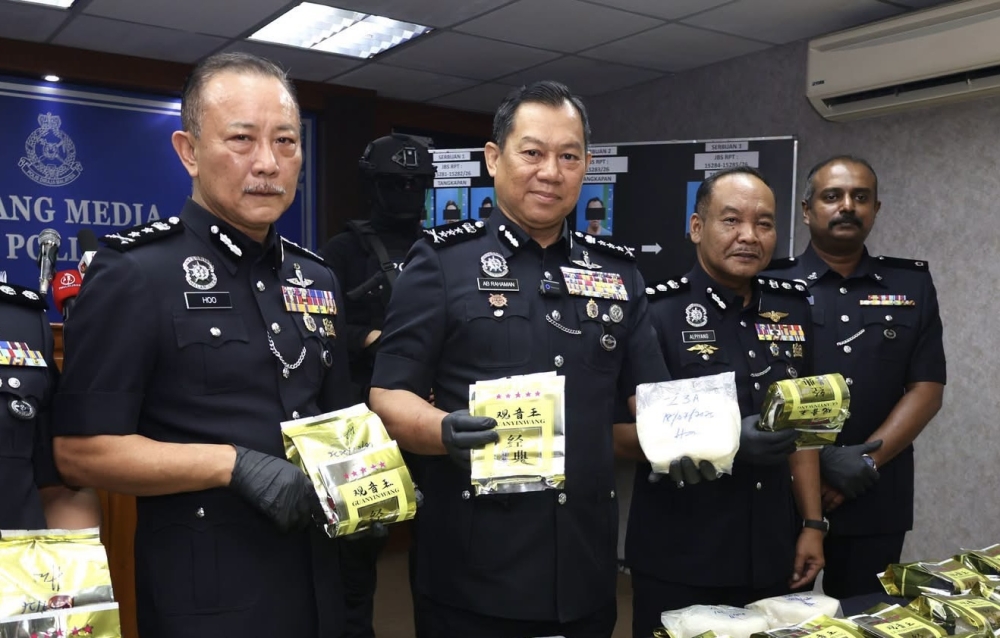
Johor Bahru police have concluded a significant operation against organised drug trafficking, resulting in the arrest of eight suspects spanning multiple demographic groups and locations throughout the southern state. The breakthrough came as authorities conducted coordinated raids that targeted members of a synthetic drug network accused of trafficking controlled substances across the region. Among those detained was a 16-year-old, underscoring growing concerns about adolescent involvement in the illicit drug trade—a troubling trend that mirrors patterns observed across Malaysia and the wider Southeast Asian region.
The investigation, which culminated in the arrests, revealed an unusually brazen operational method: members of the syndicate had been utilising a motor vehicle, reportedly belonging to an elderly relative, as a mobile distribution hub. This makeshift arrangement allowed traffickers to move their inventory discreetly across different neighbourhoods while minimising the risk of stationary surveillance. The vehicle's use as a travelling drug store suggests a deliberate strategy to evade conventional law enforcement tactics that typically focus on identified premises.
The involvement of a teenager within the syndicate's structure reflects a disturbing recruitment pattern where organised drug groups increasingly target younger individuals. Adolescents present operational advantages to criminal networks—they typically face less suspicion from enforcement agencies, can navigate communities more freely, and are often perceived as expendable by higher-ranking organisers. This particular case demonstrates how family connections may inadvertently facilitate drug operations, with the grandfather's vehicle becoming unwittingly complicit in distribution activities.
Synthetic drugs remain a persistent challenge for Malaysian law enforcement across all states, but Johor has experienced particular pressure given its geographical proximity to Singapore and its position as a major trafficking corridor. The southern corridor's porous boundaries and active port facilities create conditions where amphetamine-type stimulants and other manufactured narcotics flow relatively freely. Johor's population density in urban centres like Johor Bahru provides sufficient consumer markets to sustain distribution networks of this nature.
The police operation's success hinged on intelligence gathering and surveillance work that allowed investigators to connect individual suspects to a cohesive organisational structure. Such operations typically require weeks or months of groundwork before authorities possess sufficient evidence to execute coordinated raids. The decision to move simultaneously across multiple locations aimed to prevent suspects from destroying evidence or alerting remaining network members.
For Malaysian authorities, dismantling youth-focused trafficking networks presents particular urgency given documented links between drug abuse and rising crime rates among adolescents. When teenagers become entrenched in supply chains rather than merely consuming drugs, rehabilitation becomes exponentially more difficult. The criminal socialisation that occurs through trafficking involvement often leaves lasting psychological impacts that complicate reintegration efforts. Many Southeast Asian countries have identified this demographic segment as requiring specialised intervention strategies.
The vehicle's role in this operation also illustrates how modern trafficking adapts to enforcement pressures. Traditional fixed-location distribution points remain vulnerable to the established investigative protocols that police have refined over decades. Mobile operations, conversely, require different detection methodologies and demand resources that many jurisdictions struggle to sustain. The creativity evident in this approach underscores why law enforcement agencies continuously revise their operational doctrines.
Family involvement—whether the grandfather knowingly cooperated or remained entirely unaware—raises uncomfortable questions about how criminal networks exploit kinship ties. In many cases, older relatives possess vehicles, homes, and business interests that traffickers coerce or deceive them into facilitating. The psychological harm inflicted on such individuals when they discover they have become accomplices should not be underestimated, yet receives minimal public attention compared to more sensational aspects of drug cases.
Beyond the immediate arrests, this operation yields valuable intelligence about syndicate structures, supplier relationships, and consumer distribution patterns. Authorities will examine communication records, financial transactions, and physical evidence recovered during the raids to map broader networks. Such intelligence frequently leads to subsequent operations targeting higher-level organisers and international trafficking channels that feed drugs into Malaysian streets.
The Johor operation exemplifies challenges that regional governments share regarding synthetic drug proliferation. Malaysia's strategic location between major production zones in the Golden Triangle and massive consumer markets makes complete interdiction nearly impossible. Instead, enforcement must focus on disrupting organisational effectiveness, increasing operational costs for traffickers, and applying sustained pressure on distribution chains. Each successful bust sends ripples through networks, creating uncertainty and temporary supply disruptions that benefit public health efforts.
As Malaysian society grapples with evolving narcotics threats, cases like this serve as reminders that drug trafficking involves diverse participant categories—not merely hardened criminals but increasingly desperate adolescents, struggling families, and ordinary citizens drawn into dangerous networks through circumstance or coercion. Comprehensive responses must therefore address supply-side enforcement alongside demand reduction, youth intervention, and community education initiatives.

