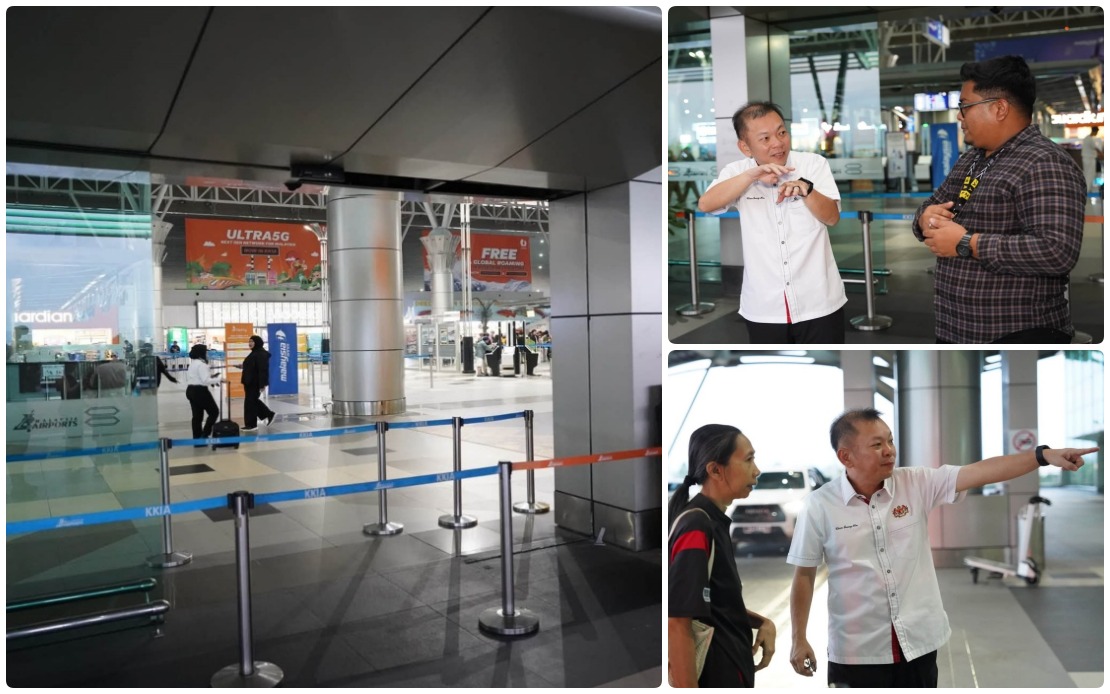
A woman driver was taken to hospital with minor injuries after losing control of her sports utility vehicle and crashing into the glass entrance doors of Kota Kinabalu International Airport's departure level on Wednesday afternoon. The accident occurred at approximately 4:20 pm on Level 3 of the terminal's kerbside entrance, causing substantial damage to the vehicle and shattering the glass door structures at the main entry point. No other airport visitors or staff members were harmed in the collision, though the impact left the front of the vehicle severely damaged and resulted in cleanup operations that extended into the early evening hours.
Police began their initial investigation immediately following the incident. District Police Chief ACP Shahrudin Mat Husain confirmed the timing and location of the crash but indicated that authorities were still working to establish the precise circumstances that caused the vehicle to lose control. The investigation remains ongoing as investigators seek to determine whether mechanical failure, driver error, medical emergency, or some other factor contributed to the accident. Police have indicated that the full findings will clarify what transpired in the moments leading up to the collision.
The airport operator mobilised its emergency response protocols swiftly following the incident. Malaysia Airports stated that Aviation Security and Customer Service personnel reached the scene within minutes of the 4:19 pm collision and immediately requested medical assistance for the injured driver. The affected motorist was transported by ambulance to a nearby hospital for treatment of her minor injuries. Personnel worked to remove the damaged vehicle and associated debris from the departure area, with the kerbside cleared and returned to serviceable condition by 6:00 pm. Repair work on the damaged entrance doors began immediately and is currently proceeding.
Despite the dramatic nature of the incident and the visible damage to airport infrastructure, Malaysia Airports confirmed that overall operations at Kota Kinabalu International Airport sustained no meaningful disruption. The operator maintained that passenger throughput and airport functions continued normally throughout the emergency response and aftermath. The incident was confined to a single entrance on the departure level, whilst alternative access points and the airport's primary facilities remained fully operational. The swift clearing of debris and damaged materials ensured that no bottlenecks developed in passenger flow or airport activities.
Deputy Minister of Agriculture and Food Security Datuk Chan Foong Hin, who was coincidentally arriving at the airport at the moment of the incident, publicly commended the airport management's handling of the emergency. In remarks posted to social media, he acknowledged the professionalism and efficiency displayed by KKIA personnel in responding to the crisis, securing the area, and restoring normal conditions. He noted that the airport's automatic door systems elsewhere in the terminal continued functioning without interruption, enabling the seamless movement of passengers and airport users throughout the incident. His intervention served to reassure the public that despite the visual impact of the collision, the airport's operational integrity had been maintained.
The damaged glass entrance doors represent the most visible consequence of the accident. The structures sustained complete failure from the impact, with the glass shattering across the departure level entrance. Malaysia Airports moved quickly to initiate repair works, with contractors engaged to restore the doors to full functionality. The airport operator has not disclosed the estimated cost of repairing or replacing the damaged glass structures or the timeline for completing restoration work. The incident highlights the vulnerability of large glass architectural elements in high-traffic airport environments, where vehicle incidents, though rare, can cause substantial damage to building infrastructure.
The matter now falls within the purview of law enforcement, with Malaysia Airports confirming that the Royal Malaysia Police has taken charge of the investigation. The airport operator stated its commitment to providing complete cooperation to relevant authorities as they examine the circumstances of the crash. Police investigations typically examine vehicle condition, driver status, eyewitness accounts, and any available security footage from airport surveillance systems to reconstruct the sequence of events. The cooperation between airport security and police will likely establish a comprehensive record of the incident.
For Malaysia's aviation sector, vehicle-related incidents at airport premises remain statistically uncommon but represent a recognised safety consideration. Airports maintain security protocols and physical barriers specifically designed to prevent unauthorised vehicle access to sensitive terminal areas. This incident appears to have involved an inadvertent loss of vehicle control rather than any deliberate or criminal act. The rapid response and damage containment demonstrate the effectiveness of airport emergency procedures in managing unexpected incidents that threaten passenger safety or infrastructure integrity.
From a passenger perspective, the incident underscores the general resilience of modern airport operations to localised disruptions. The ability to maintain service delivery and passenger throughput despite the temporary closure of a single entrance point reflects the redundancy and flexibility built into contemporary terminal design. Travellers using Kota Kinabalu International Airport would have experienced minimal inconvenience, with alternative entry and exit routes available throughout the emergency response period. The airport's swift recovery to normal operations within hours of the incident reassured users of the facility's commitment to continuous service provision.

