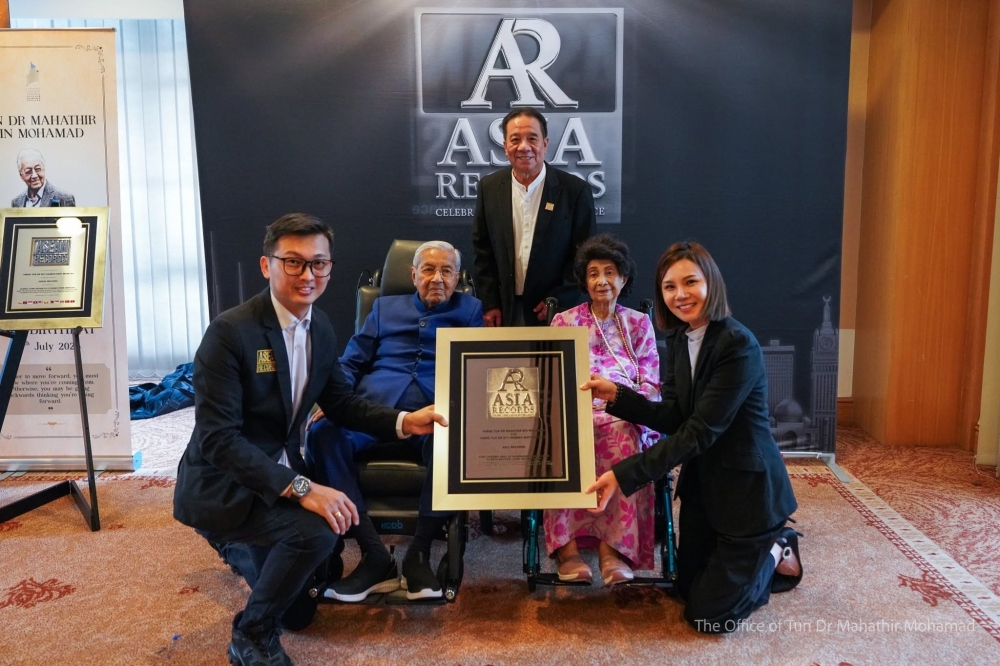
Former Prime Minister Tun Dr Mahathir Mohamad and his wife Tun Dr Siti Hasmah Mohd Ali have joined an exclusive global club by becoming centenarians, an accomplishment that has now been formally recognised by Guinness World Records through three separate citations. The dual milestone represents not merely personal longevity but underscores the enduring partnership between two of Malaysia's most prominent public figures whose combined century-plus of life experience has witnessed the nation's transformation across multiple decades.
The recognition comes as both individuals have crossed the symbolic threshold of 100 years of age, drawing international attention to their sustained vitality and active engagement in public life. Guinness World Records, the authoritative arbiter of such achievements, determined that their dual centenarian status qualified them for record classification. This acknowledgement places the couple among an exceptionally rare category of married partners worldwide who have both achieved this milestone simultaneously, a distinction that speaks to modern advances in healthcare, lifestyle management, and the particular circumstances that have enabled their exceptional longevity.
Dr Mahathir's extended public career, which included serving as Malaysia's fourth Prime Minister across two separate tenures, has made him one of the nation's most recognisable political figures. His continued involvement in political discourse and public commentary even into his second century demonstrates a level of mental acuity that defies conventional expectations of advanced age. Dr Siti Hasmah, equally accomplished in her own right, has maintained a substantial public profile through her philanthropic endeavours and advocacy work, particularly in the healthcare and education sectors. The couple's combined contributions to Malaysian society have spanned from the nation's post-independence period through to the present day.
The three records bestowed upon them reflect different dimensions of their achievement. Each category acknowledges specific aspects of their longevity milestone, recognising not only their individual attainment of century status but also the exceptional circumstances of a long-married couple reaching this point together. Such documentation by a globally respected institution like Guinness World Records carries weight beyond mere curiosity value—it provides a benchmark against which Malaysia's life expectancy and healthcare outcomes can be measured internationally.
Malaysia's demographic profile has shifted substantially over the past several decades, with life expectancy gradually increasing due to improvements in medical care, nutrition, and living standards. The centenarian population within the country has grown measurably, though individuals reaching 100 years remain statistically uncommon. Dr Mahathir and Dr Siti Hasmah's achievement thus reflects broader positive trends in public health while simultaneously highlighting their personal commitment to maintaining wellness and engagement with life.
Their records come at a time when Malaysia is grappling with an ageing society, a demographic reality with significant implications for healthcare systems, pension structures, and social support mechanisms. The visibility of active, engaged centenarians like Dr Mahathir and Dr Siti Hasmah offers a contrasting narrative to assumptions about decline associated with extreme old age. Their continued participation in public discourse—whether through media appearances, written commentary, or family engagement—demonstrates that age need not diminish intellectual capacity or social contribution.
The international recognition also carries symbolic importance for Southeast Asia more broadly. As developing economies in the region experience rising living standards and healthcare improvements, instances of citizens achieving exceptional longevity become markers of developmental progress. Malaysia's capacity to support citizens living into their second century reflects decades of investment in medical infrastructure, public health initiatives, and social safety nets that have gradually expanded across the nation.
From a family perspective, the couple's milestone represents a remarkable testament to their partnership's resilience. Dr Siti Hasmah has been a consistent presence throughout Dr Mahathir's political career, navigating the demands and pressures of political life while maintaining her own intellectual and professional pursuits. Their sustained relationship across seven decades of marriage, now acknowledged globally, presents a counternarrative to contemporary concerns about relationship stability and family cohesion.
The Guinness recognition will likely prompt increased interest in longevity studies focusing on Malaysian subjects, potentially yielding insights applicable to public health policy. Researchers may seek to understand the specific factors—genetic, lifestyle, medical, or environmental—that have contributed to their exceptional lifespans. Such investigation could inform Malaysia's approach to eldercare and preventive health strategies as the nation anticipates an increasingly aged population in coming decades.
Looking forward, Dr Mahathir and Dr Siti Hasmah's records serve multiple functions within Malaysian society. They exemplify the possibilities of longevity while raising questions about quality of life in extreme old age, the sustainability of pension systems, and the evolving role of elderly citizens in modern economies. Their achievements have repositioned conversations around ageing from one focused primarily on decline and dependency to one that acknowledges continued vitality, relevance, and contribution. As Malaysia develops policies addressing its demographic future, these centenarians offer both inspiration and practical reminders that human potential does not necessarily diminish with advancing decades.

