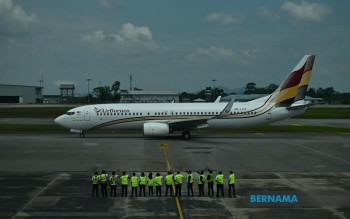
Deputy Prime Minister Datuk Seri Fadillah Yusof greeted AirBorneo Airways' inaugural flight as it touched down at Kuala Lumpur International Airport Terminal 1 today, underscoring the federal government's backing for Sarawak's ambitious aviation expansion. Flight MY5005 carried Premier of Sarawak Tan Sri Abang Johari Tun Openg alongside state ministers and dignitaries, signalling the political importance of the occasion and the strategic role the new airline will play in connecting Malaysia's largest state to the capital.
The launch represents far more than a routine commercial airline debut. For Sarawak, which has long sought greater autonomy over its aviation infrastructure and connectivity, AirBorneo's entry into the commercial market reflects a deliberate policy shift toward building indigenous air capacity. The state-owned carrier enters the market with two wet-leased Boeing 737-800 aircraft, positioning itself as a modern, professionally operated airline rather than a regional feeder service. This transition from a regional operator to a commercial jet service demonstrates Sarawak's determination to leverage aviation as an economic driver and reduce its dependence on other carriers for critical domestic connectivity.
AirBorneo chairman Datuk Amar Mohamad Abu Bakar Marzuki, who also serves as Sarawak state secretary, articulated a compelling vision for the airline's role in the state's development trajectory. He characterised aviation connectivity as a foundational economic asset that transcends the traditional airline function. By positioning aviation as central to Sarawak's future, the chairman emphasised how improved air links create cascading benefits—enabling businesses to operate more efficiently, facilitating tourism growth, and enhancing labour mobility across the state and region. This rhetorical framing places AirBorneo squarely within Sarawak's broader economic diversification strategy, particularly as the state seeks to reduce its historical dependence on commodity exports.
The federal government's presence at the event, represented by multiple ministers including Tourism, Arts and Culture Minister Datuk Seri Tiong King Sing, Women, Family and Community Development Minister Datuk Seri Nancy Shukri, and Deputy Transport Minister Datuk Hasbi Habibollah, underscores Kuala Lumpur's strategic interest in supporting state-level aviation initiatives. This intergovernmental cooperation reflects recognition that regional air connectivity strengthens Malaysia's broader economic competitiveness in Southeast Asia and facilitates the integration of Sarawak's economy with the rest of the country.
The commercial framework that AirBorneo has established demonstrates pragmatic pricing discipline. One-way Economy Class fares of RM375 position the airline competitively within Malaysia's domestic market, while Business Class starting at RM736 suggests the carrier recognises demand among business travellers and government officials who require premium service. These price points indicate management's understanding of the Kuching-Kuala Lumpur route's characteristics—a critical business and government traffic corridor that justifies both mass market and premium service offerings.
Operational planning reveals careful consideration of market demand patterns. The decision to launch twice-daily service beginning July 21, 2026, suggests confidence in sufficient passenger volumes to sustain this frequency. For Sarawak-based businesses, government agencies, and leisure travellers, this represents tangible improvement in connectivity options compared to the existing market structure. The frequency improvement alone could drive economic benefits by reducing travel friction and enabling more efficient business operations across the peninsula-Sarawak divide.
AirBorneo CEO Megat Ardian Mohd Aminuddin's emphasis on safety, reliability, and service quality reflects industry best practices and suggests the airline intends to compete seriously in Malaysia's domestic aviation sector rather than operating as a subsidised provincial carrier. This operational posture matters significantly for passenger confidence and route sustainability. If AirBorneo successfully establishes a reputation for dependable service at competitive pricing, the airline could capture meaningful market share and validate the state government's investment rationale.
The airline's geographic expansion strategy reveals ambitious growth plans. The Kuching-Kuala Lumpur route serves as the commercial foundation, but Singapore's designation as the first international destination indicates management's confidence in establishing a regional footprint. This expansion trajectory suggests AirBorneo intends to compete beyond Sarawak's borders, positioning itself as a regional carrier capable of tapping cross-border traffic. For Malaysian aviation, this represents meaningful competitive development, as the market traditionally concentrated on long-established carriers.
From a Malaysian aviation policy perspective, AirBorneo's launch exemplifies the broader strategy of encouraging state-level participation in aviation development. Rather than maintaining a centralised model where major airports and airlines concentrate in Peninsular Malaysia, federal policy increasingly facilitates regional carriers. This approach potentially distributes aviation benefits more broadly across Malaysia and strengthens individual states' capacity to shape their own connectivity destiny. Sarawak's airline venture tests whether state ownership and management can sustain competitive airline operations in Malaysia's challenging domestic market.
The timing of the launch carries economic significance as well. By establishing commercial aviation operations from Kuching, AirBorneo taps into growing recognition that Sarawak's geographic position and natural resources make it increasingly central to Malaysia's economic future. Improved air connectivity supports this repositioning by reducing travel time and costs between Kuching and national decision-making centres in Kuala Lumpur. For Malaysian businesses seeking to develop Sarawak-based operations or for state-based companies expanding eastward, enhanced aviation options reduce operational friction.
Looking forward, AirBorneo's success will depend significantly on execution across multiple dimensions. Maintaining schedule reliability, managing costs effectively, and building passenger loyalty all present considerable challenges in Malaysia's competitive aviation market. However, the state government's backing and strategic positioning suggest this venture carries longer-term significance than a typical commercial airline launch. If AirBorneo successfully establishes itself as a credible carrier while maintaining acceptable operational standards, the airline could become a model for how Malaysian states can develop aviation capacity to serve development objectives.

