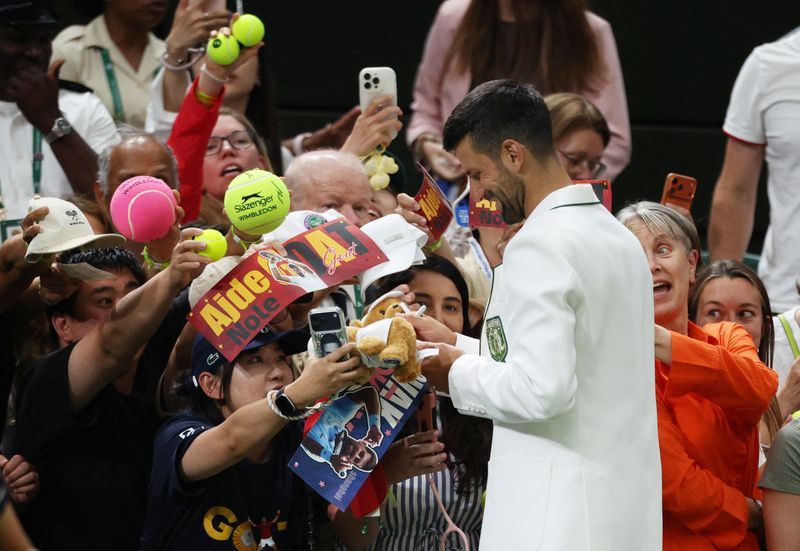
Novak Djokovic's commanding performance at Wimbledon revealed not just the dominance of his playing style but also a lighter side to the 24-time Grand Slam champion. During his lopsided victory against Stefanos Tsitsipas on Wednesday, the Serbian great cruised to a 6-3, 6-4, 6-2 victory, a scoreline that reflected his complete control of the match and allowed his personality to flourish on court and beyond.
The most memorable moment off the actual playing surface came when Djokovic, needing some black tape removed from his right shoulder, requested assistance from a nearby ball girl. In a playful moment of mischief, he feigned intense pain as she carefully cut the tape with scissors, his sudden cry alarming the young attendant. She visibly recoiled, stepping backward while clutching her chest, her face registering the shock of believing she had inadvertently caused injury to one of tennis's greatest players in front of millions of global viewers. The moment hung suspended for just a fraction of a second before Djokovic's laughter broke the tension, revealing his harmless jest. The ball girl's initial panic transformed into laughter of her own, creating a genuinely human connection in a professional sporting environment.
When asked about the prank during his post-match interview, Djokovic acknowledged that such moments typically emerge only when a player commands such authority over an opponent that the match becomes almost stress-free. The contrast between winning decisively and losing tightly fundamentally alters an athlete's demeanor and capacity for levity. He expressed genuine regret for frightening the young woman while simultaneously recognizing that the playfulness had actually enhanced his mental state during the match. This transparency about using humour as a relaxation mechanism offers insight into how elite athletes manage the psychological pressures of professional competition.
Beyond the court antics, Djokovic's performance against Tsitsipas demonstrated the Greek player's continued inability to trouble the Serbian legend on grass. The margin of victory was particularly telling—dropping only nine games across three sets indicated Tsitsipas never genuinely threatened to shift momentum. For Malaysian and Southeast Asian tennis followers, this match represented a masterclass in controlled aggression and consistency, qualities that underscore Djokovic's extraordinary achievement of maintaining elite-level performance across multiple decades.
The second act of Djokovic's entertaining afternoon unfolded when he spotted Rory McIlroy, the twice Masters champion, seated in Centre Court's Royal Box. McIlroy, one of golf's most recognizable contemporary figures, had arrived wearing his iconic green jacket—the prize every golfer covets and the uniform that distinguishes Masters champions from the rest of the sporting world. This cross-sport visibility at Wimbledon highlights the increasingly interconnected nature of global sporting events and the celebrity culture surrounding elite athletes across different disciplines.
Djokovic, who had been sporting a personalized cream-coloured blazer throughout the championships, seized the opportunity for another moment of entertainment. He gestured toward McIlroy's jacket during the on-court interview, offering an exaggerated compliment about the garment's appearance. His interest in the Masters trophy—one of sport's most prestigious and historically significant awards—was genuine enough to prompt him to explicitly ask whether McIlroy was indeed wearing the official Green Jacket from Augusta National.
What followed was a lighthearted challenge that drew roaring approval from the crowd. Djokovic proposed a swap: his personalized cream blazer exchanged for McIlroy's Green Jacket, to be decided through a tennis match rather than golf. The proposal contained multiple layers of humour. First, it playfully acknowledged that each sport has its own symbols of excellence that transcend monetary value. Second, it implied a confidence in his abilities across sports, suggesting he would trust tennis rather than golf as the mechanism for winning McIlroy's prized possession. Third, it demonstrated Djokovic's awareness of the global sporting audience and the entertainment value of cross-sport banter.
McIlroy's participation in this exchange, evident from his smiling nod and the crowd's enthusiasm, reflected the camaraderie that exists among elite athletes across different sports. Both men understood they were creating a memorable moment that would be discussed and shared far beyond the immediate Wimbledon audience. For viewers across Southeast Asia, including Malaysia, such moments humanize sports figures who often appear distant and supremely focused during competition.
The broader context of Djokovic's Wimbledon appearance carries significance for regional tennis development. His continued dominance at the game's most prestigious tournaments demonstrates the standards required to maintain peak performance in professional tennis. For aspiring players in Malaysia and the region, Djokovic's combination of technical excellence, psychological resilience, and ability to remain engaged with the sport's lighter moments offers a template for professional development that extends beyond mere technical proficiency.
Djokovic's behaviour throughout the day—from the innocent prank on the ball girl to the good-natured exchange with McIlroy—reflected the confidence of someone who has achieved virtually every major goal in tennis. Such relaxation is the privilege of champions who have secured their legacy and can afford to enjoy the moment. The contrast with his intensity during critical matches emphasizes how modern elite athletes modulate their psychological state according to competitive demands.
The Wimbledon crowd, historically known for its appreciation of tennis excellence and sporting spirit, responded enthusiastically to these moments. This suggests that spectators increasingly value not just the tennis itself but the authentic personality of the players. Djokovic's willingness to engage in playful interaction, rather than maintaining a stern, business-like demeanor throughout the tournament, likely contributed to the positive reception of both the prank and the McIlroy exchange.
As Djokovic continues his campaign through Wimbledon, these moments will likely be remembered alongside the clinical efficiency of his dominant victory. They serve as reminders that even at the highest levels of professional sport, moments of genuine human connection and entertainment can coexist with extraordinary athletic achievement. For Malaysian audiences following the championships, such displays demonstrate that greatness encompasses not just winning margins but also the ability to bring joy and laughter to those around you, from ball girls to fellow sporting legends.

