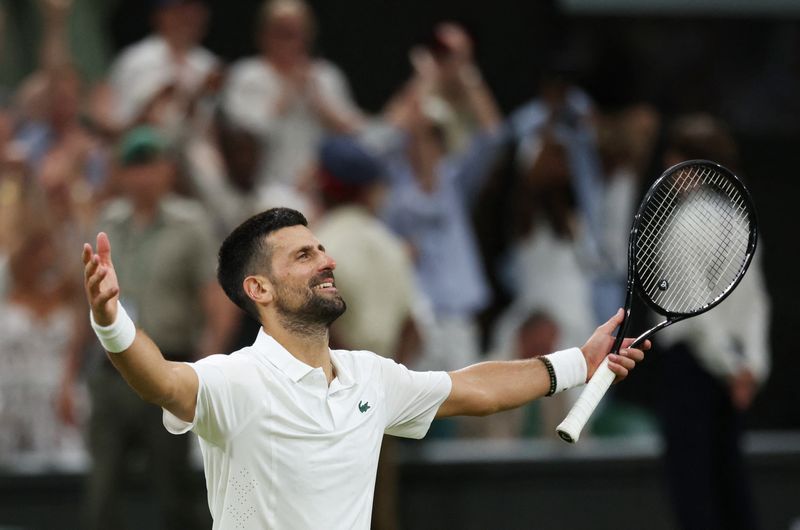
Novak Djokovic advanced to the Wimbledon semifinals for the eighth consecutive year on Tuesday, outlasting Canadian Felix Auger-Aliassime in an exhausting quarterfinal encounter that stretched across five hours and 15 minutes—the longest such match in the tournament's storied history. The Serbian champion secured the victory with a 7-6(10) 3-6 6-3 6-7(4) 7-6(10-4) triumph that tested both competitors' physical resilience and mental fortitude in a match that swung repeatedly in both directions before Djokovic ultimately prevailed in the deciding tiebreak.
At 39 years old, Djokovic continues to defy the conventional wisdom about athletic longevity on the professional tennis circuit. By advancing past Auger-Aliassime, the world number seven recorded his 106th victory at the All England Club, surpassing the previous record held by Roger Federer for most match wins at a single Grand Slam venue. More impressively, this latest semifinal appearance marks an unprecedented achievement: Djokovic has now become the first male player in tennis history to reach the last four in the same tournament for eight consecutive years, further extending his already considerable legacy at Wimbledon.
The quarterfinal itself unfolded as a compelling tactical duel between contrasting playing styles. Auger-Aliassime, the Canadian talent ranked among the world's emerging forces, displayed remarkable composure throughout much of the contest, particularly in the opening exchanges where he navigated a marathon first-set tiebreak that saw multiple opportunities slip away. The match's trajectory appeared to favour the younger player at several junctures, most notably when Auger-Aliassime engineered a decisive break in the second set to establish a commanding 5-3 lead. However, Djokovic's experience in high-pressure situations proved invaluable as he steadied himself, particularly after the Centre Court roof was closed at approximately 7:40 p.m. local time, an adjustment that subtly shifted the match's dynamics.
Djokovic's return to form in the third set demonstrated why he remains a formidable competitor despite his advancing years. The Serbian champion elevated his ground-stroke consistency, forcing Auger-Aliassime into increasingly uncomfortable positions and breaking his opponent in the sixth game to seize control of the match. This momentum appeared decisive until the fourth set, where Auger-Aliassime's fighting spirit reasserted itself. The Canadian recovered from an early service break to force a tiebreak, and an enthralling fifth-set decider ensued with neither player gaining a decisive advantage until Djokovic drew upon his vast reservoir of experience in match tiebreaks to finally prevail.
In characteristically reflective comments following his victory, Djokovic acknowledged the emotional and psychological toll of such gruelling matches. "I won with a racket and a lot of heart," he remarked, before elaborating on the mental challenge of maintaining composure during extreme pressure situations. He emphasised that the match represented precisely the type of contest that continues to motivate him to compete at the highest level, noting that the scoreline remained level throughout most of the encounter and that the final tiebreak could have feasibly concluded in either competitor's favour. Djokovic also revealed that the match's late finish meant he had to encourage his children to remain awake past their bedtime, calling it one of the most memorable contests of his entire career on Centre Court.
Djokovic's quest for an eighth Wimbledon title—which would match Federer's record at the tournament—now hinges on navigating an increasingly formidable semifinal challenge against defending champion Jannik Sinner. The Italian has established himself as the current world number one and represents a significant obstacle to Djokovic's pursuit of a 25th Grand Slam title, which would position him ahead of Margaret Court's 24 major championships. This prospective matchup carries considerable significance for the sport's narrative trajectory, pitting the veteran Serbian champion against a player representing the sport's next generation of dominance.
The physical and mental demands of the Auger-Aliassime encounter will inevitably influence Djokovic's preparation for the semifinal. He acknowledged the importance of recovery in the coming days, recognising that his body's resilience will prove critical in sustaining his challenge in the tournament's final stages. The extended quarterfinal, while ultimately successful, consumed substantial energy reserves that younger competitors entering their own semifinals would not have necessarily depleted to the same degree.
For Auger-Aliassime, the loss represents a bitter conclusion to a quarterfinal effort that demonstrated considerable promise and quality. The Canadian competitor showed glimpses of the talent required to compete against elite opponents, and his ability to push Djokovic so thoroughly suggests that major tournament success remains within his realistic reach. However, the inability to convert the numerous opportunities presented, particularly in the opening set and second-set service break, illustrates the razor-thin margins that separate champions from those competing at the sport's highest echelon.
The broader implications of Djokovic's advancement extend beyond individual tournament success. His continued performance at the highest level challenges prevailing assumptions about physical and mental decline with age, and his presence in the final stages of the season's most prestigious grass-court championship ensures that Wimbledon maintains its compelling narrative arc. Southeast Asian tennis enthusiasts will observe with interest how Djokovic's semifinal clash against Sinner unfolds, as the match will likely determine whether the veteran champion manages to extend his extraordinary Wimbledon legacy or whether the sport's generational transition accelerates beyond his competitive reach.

