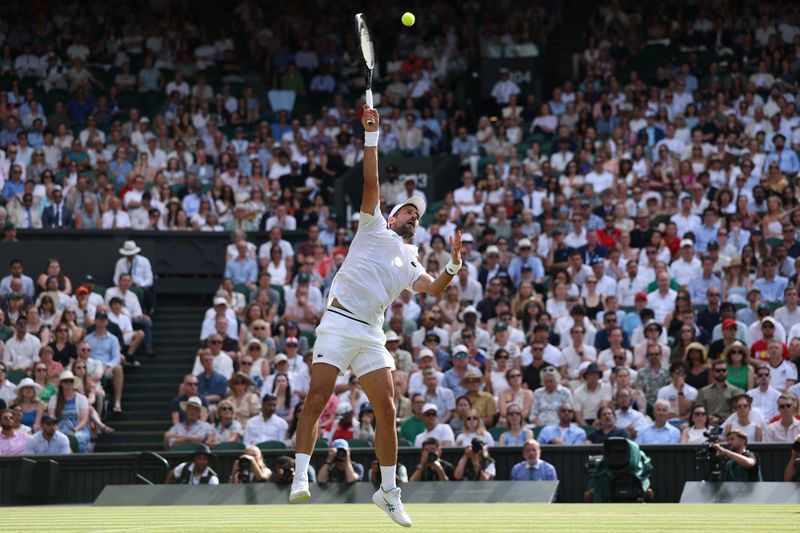
Novak Djokovic cemented his status as one of tennis's greatest Wimbledon performers on Sunday, overcoming a determined challenge from world number 132 Roman Safiullin to advance into the quarter-finals. The seventh seed's commanding 7-6(6) 6-3 3-6 6-3 victory at the All England Club delivered more than just a passage to the last eight; it represented a historic moment in tennis, as Djokovic claimed his 106th match victory on the famous grass courts, eclipsing the previous record held by retired Swiss icon Roger Federer.
The achievement underscores the remarkable consistency Djokovic has demonstrated across multiple decades at Wimbledon, a tournament that has long favoured his aggressive baseline style and serve dominance on grass. At 39 years old, the Serbian champion continues to defy expectations about athletic longevity in professional tennis, maintaining the hunger and competitive edge necessary to compete against players a generation younger. His record at the southwest London venue now stands as one of the most formidable legacies in Grand Slam history, with Djokovic now explicitly within range of Federer's eight Wimbledon titles—a target that looms large as he pursues his 25th Grand Slam championship.
Yet the path to this milestone victory proved far more challenging than the final scoreline might suggest. Safiullin, returning to competitive action following an extended layoff due to hip injuries, brought an aggressive energy that repeatedly unsettled Djokovic during the opening stages. The Russian qualifier displayed exceptional composure and tactical maturity for someone at ranking 132, forcing the seven-time Wimbledon champion to retrieve two set points while trailing 2-5 in the opening set. Djokovic's ability to manufacture a tiebreak victory from that precarious position demonstrated the mental resilience that has defined his career, yet it also hinted at vulnerabilities that continued to surface throughout the encounter.
The most striking aspect of Djokovic's performance was his acknowledged struggle from the baseline during extended rallies. In his post-match reflections, the Serbian expressed genuine surprise at finding himself in such unfamiliar territory, noting that few opponents throughout his legendary career have forced him to abandon his preferred court positioning. The Centre Court wind and the particular conditions created by the grass surface appeared to favour Safiullin's more aggressive approach, compelling Djokovic to recalibrate his strategy mid-match. This tactical recalibration became crucial to his success, as his serve-and-volley sequences in the second set proved devastatingly effective, breaking Safiullin's resilience and reasserting dominance when it mattered most.
Safiullin's third-set victory, while ultimately unsuccessful in derailing Djokovic's progression, demonstrated that the Russian has returned from injury with his competitive edge intact. His willingness to hold serve and push aggressively even after falling behind two sets provided a template for how lesser-ranked players might occasionally trouble elite competitors. However, Djokovic's fourth-set performance illustrated precisely why he remains atop the professional hierarchy. After securing a tight hold to open the set, he elevated his overall level, particularly his first-serve accuracy, which he identified as the critical factor in neutralizing Safiullin's threat.
Djokovic's statement that he needed to "survive to thrive" encapsulates a pattern that has emerged during his opening week at this year's championship. Remarkably, the champion has dropped sets in three of his first four matches, a development that invites scrutiny about his physical preparation and current form heading into the tournament's crucial latter stages. For Malaysian readers and Southeast Asian fans, this observation carries particular resonance, as it demonstrates that even titans of sport must navigate periods of adjustment and reset. The question now becomes whether the accumulated competitive rust from the early rounds will impede his journey towards another Wimbledon triumph, or whether, as his comments suggest, he is using these challenging matches as preparation for stiffer tests ahead.
The quarter-final draw presents Djokovic with opposition in the form of either third seed Felix Auger-Aliassime or Spanish competitor Alejandro Davidovich Fokina. Both represent significantly different stylistic challenges from Safiullin's aggressive baseline game, suggesting that the tournament's difficulty profile will continue to escalate as the rounds progress. Auger-Aliassime's powerful serve and court coverage present a formidable obstacle, whilst Davidovich Fokina's tactically sophisticated approach and defensive capabilities have made him increasingly competitive against elite opponents. For regional tennis enthusiasts observing Djokovic's path, these matchups will provide valuable insight into whether his current physical condition and form justify the expectations surrounding his pursuit of Federer's Wimbledon legacy.
The broader context of Djokovic's Wimbledon record gains additional significance when considered alongside his ongoing quest for a 25th Grand Slam title. This pursuit has taken on heightened meaning since his absence from several major tournaments owing to travel restrictions related to his vaccination status. Each Grand Slam appearance now carries compressed significance, representing concentrated opportunities to close the gap with historical rivals. His dominance at Wimbledon—now quantified through this 106-match milestone—positions grass courts as his most promising avenue for capturing the elusive titles needed to further cement his legacy alongside Federer and Rafael Nadal.
For Malaysian enthusiasts of professional tennis, Djokovic's sustained excellence at Wimbledon offers a masterclass in adaptation and mental fortitude. The Serbian's willingness to acknowledge struggle, recalibrate strategy mid-match, and ultimately overcome adversity resonates beyond the sporting arena, embodying principles relevant to competition and resilience across various fields. His record-breaking achievement against Federer's long-standing mark represents not merely statistical accomplishment but a testament to the physical and psychological demands of competing at the highest level across three decades. As he enters the quarter-finals, observers across Southeast Asia will be watching closely to determine whether Djokovic can convert this historic milestone into tangible silverware, ultimately defining the true measure of his legendary Wimbledon legacy.

