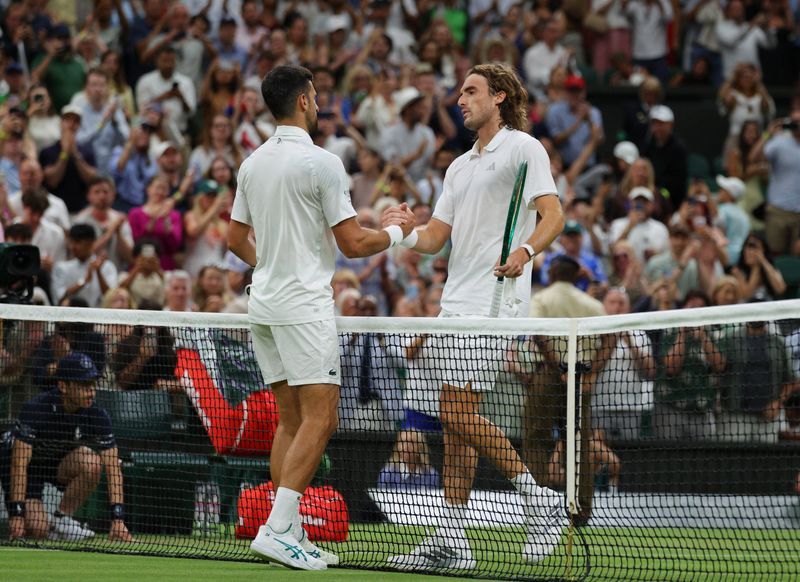
Novak Djokovic's journey through the opening rounds of Wimbledon continues to defy conventional expectations about athletic longevity, as the 39-year-old Serbian champion dispatched Stefanos Tsitsipas with the kind of clinical efficiency that has become his trademark at the All England Club. The match, billed as a heavyweight Centre Court collision in the tournament programme, ultimately proved to be a one-sided affair, with Djokovic advancing to the third round courtesy of a commanding 6-3 6-4 6-2 victory on Wednesday.
The turning point came at 4-4 in the second set when Tsitsipas held break point opportunities that could have shifted momentum decisively. The Greek player squandered both chances with poorly executed overhead shots, a critical lapse that Djokovic immediately capitalised on to secure the break. This moment encapsulated the match's broader narrative—Djokovic punishing mistakes with the ruthlessness that has defined his career, while simultaneously foreclosing any realistic pathway for his opponent to engineer a comeback. From that juncture forward, the Serbian veteran seized control, winning eight of the final ten games to effectively decide the encounter.
This victory represents the 12th consecutive head-to-head triumph for Djokovic against Tsitsipas, extending a rivalry that has consistently favoured the older player. The dominance is particularly striking given Tsitsipas's trajectory in professional tennis. Once viewed as a potential multiple Grand Slam champion capable of defining the next generation of men's tennis, the 27-year-old has instead found himself battling mounting obstacles both on and off court. His ranking has deteriorated to world number 87, reflecting a sustained period of underperformance that has fundamentally altered perceptions of his career trajectory.
The circumstances surrounding Tsitsipas's preparation for Wimbledon underscore the broader challenges he faces. Just days before arriving at the grasscourt major, he parted ways with his coach—a decision rendered particularly complex by the fact that his coach is also his father, Apostolos. This professional rupture follows a troubling period where chronic back pain threatened not merely his competitive prospects but his continued participation in professional tennis. Last year's Wimbledon championship saw him withdraw midway through his opening match, a stark reminder of the physical toll his injury had exacted.
Yet Tsitsipas did arrive at Wimbledon with a measure of redemption motivation. His return to competitive tennis represented a significant personal achievement, particularly given the severity of the back injuries that had threatened to curtail his career prematurely. However, the timing of his coaching separation, combined with his descending ranking, meant he entered Centre Court facing both external pressure and internal uncertainty. The psychological weight of these circumstances manifested clearly in the performance itself, as Tsitsipas struggled to generate the aggression and precision necessary to trouble Djokovic.
Djokovic's own comments following the match revealed a player operating at peak satisfaction with his performance. Speaking to the crowd, he emphasised feeling privileged to be competing at Wimbledon at his current age, noting that while comments about age being merely a number might sound clichéd, he genuinely embraced that perspective. His physical presentation—complete with a cream-coloured blazer that he himself acknowledged could have belonged to a high-school student—underscored his seemingly timeless approach to professional tennis. This sartorial choice, combined with his dominant Court performance, suggested a player comfortable occupying an unusual position as one of professional sport's genuine elder statesmen still performing at the championship level.
Looking toward the next challenge, Djokovic will confront 25th-seeded Frenchman Arthur Rinderknech, a matchup that appears unlikely to derail his progress through the draw. This victory leaves Djokovic tantalizingly positioned in relation to Roger Federer's men's record of 105 match-wins at Wimbledon—the Serbian requires just one additional victory to draw level with that benchmark. For Malaysian and Southeast Asian tennis enthusiasts, Djokovic's continued presence in major tournaments remains significant, as his performances continue to reshape perceptions of athletic longevity and recovery from serious injury.
The broader implications of this victory extend beyond the immediate tournament context. Djokovic continues to pursue an eighth Wimbledon title, which would cement his already extraordinary grasscourt legacy while simultaneously advancing his quest for a record 25th Grand Slam championship. Each victory at this stage brings him mathematically closer to achievements that seemed impossible even five years ago, particularly following his vaccine-related exclusions from major tournaments. His steady progression through the draw suggests that predictions of imminent decline, once fashionable among commentators, require significant recalibration.
For Tsitsipas, the comprehensive defeat represents another missed opportunity to establish himself as a genuine threat to the established hierarchy of men's professional tennis. The player who contested two Grand Slam finals—at Roland Garros in 2021 and the 2023 Australian Open—found himself thoroughly outclassed by a supposedly ageing rival. The disparity raises uncomfortable questions about whether Tsitsipas can reconstitute his career trajectory, particularly given the ongoing physical complications and professional instability that have characterised his recent seasons.
The match also demonstrated the persistent gap between generational cohorts in men's tennis, a theme that has animated professional tennis discourse throughout this particular era. Despite considerable speculation about the emergence of a new generation, players like Djokovic continue demonstrating competitive supremacy, suggesting that the predicted transition remains protracted. This extended dominance carries implications for younger players seeking to establish themselves, as the template for sustained excellence continues expanding, potentially delaying the natural generational progression that typically characterises professional sports.

