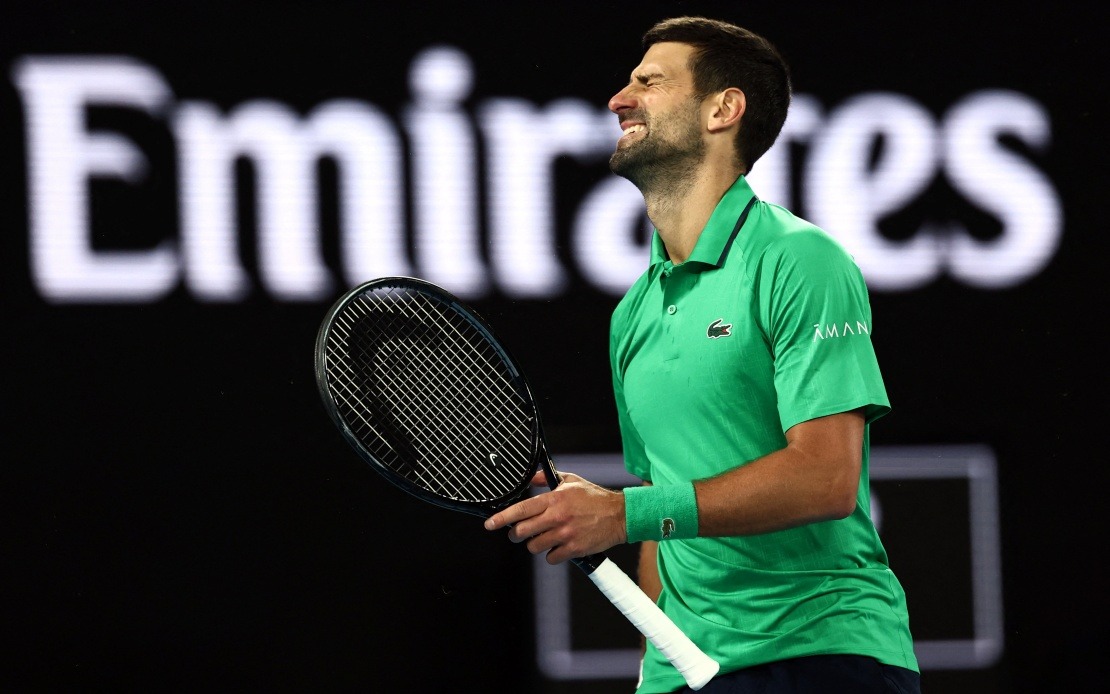
Novak Djokovic has moved into rarefied air at Wimbledon, matching one of tennis's most enduring records after his commanding victory over France's Arthur Rinderknech on Friday. The 39-year-old Serbian champion secured his 105th men's singles win at the All England Club, equalling the benchmark established by Roger Federer across their respective dominance of the grass court season. The achievement comes at a particularly poignant moment in Djokovic's career, given his age and the persistent questions about his longevity at the sport's highest level.
Djokovic's path to the fourth round proved gruelling despite his superior ranking. Against 25th seed Rinderknech, the seven-time Wimbledon champion found himself pushed to the brink in a three-hour Centre Court encounter that demanded both technical precision and mental resilience. Djokovic ultimately prevailed 7-5, 6-4, 1-6, 7-6 (7-4), a scoreline that reveals how competitive the contest became despite the gulf in seeding and experience. The victory marked the Serbian's 18th appearance in the tournament's final 16, underscoring his unparalleled consistency at an event where he has clearly felt most at home.
The milestone prompted characteristic humour from Djokovic during his on-court interview. Rather than dwelling on the achievement, he proposed a novelty showdown with Federer to determine who would claim the 106th victory, a quip that resonated with the crowd while simultaneously downplaying the significance of individual records. Yet his subsequent remarks revealed the genuine weight he attaches to making history on grass. Djokovic emphasised that Wimbledon represents a childhood dream realised, and that the pursuit of each match victory supersedes any obsession with numerical milestones or comparisons with predecessors.
The record underscores Djokovic's transformation of Wimbledon from Federer's personal fiefdom into a venue where he too has flourished. Where Federer accumulated his 105 wins across a longer period, Djokovic has compressed exceptional longevity into his Wimbledon campaigns, arriving as the 24-time Grand Slam champion with undisputed supremacy across multiple surfaces. His next test comes against Russian qualifier Roman Safiullin, an opponent unlikely to pose the challenge Rinderknech demonstrated, yet another stepping stone towards potential quarter-final placement.
Parallel developments in the men's draw showcase the tournament's competitive depth. Defending champion Jannik Sinner, the Italian world number one, advanced past American Jenson Brooksby with ease, recording a 6-4, 6-3, 6-4 victory that cemented his perfect third-round record across Grand Slams. Sinner has now won 20 consecutive matches in this round across major tournaments—an Open Era men's record that speaks to his clinical efficiency when navigating the tournament's middle stages. The youngster's dominance suggests he may emerge as Djokovic's most formidable challenger this fortnight.
On the women's side, top seed Aryna Sabalenka has maintained her pursuit of a first Wimbledon title by dispatching former French Open champion Jelena Ostapenko in straight sets. The Belarusian's 6-4, 6-4 victory over Ostapenko continued an unbeaten run that positions her among the tournament favourites. Sabalenka's aggressive baseline game, which has produced two Australian Open victories and multiple other Grand Slam finals, translates effectively to grass, though Wimbledon has proven more elusive than other majors for her particular skill set.
Sabalenka now faces a fourth-round showdown with Naomi Osaka, an encounter that promises compelling tennis between two of the sport's most dynamic strikers. Osaka reached the Wimbledon fourth round for the first time in her career, having dismissed Daria Kasatkina in comprehensive fashion with a 6-1, 6-3 victory. The Japanese champion's power and aggression have served her exceptionally well at the Australian Open, where she won twice, yet grass court tennis has traditionally required different tactical approaches. Osaka's straightforward dismissal of Kasatkina suggests she may have found solutions to grass court challenges that eluded her previously.
Sabalenka's acknowledgment of the impending challenge revealed her tactical awareness. In describing Osaka as another aggressive, powerful opponent, Sabalenka implicitly recognised that her winning formula—sustained baseline pressure and controlled aggression—faces a different examination when confronted with similarly attacking players. Both women rely on pace and depth to dictate rallies, creating the possibility of a match that swiftly concludes or extends depending on early momentum swings. Sabalenka declared her readiness to employ whatever tactical adjustments proved necessary, a mature response that suggests she has learned lessons from previous Wimbledon campaigns.
For Malaysian and Southeast Asian tennis followers, these developments carry significance beyond mere entertainment. While the region has not recently produced major Grand Slam contenders, the continued dominance of players like Djokovic, Sinner, and Sabalenka illustrates the qualities necessary to sustain excellence across multiple years and surfaces. Djokovic's longevity and Sinner's precocious excellence particularly merit attention, as they demonstrate pathways to sustained success distinct from the one-dimensional dominance that characterises some specialist players.
The Wimbledon fortnight continues to deliver compelling narratives as veterans demonstrate enduring capabilities while emerging talents assert their credentials. Djokovic's achievement of equalling Federer's record places him in a select category of players whose legacies transcend individual tournaments. Yet his insistence that the focus remains on the next match, rather than career totals, speaks to the mentality required to sustain excellence. Whether he surpasses Federer's mark or concedes the record will ultimately depend on his performance across the remaining rounds.

