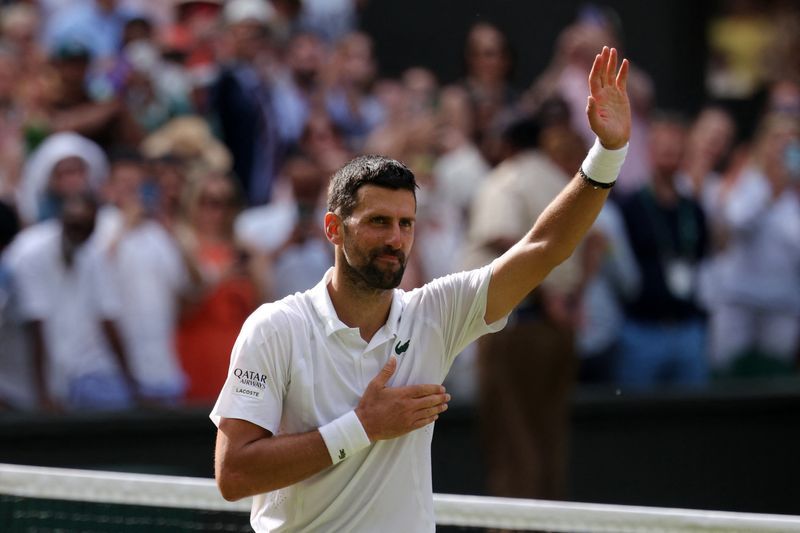
Wimbledon's quarter-final stage gets underway on Tuesday with two tantalising matchups that promise to shape the tournament's narrative. The 39-year-old Novak Djokovic, aiming for a record 25th Grand Slam championship, confronts third seed Felix Auger-Aliassime on Centre Court, whilst Naomi Osaka, the 14th seed, takes on Karolina Muchova in what has emerged as one of the women's headline fixtures. Both contests carry substantial implications for the respective draws, with Djokovic's age and recent struggles against lower-ranked opposition contrasting sharply with Osaka's apparent renaissance after years of inconsistency.
Djokovic has reached the quarter-finals following a gruelling four-set victory over Russian qualifier Roman Safiullin that proved both physically demanding and emotionally draining. The All England Club showdown took three and a half hours, during which Djokovic accumulated his 106th Wimbledon victory—a record that underscores his extraordinary longevity at the grass court championship. Yet the Serbian icon was candid in acknowledging that the manner of his progression concerned him, having been pushed to the brink in successive matches where he was forced to manufacture victory through sheer resilience rather than commanding performance. The grinding nature of these contests places question marks over whether Djokovic possesses sufficient reserves of energy and mental fortitude to withstand a potential semi-final clash against either defending champion Jannik Sinner or Jan-Lennard Struff.
Auger-Aliassime represents a qualitatively different challenge from the players Djokovic has navigated to this point. The 25-year-old Canadian, seeded third, has demonstrated considerable growth within a relatively short timeframe and carries the motivation of attempting to upset one of tennis's greatest champions. The pair contested two matches in 2022, splitting the results evenly, which provides Auger-Aliassime with empirical evidence that Djokovic remains beatable at the highest level. The younger player's comments reflect both reverence and emerging self-belief—he acknowledged being daunted by Djokovic's historical achievements whilst simultaneously expressing conviction that his own development as a competitor warrants respect. The gulf between their respective career trajectories remains immense, yet Auger-Aliassime's trajectory suggests he possesses the weapons, particularly through an aggressive baseline game and improving serve accuracy, to capitalise on any physical vulnerability Djokovic might display.
On the women's side, Osaka's quarter-final appearance marks a significant milestone in her attempted comeback from a period characterised by mental health challenges and tournament inconsistency. Her demolition of world number one Aryna Sabalenka in the fourth round proved revelatory, suggesting that the Japanese player's grass-court technique and aggressive striking capacity remain formidable when she achieves psychological equilibrium. Osaka has not claimed a Grand Slam title since 2021, a drought that has tested her resilience, yet her performance against Sabalenka—who had defeated her in three earlier encounters this year—demonstrated conclusively that mental recalibration, not technical regression, had compromised her recent campaigns. The fashion-forward player's presence at Wimbledon has captured headlines beyond mere tennis discourse, with her sartorial choices reflecting a broader self-assurance that appears to have translated into improved court performance.
Osaka's opponent Muchova brings entirely different credentials to their quarter-final encounter. The Czech 10th seed has reached three previous Wimbledon quarter-finals without advancing further, a statistical reality that carries psychological weight. However, Muchova possesses a significant advantage: their sole grass-court meeting occurred last month at the Bad Homburg Open, which Muchova won. This recent competitive history suggests the Czech player understands the tactical requirements for neutralising Osaka's forehand aggression whilst deploying her own slice game and movement patterns effectively. Muchova's preparatory tournaments before Wimbledon—a conscious strategy she articulated publicly—provided her with essential grass-court familiarisation that potentially positions her favourably against an opponent who may lack recent exposure to the surface's peculiar demands.
Meanwhile, defending champion Sinner faces what superficially appears a favourable fourth-round matchup against Struff, whom he has defeated in all three previous encounters. However, the Italian's carefully measured comments suggested he recognises that past results carry minimal predictive value in the pressure-cooked environment of a Grand Slam quarter-final. Sinner, at 22, remains establishing his credentials as a potential multiple major winner, and successive deep runs at the sport's most prestigious events would substantially reinforce his emerging status as tennis's generational successor to Djokovic and his contemporaries. The Italian's philosophical approach—acknowledging past matches as irrelevant to present circumstances—reflects professional maturity uncommon in competitors of his age.
Struff's journey to the quarter-finals constitutes the tournament's most improbable narrative thread. At 36 years old, the German left-hander became the oldest male player in the Open Era to reach a Grand Slam quarter-final for the first time, a distinction earned when Hubert Hurkacz's hip injury forced withdrawal whilst Struff led convincingly in their fifth-set encounter. For Struff, reaching this stage represents not merely a career achievement but vindication of his persistent commitment to professional tennis during an era when younger, more celebrated colleagues dominated global rankings. His exuberance regarding this accomplishment was entirely evident, yet the pragmatic acknowledgment that immediate recovery becomes essential before confronting a four-time major champion suggests realistic assessment of the monumental challenge ahead.
The women's draw has been fundamentally reshaped by high-seeded eliminations, with Jessica Pegula and Coco Gauff—both American and seeded fourth and seventh respectively—occupying the opposite Centre Court quarter-final. Pegula's fourth-seeding reflects her improved consistency across multiple surfaces, whilst Gauff's fourth-round appearance continues the pattern of American success at the All England Club that has characterised the past decade of tennis. That two American representatives occupy one quarter-final whilst Osaka and Muchova occupy the other emphasises the contemporary balance of competitive strength, with American dominance in seeds not necessarily translating to actual championship outcomes.
For Malaysian and Southeast Asian tennis followers, Osaka's quarter-final carries particular resonance given her cultural significance within Asian sporting circles and her documented mental health advocacy that resonated across the region. Her resurgence would carry implications extending beyond sporting achievement, reinforcing narratives of redemption and psychological wellness that transcend traditional sports commentary. The regional tennis development trajectory, demonstrated by players capable of competing at this elite level, provides tangible evidence of emerging talent streams within Asian competitions, though Malaysia itself remains underrepresented among the tournament's elite brackets.
Djokovic's quest for his 25th Grand Slam represents potentially the final chapter of the greatest career in men's tennis history, yet remaining obstacles have demonstrably accumulated. Auger-Aliassime, Sinner, and potentially Muchova or Osaka represent generational representatives who have grown to adulthood watching Djokovic's dominance, now possessed of sufficient skill and confidence to challenge that supremacy. The quarter-finals determine whether tennis's established order persists or whether 2024 marks the definitive moment when the sport's generational transition accelerates beyond reversibility.

