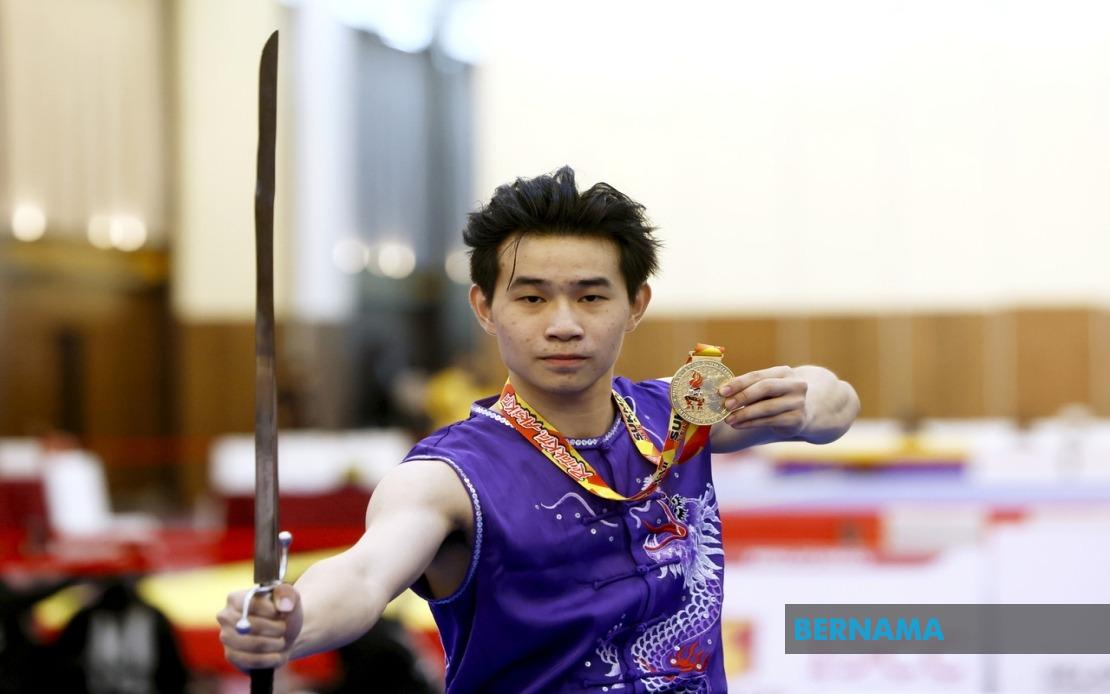
Penang's Wee Din Jun delivered a triumphant finish to his Malaysia Games career on Wednesday, capturing the gold medal in the men's nandao nangun wushu event despite battling a hip injury that emerged just weeks before competition began. The 21-year-old athlete produced a commanding performance at the Ideal Convention Centre in Shah Alam, scoring 9.600 points to edge out a competitive field and secure the top podium finish in what marks his final SUKMA outing.
Din Jun's victory represents significant personal redemption for the Bayan Lepas native, who has traversed a challenging trajectory through Malaysia's premier multi-sport Games. The margin of success was narrow but decisive, as Sarawak's John Phang trailed closely with 9.563 points while Selangor's Tan Yu Zhe rounded out the medal positions with 9.550 points. In competitive wushu, where technical precision and athletic execution determine outcomes measured in hundredths of points, Din Jun's ability to edge his rivals speaks to both his technical proficiency and mental fortitude during a competition season complicated by physical recovery demands.
The emotional weight of this achievement becomes apparent when examining Din Jun's previous SUKMA experiences. At the 2022 edition held in Kuala Lumpur, the then-teenager managed only a bronze medal—a respectable showing for a younger athlete but perhaps not the breakthrough performance he envisioned. However, the trajectory took a sharper downturn at SUKMA 2024 in Sarawak, where Din Jun returned without claiming any medal across his three scheduled events, a disappointing outcome that he has since attributed to technical mistakes during competition that undermined his preparation and confidence.
The hip injury that struck approximately one month before the Shah Alam competition could have derailed Din Jun's plans entirely, particularly for an athlete whose sport demands explosive movement, rapid directional changes, and precise lower-body control. Wushu practitioners rely heavily on uncompromised hip mobility and strength to execute the flowing movements and rapid transitions that characterize both nandao and other traditional weapons forms. Rather than allow the injury to become an excuse, Din Jun instead channeled the recovery process toward mental preparation, working with coaching staff to develop psychological resilience alongside physical rehabilitation.
When recounting his approach to the final SUKMA event, Din Jun emphasized the shift in mindset that proved instrumental to breaking through. He explained to local media that his coach counseled him toward emotional equilibrium, encouraging him to remain calm and embrace the performance experience rather than becoming ensnared by anxiety about outcomes. This coaching wisdom proved effective, as Din Jun consciously bracketed peripheral concerns and concentrated entirely on executing his techniques with maximum fidelity. Such mental discipline distinguishes elite performers from competent ones, particularly in judged sports where consistency and confidence visibly influence technical execution.
Beyond the immediate competitive result, Din Jun's gold medal carries layered significance regarding redemption narratives in Malaysian sport. The 2024 SUKMA disappointment had created a deficit in his medal portfolio that threatened to overshadow his earlier achievements and raise questions about his developmental trajectory. Athletes at this age often face psychological pressure when previous performances fall short of expectations, risking the emergence of self-doubt that can become self-fulfilling. Din Jun's ability to compartmentalize that experience and emerge victorious suggests a maturity and mental resilience that should serve him well in future competitive endeavors, whether at subsequent national Games or international platforms.
The significance of his achievement extends to recognition of those who contributed to his development. Din Jun dedicated the gold medal to his former coach, who has since relocated to China and therefore could not witness his protégé's redemption firsthand across the previous two SUKMA editions. This acknowledgment reflects the often-invisible labor that coaching staff invest in athlete development, particularly in traditional martial arts where technical mastery requires sustained mentorship and calibrated instruction. The coach's absence from Shah Alam made the victory bittersweet, offering achievement tempered by the inability to celebrate in person with someone instrumental to Din Jun's journey.
Looking forward within the same Games, Din Jun's competitive calendar extends beyond the nandao nangun victory. He remains scheduled to compete in the nanquan event during subsequent competition days, offering the opportunity to conclude his final SUKMA appearance with additional medals and perhaps establish himself as a multi-discipline wushu medallist. A strong showing in nanquan could substantially elevate the significance of his overall Games contribution, particularly if he can demonstrate consistent excellence across separate technical formats. This prospect also extends the narrative arc of his comeback, transforming what might have been a single redemptive moment into a more comprehensive restoration of competitive credibility.
For Malaysian wushu development, Din Jun's performance and trajectory carry implications for athlete retention and support systems within traditional martial arts disciplines. Wushu occupies a specialized niche within Malaysia's sporting ecosystem, with significantly smaller athlete pools and funding mechanisms compared to mainstream sports. Athletes who experience setbacks risk discouragement leading to early retirement or pursuit of alternative careers. Din Jun's persistence through injury and previous disappointment, culminating in a gold medal performance, reinforces the value of continued investment in these athletes and demonstrates that commitment through difficult periods can yield national achievements.
The broader context of SUKMA 2026 also reflects Malaysia's ongoing commitment to hosting competitive platforms that recognize diverse sporting traditions and cultural practices. Wushu represents a significant bridge between Malaysia's multicultural communities and broader Asian sporting heritage, with particular resonance within Chinese Malaysian populations. Success stories like Din Jun's contribute to the profile of traditional martial arts within national consciousness and potentially inspire younger practitioners to pursue excellence in these disciplines rather than restricting ambitions to conventional sports pathways.
As Din Jun prepares for his final SUKMA events, his journey encapsulates themes of perseverance, technical refinement, and psychological resilience that define elite athletic performance. The hip injury that threatened his preparation, the previous medal-less appearance that tested his confidence, and the coaching wisdom that refocused his approach all converged at Shah Alam to produce a significant personal and national achievement. Whether his nanquan performance can build upon this momentum remains uncertain, but the gold medal in nandao nangun already secures his place in SUKMA history and demonstrates that redemption remains possible even after apparent failure.

