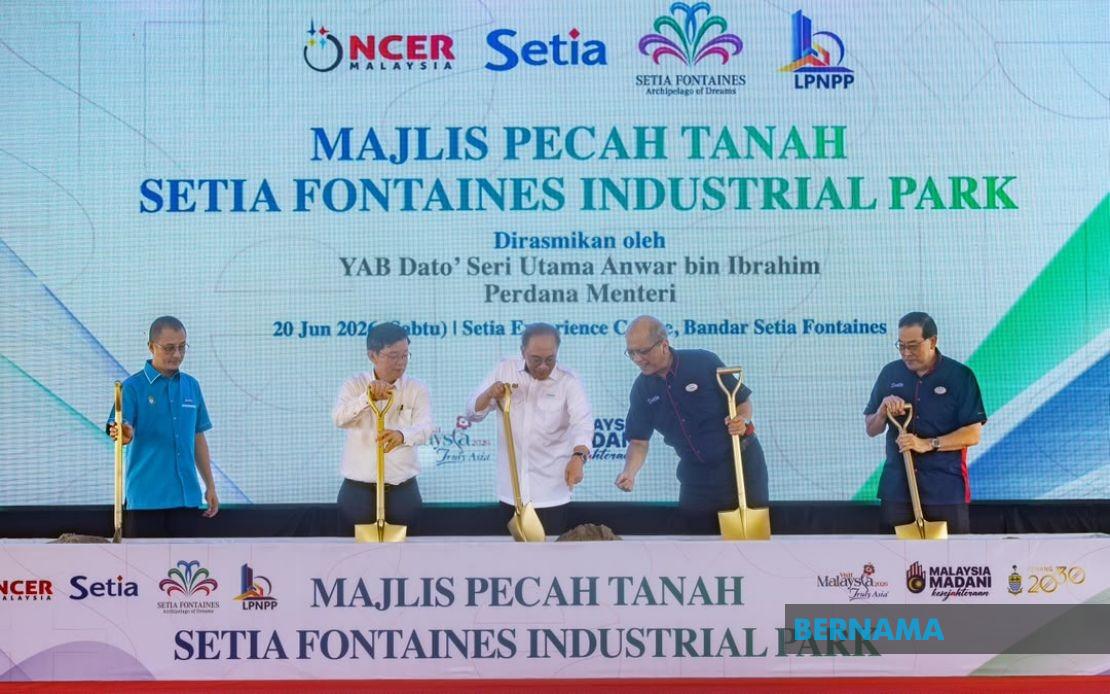
Prime Minister Datuk Seri Anwar Ibrahim has called on government-linked companies and the private sector to ensure their development initiatives create tangible economic opportunities for middle and lower-income Malaysians, framing inclusive growth as essential to national stability. Speaking at the groundbreaking ceremony for the Setia Fontaines Industrial Park in Bandar Setia Fontaines, Anwar underlined that rapid development and surging investment must not become engines of inequality, but rather vehicles for shared prosperity across all segments of society.
The Prime Minister's intervention reflects growing concern within policy circles that Malaysia's economic expansion, while impressive in headline figures, has left pockets of the population vulnerable to being left behind. Anwar specifically referenced major institutional investors—Khazanah Nasional Berhad, Permodalan Nasional Berhad, and the Employees Provident Fund—alongside private enterprises, signalling that every tier of the business ecosystem bears responsibility for inclusive development. This multipronged approach acknowledges that Malaysia's wealth creation involves diverse actors, from state-owned sovereign wealth funds to multinational corporations and domestic developers.
The risk Anwar identified is not merely moral but economic and political. When opportunities concentrate among already-privileged cohorts whilst lower-income groups face tightening constraints, social cohesion deteriorates and resentment accumulates. His comments suggest the administration recognises that rising GDP figures mean little to citizens unable to participate in the jobs and prosperity those figures represent. This concern has particular resonance in Malaysia, where income inequality has widened over recent decades despite sustained growth, and where regional disparities between developed urban centres and peripheral areas remain pronounced.
Anwar stressed that economic success cannot be judged by statistics alone; genuine development requires tangible improvements in living standards, employment quality, and wealth distribution across society. This rhetorical pivot away from GDP-centric metrics reflects a shift in how the government frames development outcomes. Rather than celebrating investor inflows or infrastructure projects in isolation, the Prime Minister is insisting that measurement systems incorporate equity metrics—whether a project genuinely creates employment for local residents, whether wages remain accessible to lower-income workers, and whether skill development programmes prepare disadvantaged communities for emerging roles.
The Setia Fontaines Industrial Park development serves as a concrete example of Anwar's inclusive growth philosophy. Located in Bandar Setia Fontaines on the Seberang Perai mainland, the park represents efforts to distribute economic dynamism beyond the more prosperous island and southern zones of Penang. This geographic distribution strategy acknowledges that development has historically concentrated in specific regions, leaving other areas—and their residents—marginalised from growth corridors. By anchoring investment in Seberang Perai, the government aims to rebalance development patterns and provide northern Penang residents with employment pathways.
Crucially, Anwar framed the industrial park's significance within Malaysia's broader economic transformation. As the country shifts from labour-intensive, lower-value manufacturing toward advanced technology sectors and higher-skill production, employment patterns inevitably change. Workers displaced from declining industries must transition into emerging fields, yet such transitions require deliberate investment in education and training. Without proactive reskilling initiatives, economic upgrading risks creating unemployment and underemployment among displaced workers whilst leaving vacancies unfilled because local talent lacks required expertise.
The Prime Minister emphasised that industry collaboration with technical and vocational institutions and universities, including Universiti Sains Malaysia, is indispensable for bridging this skills gap. This tripartite approach—industry, educational providers, and workers—reflects recognition that market forces alone will not automatically ensure local workers benefit from advanced-sector expansion. Industry must communicate skill requirements clearly; educational institutions must adapt curricula responsively; and workers must have affordable access to training. The alignment must be dynamic because, as Anwar noted, technology landscapes shift within years, rendering static training programmes obsolete.
Anwar's remarks also implicitly challenge companies to move beyond tokenistic corporate social responsibility initiatives toward structural embedding of opportunity-creation within business models. Rather than treating inclusion as philanthropic add-ons, companies must architect projects such that middle and lower-income Malaysians occupy substantive roles in project execution, benefit from employment creation, and access professional-tier positions alongside growth. This requires examining hiring practices, apprenticeship schemes, supplier diversity initiatives, and workforce development programmes to ensure they genuinely serve target communities rather than merely satisfying compliance checklists.
The timing of Anwar's intervention carries weight. Malaysia faces competing pressures: attracting foreign direct investment demands competitive advantages and business-friendly policies, yet domestic inequality and regional disparities generate political pressure for redistribution and equity-focused initiatives. Anwar is attempting to thread this needle, signalling to investors that inclusive growth is compatible with profitability whilst reassuring lower and middle-income Malaysians that the government remains committed to their advancement. This balancing act will shape how development projects are structured, funded, and implemented across the coming years.
For Southeast Asian observers, Anwar's stance reflects broader regional trends as countries grapple with managing rapid development amid widening inequality. Nations from Thailand to Indonesia have confronted backlash when growth concentrates among elites whilst majority populations experience stagnant real wages and limited advancement. Malaysia's attempt to institutionalise inclusive growth principles—embedding them in project approvals rather than treating them as secondary considerations—offers a potential model, though success will ultimately depend on implementation rigour and whether corporate actors genuinely embrace equity rather than resisting it as cost-adding constraint.
The challenge ahead involves translating rhetoric into durable structural change. Anwar has set expectations clearly: Malaysia's development model must visibly benefit working-class and middle-income Malaysians, not merely enrich investors and elites. Whether government agencies enforce this principle consistently, whether companies view it as legitimate requirement rather than government overreach, and whether educational institutions genuinely prepare workers for emerging opportunities will determine whether inclusive growth remains aspirational or becomes embedded practice across Malaysia's development trajectory.
%22%2F%3E%3C%2Fpattern%3E%3C%2Fdefs%3E%3Crect%20width%3D%22100%25%22%20height%3D%22100%25%22%20fill%3D%22url(%23ph1o3zeg)%22%2F%3E%3Crect%20width%3D%22100%25%22%20height%3D%22100%25%22%20fill%3D%22url(%23ph1o3zep)%22%2F%3E%3Ctext%20x%3D%2250%25%22%20y%3D%2250%25%22%20text-anchor%3D%22middle%22%20dominant-baseline%3D%22central%22%20fill%3D%22rgba(255%2C255%2C255%2C0.95)%22%20font-family%3D%22Georgia%2C%20'Times%20New%20Roman'%2C%20serif%22%20font-weight%3D%22700%22%20font-size%3D%22170%22%20letter-spacing%3D%22-0.02em%22%3ENational%3C%2Ftext%3E%3C%2Fsvg%3E)
%22%2F%3E%3C%2Fpattern%3E%3C%2Fdefs%3E%3Crect%20width%3D%22100%25%22%20height%3D%22100%25%22%20fill%3D%22url(%23ph4gh41g)%22%2F%3E%3Crect%20width%3D%22100%25%22%20height%3D%22100%25%22%20fill%3D%22url(%23ph4gh41p)%22%2F%3E%3Ctext%20x%3D%2250%25%22%20y%3D%2250%25%22%20text-anchor%3D%22middle%22%20dominant-baseline%3D%22central%22%20fill%3D%22rgba(255%2C255%2C255%2C0.95)%22%20font-family%3D%22Georgia%2C%20'Times%20New%20Roman'%2C%20serif%22%20font-weight%3D%22700%22%20font-size%3D%22170%22%20letter-spacing%3D%22-0.02em%22%3EMalaysia%3C%2Ftext%3E%3C%2Fsvg%3E)
%22%2F%3E%3C%2Fpattern%3E%3C%2Fdefs%3E%3Crect%20width%3D%22100%25%22%20height%3D%22100%25%22%20fill%3D%22url(%23ph4a2eeg)%22%2F%3E%3Crect%20width%3D%22100%25%22%20height%3D%22100%25%22%20fill%3D%22url(%23ph4a2eep)%22%2F%3E%3Ctext%20x%3D%2250%25%22%20y%3D%2250%25%22%20text-anchor%3D%22middle%22%20dominant-baseline%3D%22central%22%20fill%3D%22rgba(255%2C255%2C255%2C0.95)%22%20font-family%3D%22Georgia%2C%20'Times%20New%20Roman'%2C%20serif%22%20font-weight%3D%22700%22%20font-size%3D%22136%22%20letter-spacing%3D%22-0.02em%22%3EGovernment%3C%2Ftext%3E%3C%2Fsvg%3E)